How to Clean Wool Coat Safely, Step by Step
Learn how to clean wool coat safely: read the care label, spot-treat marks, hand-wash only when allowed, and know when to book a professional.


You stepped inside with road salt on the hem and a damp wool coat over your arm. The washer is two steps away, and the cloth looks thick enough to take a cycle. That shortcut is how a structured coat loses its shoulders, its lining, and its colour in one afternoon.
Wool scales lock when water, heat, and rubbing meet. Under the shell you may also have acetate, fused canvas, leather, or a coating that will not survive the same bath. Learning how to clean wool coat cloth means reading those parts first, then choosing airing, a small blot, a true hand wash, or a cleaner.
Read the Care Label Before You Clean
Don't assume a wool coat is machine-washable. The shell can sit over a synthetic lining, fused interlining, leather trim, adhesive, shoulder pads, or a waterproof coating, and those parts fail separately from the wool.
In Canada, care labelling is voluntary, yet any care information supplied must be accurate and not misleading, under the Competition Bureau textile labelling requirements. Federal symbols cover washing, bleaching, drying, ironing, and professional cleaning, and bars and dots show severity and temperature. Permanent labels are generally designed to withstand 10 cleanings, so photograph yours before the print fades.
| Label instruction | What it means | Your action |
|---|---|---|
| Dry clean only (circle symbol) | Solvent cleaning only; water may damage the shape or finish | Book a professional cleaner; brush and spot-test at home only |
| Do not dry clean (crossed circle) | Solvent cleaning could damage the coat or its construction | Home hand wash only if a hand symbol is also present; otherwise spot-clean |
| Hand wash, cool (hand symbol) | Gentle cool-water washing with no wringing is allowed | Hand-wash in cool water with a wool-specific neutral detergent |
| Machine wash, gentle or cold (tub symbol) | A gentle cycle is permitted, which is rare for tailored coats | Still prefer hand washing, use a wool cycle and never use the dryer |
| No label or unclear symbols | Care information is missing, so the safe method is unknown | Treat as dry clean only and ask a professional to assess it |
| Lining, trim, leather or waterproof coating present | Components may shrink, bleed or delaminate separately from the wool | Check each component on the label; choose professional cleaning if any component cannot be washed |
A circle means you book a cleaner and keep home work to brushing and a colour test. A hand symbol means a cool hand wash is allowed. No label, or symbols you can't read, means you treat the coat as dry clean only.
Photograph the label and each trim, and name stains, coatings, leather, faux fur, glue, or a zip-off piece when you drop it off. A membrane shell is a different job, which is why a dry clean for a winter jacket follows construction rather than the word wool.
Practical rule: If one component can't be washed, keep the whole coat out of water.
How to Brush and Spot-Treat Minor Marks
Dust, lint, and a fresh speck don't justify a full wash. A soft clothes brush does more good than a basin, as long as you document the mark before you touch it.
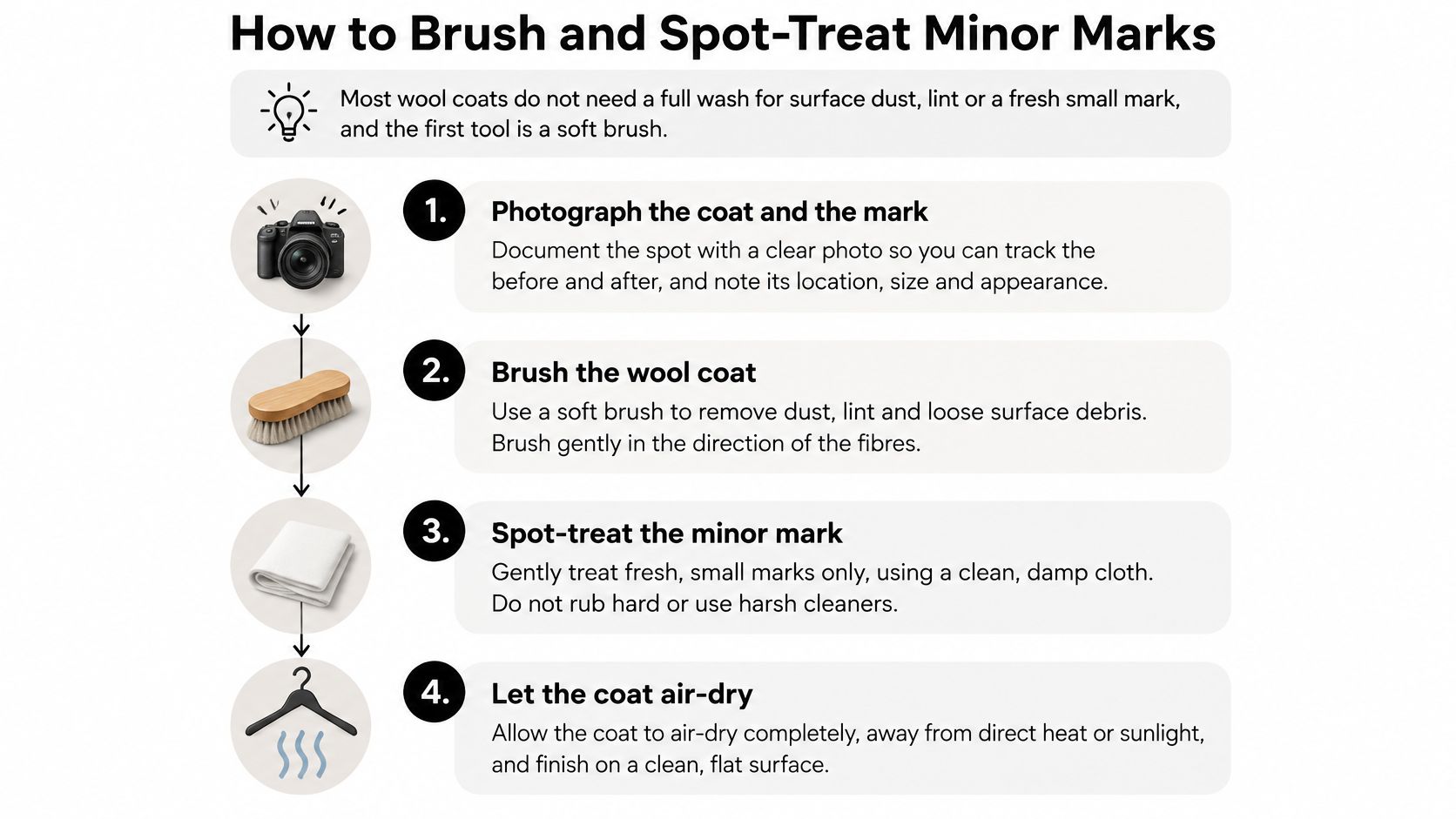
- Photograph the coat and the mark, including seams, lining, buttons, and any tear. You need a before image if dye moves or a tide line appears.
- Brush dry dust and lint with a soft clothes brush, following the nap from shoulders to hem. Loose soil comes off dry; grinding it into damp wool starts felting.
- Test colourfastness on an inside seam allowance with a barely damp white cotton cloth, then wait a few minutes. If colour lifts, stop. The same discipline matters when you clean a wedding dress: prove the dye before you treat the face.
- Decide whether the soil is oily or water-based. A water-based speck can take a barely damp cloth. Oil, grease, ink, soot, wax, tar, and paint behave differently, and water only spreads them.
- Blot from the edge toward the centre. Never rub. Stop when the cloth no longer lifts colour, because extra moisture leaves a ring that is harder to remove than the original speck.
- Let the spot dry away from heat, then brush once more. Heat sets whatever is left in the fibre.
Keep home spot work cool, brief, and dry-handed: minimal moisture, gentle contact, then air drying. If the mark sits beside leather, faux fur, glued trim, or a coated panel, keep the cloth away from that component. The Competition Bureau's labelling guidance requires care information to be accurate, so a blank or unreadable label calls for a professional assessment before water touches wool.
Skip chlorine bleach, hot water, a household dryer, and any spot chemical you haven't tested. Send ink, red wine, grease, mould, and unknown marks to a qualified cleaner after brushing only.
How to Hand-Wash a Wool Coat at Home
Hand washing is only for a coat whose label allows it, and only when the coat is simple, unlined, or lightly lined. A canvassed overcoat stays with a cleaner.
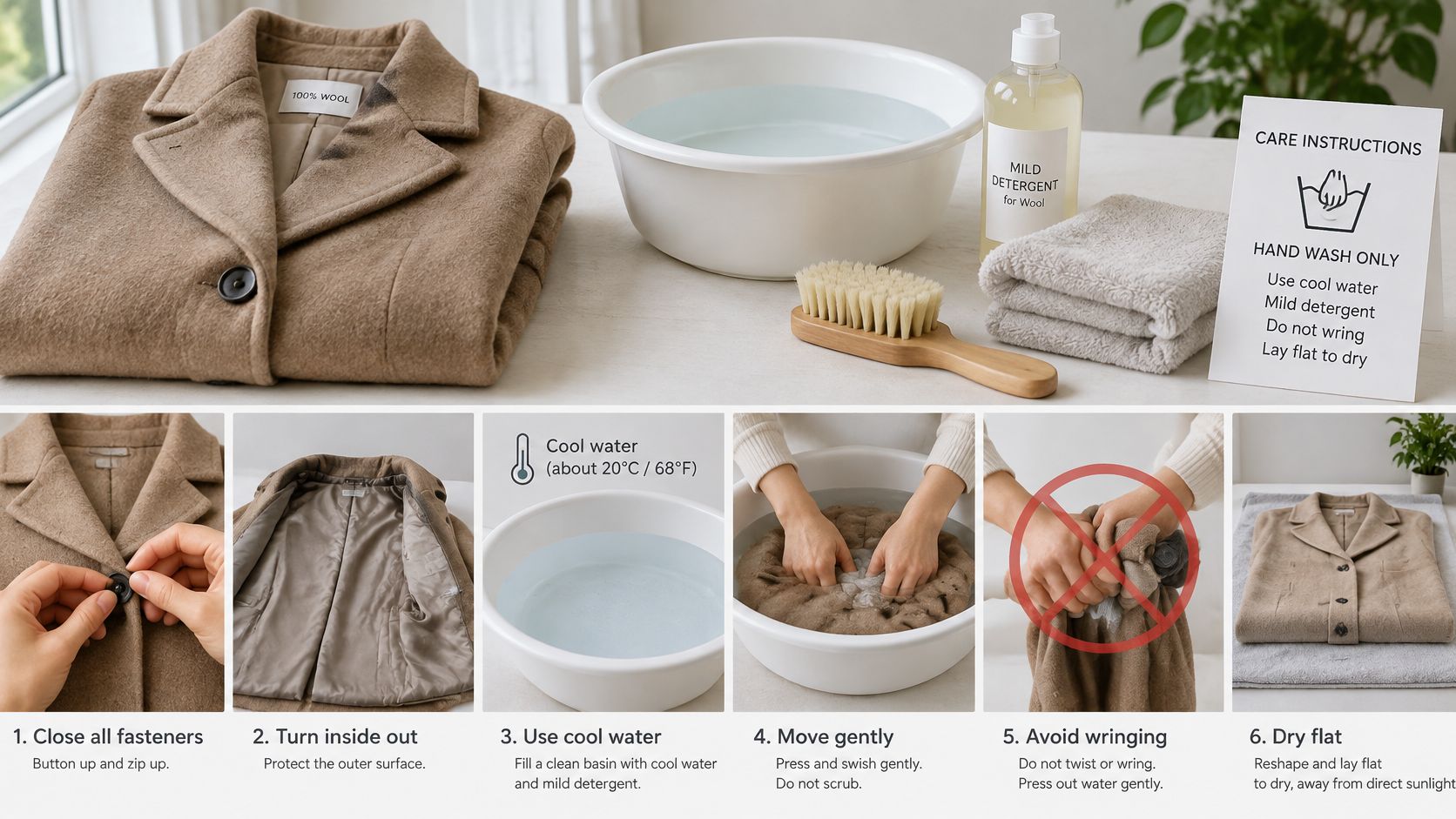
- Close fasteners and take off belts or detachable trim. Open hardware snags wool and traps dirty water in the folds.
- Brush off dry soil and turn the coat inside out. Surface grit acts like sandpaper once the cloth is wet.
- Fill a basin with cool water and a wool-specific neutral detergent. Enzyme detergent and anything bleached roughens the scales.
- Submerge the coat and move it gently for a short time. Rubbing, twisting, and a long soak felt the yarn and can shift a facing.
- Rinse at a similar temperature. A sudden jump from warm to cold shocks the fibre and encourages shrinkage.
- Lift the full wet weight in both arms. Never hang it. Water makes the coat heavy enough to stretch shoulders and lining for good, which is why Canadian Conservation Institute notes treat lined wool as a poor candidate for routine washing.
- Press water out between clean towels. Wringing twists the weave and the seams.
- Reshape shoulders, lapels, sleeves, and hem while the coat is still damp. Once it dries crooked, pressing won't put the canvas back.
- Dry flat on a ventilated surface, out of sun and away from radiators. Heat finishes the felting that agitation started.
Stop the moment dye transfers, the cloth felts, or the lining bubbles. That coat needs a cleaner, not another rinse.
When it's dry, brush the nap in one direction. Steam lightly from a distance only if the label allows it, then hang the coat on a broad, shaped hanger inside a breathable cover. Salt rings and road grime on a dry-clean-only label should go to a professional promptly. Repeated home wetting leaves tide marks and shrinkage even when the outer wool still looks stable. If you're weighing water against solvent for a lined coat, the difference is laid out in wet cleaning versus dry cleaning.
Winter Salt, Airing and Storage Between Seasons
Say you walked through slush at a North York corner, then hooked the coat by the door. It stays damp, salt sits in the nap, and by morning the hem is stiff. Brushing that wet crust only drives crystals deeper.
Let the coat dry completely in a cool room first. Once the cloth is dry, use a soft brush and short strokes, hem and cuffs included. Don't rub. Wet salt plus friction felts the surface and can drag a pale edge into a larger mark.
When brushing isn't enough
Escalate if residue has reached the hem, collar, lining, or interfacing, or if a pale tide mark remains after the coat is dry. That isn't a spot you keep wetting at the sink. Airing and brushing handle light contamination. They don't replace a clean when oil, deep salt, or odour is already in the cloth. There's no measured local average for how often Toronto coats need that step, so judge this coat: exposure, smell, visible soil, and the label.
After wet weather, hang the coat in a dry room for about a day, clear of radiators and direct sun. Empty the pockets so a damp receipt doesn't mark the lining. If a stale smell remains after that airing, treat it before storage using the same caution you'd use to remove a musty smell from clothes.
Before the coat goes away for the season, clean it if it's soiled or it smells. Confirm it's fully dry, then use a wide, padded or shaped hanger. A wire hanger cuts dents into the shoulders that next winter won't shake out. Choose a breathable cotton garment bag, not plastic, which traps moisture and can yellow the cloth. Cedar or another moth product can sit nearby, not against the wool. The same dry-fully, no-plastic habit protects wool throws for your home if they share that closet.
Run a hand along seams, lining, and buttonholes before you zip the bag. Repeated wet-dry cycles weaken stitching long before the shell looks worn.
Decide Between Home Care and a Professional Cleaner
A wool coat usually gives the answer in three places: the care label, the lining, and the trim. Routine airing and salt removal are maintenance. A full clean is the reset for oil, odour, deep soil, or a coat whose shape depends on canvas and pressing.
| Situation | Recommended action | Timing |
|---|---|---|
| Light dust, lint or fresh surface dirt | Brush with a soft brush and air the coat | After every few wears |
| Body odour or smoke smell | Air in a dry room, then book a professional clean if the smell remains | After wear, then as needed |
| Oil, grease or ink mark | Book a professional cleaner and avoid home solvents | Promptly |
| Red wine, mould or unknown stain | Book a professional cleaner; do not apply home treatment | Promptly |
| Soiled coat before seasonal storage | Professional clean, then store fully dry | Before storage |
| Felted, shrunken or distorted fabric | Stop home treatment and request a professional assessment | Immediately |
Route the coat in four moves
- Photograph the label and every lining, leather, coating, or trim detail so the cleaner is not guessing.
- Brush, then spot-test colourfastness, before any moisture.
- Choose a home hand wash only if the label allows it and the coat is simple or lightly lined.
- Book a professional if the label says dry clean only, the stain is oily, inky, or unknown, or the coat is structured, fitted, or heavily lined.
A structured coat needs more than stain lifting. Shoulder line, lapel roll, and sleeve pitch are set with pressing equipment, and a flat dry on a towel cannot rebuild them. Dry cleaning also works differently from laundering: it uses dry solvents rather than wetting the cloth with water, which matters when the label is trying to protect interfacing, dye, and finish. Bring the label photo and a written stain list so the method is chosen before the first treatment. At CleanOnline, the dry cleaning process starts with intense sorting by fabric, colour, and soil level, then moves to spot stain removal, repairs on the go, custom detergents, pressing, and folding.
For general context on how item, service, and spot work shape a specialist ticket, it helps to understand specialist dry cleaning prices before you compare a local quote. At our North York counter, dry cleaning a press-only coat is $16.99, a special care coat $24.99, a spring coat $19.99, a trench coat $21.99, a winter coat $21.99, a heavy winter coat $24.99, a heavy and long winter coat $34.99, and a coat with leather trim $24.99. We dry clean jackets, coats, sweaters, and other outerwear, including overalls, woolens, denim, and fleece jackets. Confirm the item, the service, and the final charge before you book, because leather trim, heavy length, and extra spot work change the ticket.
I would start with the cheapest safe fix, a brush and patient air, and I would not put a canvassed winter coat in water to save a trip. Once wool has felted, that damage does not come back.
CleanOnline, North York's Premium Dry Cleaners handles wool coats and other outerwear with label-based cleaning, spot treatment, stain removal, scent therapy, and pressing, with special fabric dry cleaning available for leather, silk, rayon, and velvet. If your coat is dry clean only, salt-stained, or too structured for a basin, bring the label photo and the stain list to CleanOnline, North York's Premium Dry Cleaners before the next freeze.