How to Remove Musty Smell from Clothes for Good
Learn how to remove musty smell from clothes with a washing routine, a fabric guide and damp-storage fixes so the smell stays gone.

You pull a freshly washed shirt from the closet, put it on, and notice that familiar damp-basement smell. The fabric looks clean, but another wash hasn't solved anything. Before you add more detergent or reach for a fragrance booster, check where the shirt has been drying and sitting.
Learning how to remove musty smell from clothes means treating both the garment and the damp conditions around it. Start with a fabric-appropriate wash and complete drying, then investigate the closet, washer and dryer. Otherwise, you may clean the clothing only to put it straight back into the same problem.
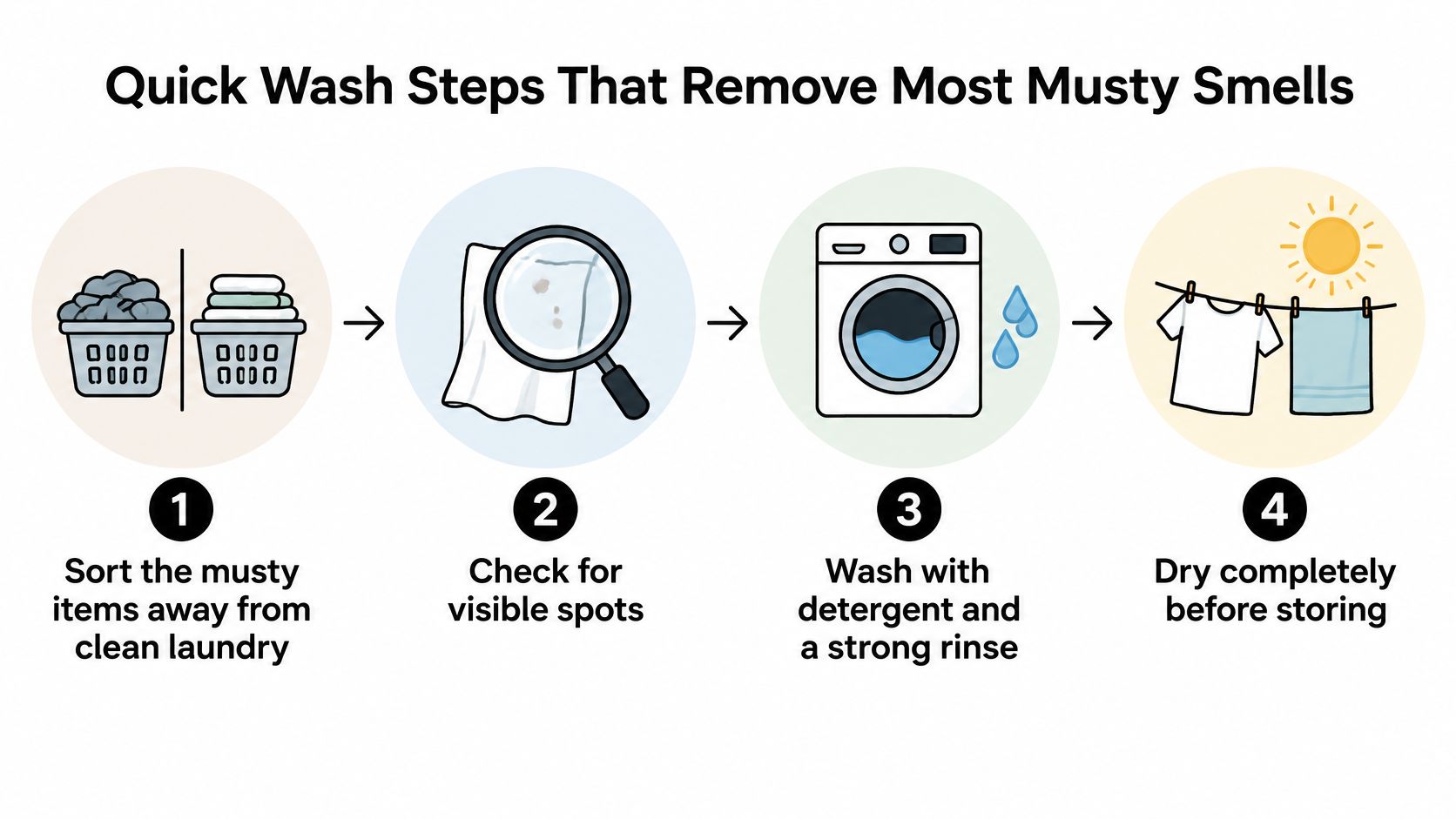
Quick Wash Steps That Remove Most Musty Smells
For washable cotton and synthetic clothing without visible mould, start with detergent, thorough rinsing and prompt drying. Don't begin with a complicated mixture of household products. A controlled wash makes it easier to tell whether the problem was ordinary stale laundry or something that needs closer assessment.
A single washable garment with a faint stale-storage note can first be aired outdoors in shade. Spread it out rather than leaving it folded over a hanger, then reassess it. Airing isn't a treatment for fuzzy growth, suspicious dark spots or a strong mould smell.
Start with a controlled wash
Separate and inspect the clothing. Keep musty items away from clean laundry and examine collars, seams, pockets and folded areas. Anything with suspicious spotting or fuzzy growth should leave this routine and go into the professional-assessment route.
Read the complete care label. Check washing, bleaching and drying instructions, not just the fibre name. A washable outer fabric doesn't mean its lining, trim or interfacing can tolerate the same treatment.
Wash with a suitable detergent. Use the care-label temperature and measure detergent for the load, soil level and machine instructions. Don't cram the drum, because garments need room to move and rinse.
Rinse thoroughly. Select an extra rinse if the fabric feels slippery, the machine shows lingering suds or you suspect detergent buildup. More detergent isn't a substitute for removing what's already in the fabric.
Transfer straight to drying. Use shaded outdoor airflow or a dryer setting permitted by the label. Check waistbands, cuffs, pockets and thick seams before deciding that the garment is completely dry.
Assess the dry result. Let dryer-warm clothing cool before smelling it, and check individual pieces rather than judging the whole basket. If a musty note remains, investigate the garment and its environment instead of automatically repeating the same wash.
Keep additives secondary
Vinegar and baking soda aren't prerequisites for this process, and neither should be treated as a reliable mould-removal system. Check garment and appliance instructions before using an additive. Never combine vinegar with bleach, and don't layer cleaning products in an attempt to make the wash stronger.
The essential sequence is cleaning followed by complete drying and corrected storage. Health Canada's healthy-home guide identifies moisture control, ventilation, leak repair and outdoor dryer venting as measures for addressing household mould conditions.
Sports equipment needs extra attention because padding, straps and protective components don't behave like a cotton shirt. Use the separate guidance on washing hockey gear rather than applying this clothing routine to every piece in a kit.
Practical rule: A successful result smells neutral once the garment is dry. A strong perfume smell doesn't demonstrate that the underlying mustiness is gone.
Which Fabrics Can Take a Home Wash
Fibre type changes how readily clothing releases odour, but garment construction decides whether a home wash is appropriate. University of Alberta textile work described in The Conversation's explanation of smelly laundry found that laundering removed odour compounds more effectively from cotton than polyester, which retained oily odour compounds more readily.
That helps explain why a cotton T-shirt may recover with straightforward laundering while a polyester training top needs closer attention to rinsing and drying. It doesn't mean the synthetic top needs hotter water. Heat tolerance still comes from the care label, including any restrictions imposed by stretch fibres or printed decoration.
Home method and avoid list by fabric
These methods apply to ordinary stale odour, not visible mould. For washable options, the garment's care instructions take precedence.
| Fabric | Home method | Avoid |
|---|---|---|
| Cotton | Wash at care-label temperature, rinse fully and dry completely | Leaving the load damp in the machine |
| Polyester and activewear | Use an extra rinse where needed and dry promptly | Storing before fully dry |
| Wool | Use a cool wool cycle or hand wash if permitted, then dry flat | Hot water and tumble drying unless explicitly permitted |
| Silk and rayon | Gentle hand washing only when permitted, or dry cleaning if required | Wringing and direct heat |
| Leather and suede | For ordinary surface care, use a material-approved wiping method and air dry away from heat | Soaking in water |
| Structured or lined items | Professional dry cleaning where specified | Machine washing that distorts the shape |
| Dry-clean-only items | Professional care only | Any home washing |
Construction can override the fibre
A lined wool jacket isn't a washable wool jumper. Its shoulders, internal supports and lining may respond differently to water, leaving a garment that smells better but no longer fits properly. Likewise, rayon can lose shape during wet handling, and silk may have unstable dyes or finishes.
Leather and suede deserve particular restraint. A wipe is surface maintenance, not a solution for mustiness inside the hide, lining or padding. Don't saturate them with vinegar spray or place them beside a heater.
For garments that permit hand washing, support the wet fabric, avoid twisting and reshape before drying. For activewear, focus on areas that retain body oils, including underarms and waistbands, without scrubbing printed or bonded details aggressively.
The distinction between wet cleaning and dry cleaning matters most when water exposure itself threatens the garment. If the label says dry clean only, skip the home-washing experiment. Persistent odour isn't a reason to override that instruction.
Find and Fix the Moisture Source
A clean wash can't compensate for a damp closet. If you return clothing to a space with condensation, poor airflow or a leak, you haven't finished the job. For Toronto-area households, this check is especially useful in basement storage rooms and closets against cold exterior walls.
Health Canada recommends maintaining indoor relative humidity between 30% and 50% to help address moisture and mould. Use a basic hygrometer to check the closet, laundry area and storage room rather than assuming they match the thermostat's reading elsewhere in the home.
The Canadian Conservation Institute's textile-storage guidance indicates that textile mould development can take three months or more at approximately 70% relative humidity, but occur within a few days at 90%, while growth is considered unlikely below 60% with good air circulation. These are conservation benchmarks, not a guarantee that clothing stored just below a threshold will stay trouble-free.
Inspect the space and the appliances
Start behind the clothes. Pull garments away from exterior walls and look for damp patches, peeling finishes or condensation. Avoid packing clothing tightly against a cold surface, and don't conceal a suspect wall behind storage boxes.
Check basement storage after rain and inspect nearby plumbing. A dehumidifier can help manage airborne moisture, but it won't repair water entering through the building. Where an underlying crawl space contributes damp air, Home Dehumidifier Reviews' guide can help you consider equipment to control humidity beneath your home, alongside leak and drainage repairs.
Then inspect the laundry equipment:
- Washer gasket and drawer: Remove trapped lint and residue according to the appliance manual. Let accessible wet areas dry between uses where it's safe to leave them open.
- Washer cleaning cycle: Run the manufacturer's maintenance cycle with its recommended cleaner. If the manual specifies an empty hot cycle, follow that procedure rather than improvising a chemical mixture.
- Dryer airflow: Clean the lint filter and inspect the exhaust route. A dryer that runs but leaves thick seams damp needs an airflow check, not a hotter setting.
- Hamper contents: Hang wet towels and sweaty clothing to dry before they sit against other garments. Empty the hamper daily when it contains damp laundry.
Musty smell symptoms, likely sources and first checks
| Symptom | Likely source | Check and fix |
|---|---|---|
| Smell returns after drying | Damp closet or storage area | Measure humidity, improve airflow and confirm complete drying before storage |
| Smell in clothes from the same machine | Detergent buildup or slow drying | Use the prescribed washer-cleaning cycle, review detergent dosing and dry promptly |
| Musty items from a basement or hamper | Condensation, leak or damp hamper | Find the moisture, empty the hamper daily and dry the laundry area |
| Smell after a dryer load | Lint buildup or restricted outdoor exhaust | Clean the lint filter and confirm the vent exits outdoors |
| Dark spots or fuzzy growth | Possible active mould | Isolate the items and stop routine home washing |
Don't overlook nearby textiles. If curtains or drapes beside the closet also smell stale, inspect the window and surrounding wall before cleaning everything separately. The guidance on cleaning heavy drapes helps distinguish manageable household care from bulky textile work.
In a condominium or rental apartment, document recurring condensation and leaks and report building-related problems to management. You may be able to improve garment spacing, but you can't correct concealed plumbing or shared ventilation with laundry products.
If clothing smells neutral after drying but becomes musty after storage, investigate the storage space before changing the wash formula.
When Home Treatment Is No Longer Safe
Washing harder is often the wrong response to suspected mould. More heat can damage fibres, stronger products can affect colour and finishes, and repeated handling can spread contamination to other laundry. Ordinary stale odour and visibly mould-affected clothing shouldn't follow the same treatment route.
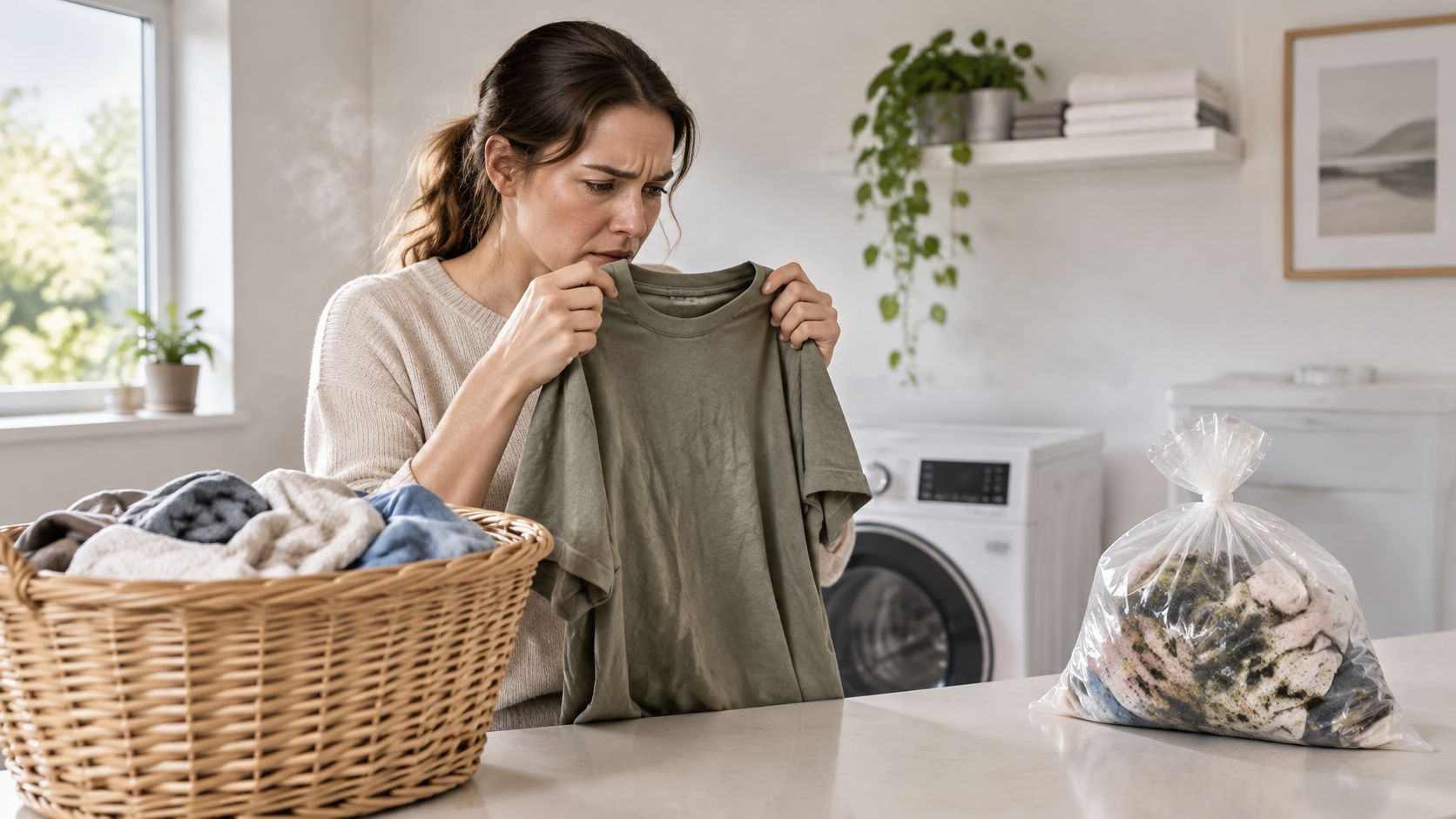
For visible growth or a strong mould smell, isolate the items in sealed plastic bags and keep them out of the normal laundry stream. Don't shake or brush them indoors, and don't put them on to see whether the smell disappears with wear.
Recognise the escalation signs
Health Canada's mould guidance recommends protective equipment including an N95-or-better respirator, eye protection and gloves for mould cleanup, and professional consultation when mould covers more than 1 square metre, appears in multiple patches or repeatedly returns. Treat that area measure as household cleanup guidance, not permission to home-wash a smaller patch on valuable clothing.
Use particular caution in households with people who have asthma, allergies or weakened immunity, as well as children and seniors. If handling an item causes coughing, wheezing or irritation, stop handling it and seek appropriate health advice.
- Contaminated-water exposure: Don't treat clothing exposed to contaminated water as an ordinary deodorising job.
- Fragile or valuable textiles: Keep weakened, decorated, historic or unstable pieces out of household appliances.
- Recurring contamination: Address both the affected contents and the building conditions rather than commissioning another wash alone.
The Canadian Conservation Institute's guidance on mould growth on textiles recommends consulting a conservator before washing or dry-cleaning mould-affected textiles and warns that household appliances are too rough for delicate pieces. Removal of visible contamination is specialised work, not an instruction to scrub a mouldy blouse in the kitchen.
An eco-friendly dry-cleaning process also shouldn't be confused with a guarantee that mould-damaged material is recoverable.
Stop point: If odour persists after a correctly specified cleaning cycle, don't escalate to stronger bleach, perfume or heat. Get the item assessed.
Decide Whether to Rewash or Send Them Out
Choose the route by condition, construction and the result of proper care, not by how strongly you want to save another cleaning bill. An intact washable T-shirt with ordinary stale odour is a reasonable home-laundry candidate. A lined jacket, unstable silk blouse or garment with suspected mould needs a different decision.
The cheapest route isn't always another wash. If the item has already been cleaned correctly and still smells wrong, another round of detergent may cost time without resolving the cause. Keep it separate while you decide whether the remaining issue is the garment, the equipment or storage.
Make a practical sorting decision
- Use home laundry for suitable everyday clothing. Choose intact, machine-washable cotton and synthetics without suspicious growth, and prepare a dry place for them before starting.
- Choose professional garment care for construction-sensitive pieces. Structured tailoring, dry-clean-only clothing and delicate fabrics shouldn't be used to test a stronger home recipe.
- Separate bulky textiles from the clothing load. An item that barely fits the drum won't have useful room for washing and rinsing. Overloading also makes drying harder.
- Flag suspected contamination before transport. Tell the cleaner about visible growth, prolonged damp exposure or contaminated water before arranging collection. Keep those pieces apart from routine laundry.
We offer special fabric dry cleaning for leather, silk, rayon and velvet, as well as specialised washing for demanding fabrics and bulky items such as area rugs, pillows and drapes. That gives you a professional route for pieces the everyday clothing routine can't safely handle, without assuming every musty item needs the same process.
Prepare the information that matters
Keep the care label attached and note where the item was stored, whether it became wet and what products you've already used. Don't apply a fragrance finishing spray before assessment, because it makes the original odour harder to judge.
If you're arranging laundry pickup near you, sort ordinary washable laundry separately from garments needing individual attention. We sort by fabric, colour and soil level as part of our cleaning process.
Take action today: measure the closet humidity, sort the affected items by fabric and assign each one a safe cleaning route. Have the dry storage space ready before the clean garments return.
For musty everyday laundry and delicate garments that need more controlled care, we offer wash-and-fold laundry, specialised dry cleaning and doorstep pickup and delivery. Visit CleanOnline, North York's Premium Dry Cleaners to arrange service, and flag any suspected mould or water exposure before collection so the cleaning route can be assessed.