Dry Clean Winter Jacket: When to Do It and What It Costs
Learn when a dry clean winter jacket is needed, how to read its care label, and what Toronto cleaners charge in 2026.
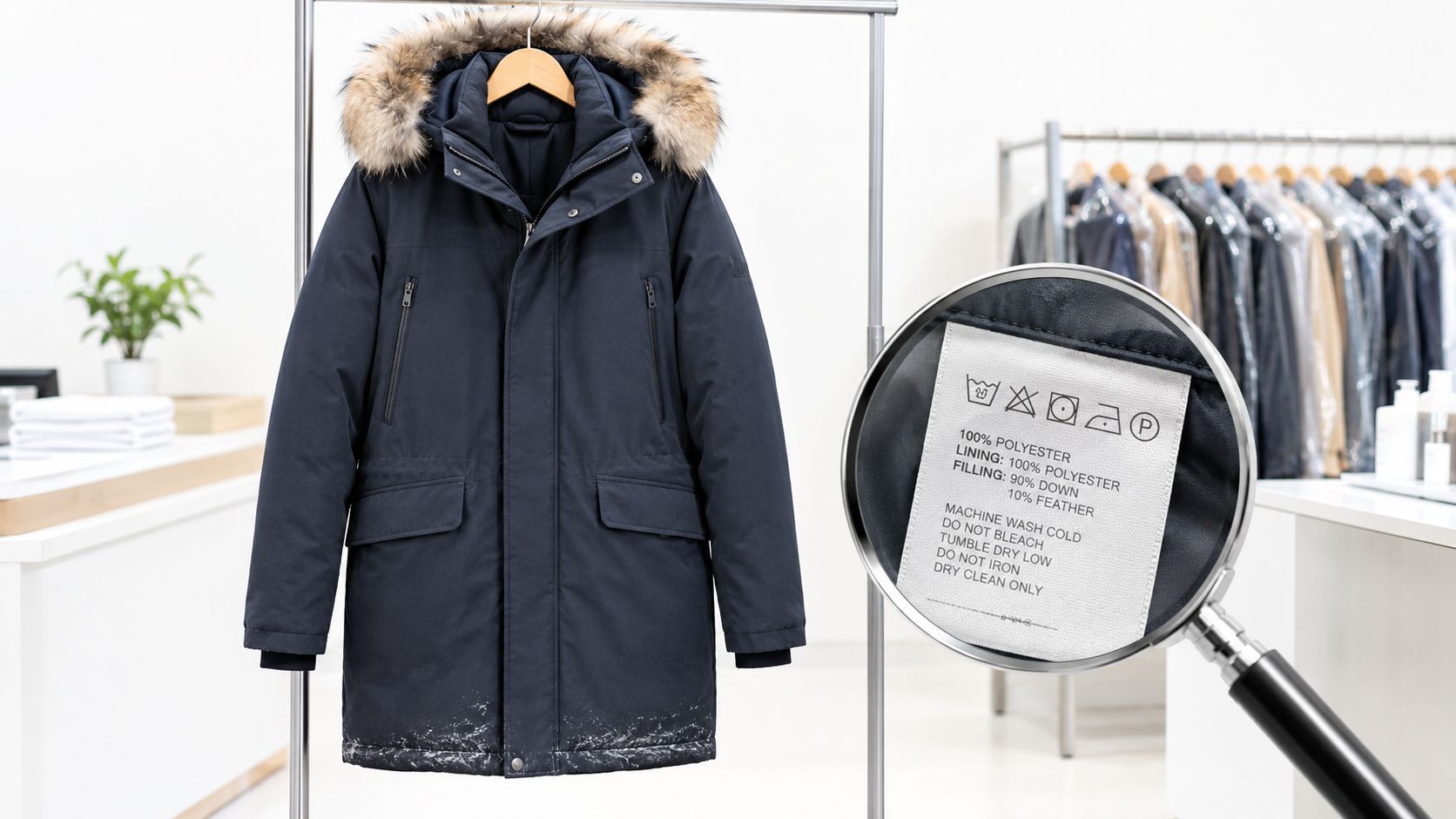
Your winter jacket is hanging by the door with a grey line around the hem, a shiny collar and a cuff that never seems quite clean. You're ready to put it away, but you're not sure whether to book dry cleaning, wash it or leave it alone.
The right choice starts with what's inside the jacket, not just how dirty it looks. The shell, insulation, waterproof layers and trims must all tolerate the cleaning method. Sometimes the next step is a full clean. Sometimes it's a repair or careful spot treatment.
When a Winter Jacket Actually Needs Dry Cleaning
A Toronto jacket collects more than snow. Slush splashes onto the hem, road residue settles around seams, and skin oils build up where your neck and hands touch the fabric.
Environment and Climate Change Canada's Toronto climate normals record 114.5 centimetres of average annual snowfall for 1991–2020 and approximately 37.4 days per year with at least 5 centimetres of snowfall. Your coat faces repeated wetting and contamination, not just the occasional storm.
Match the treatment to the situation
The verdicts below assume the jacket's construction and care instructions permit dry cleaning. A “yes” means arrange cleaning, not authorise a standard solvent cycle without assessment.
When dry cleaning is needed, by situation
| Situation | Dry clean? | Why it matters |
|---|---|---|
| End of winter, before storage | Yes, if permitted | Accumulated residue can become harder to remove and contribute to odour during storage |
| Salt or grey slush marks on the hem | Yes, arrange treatment within days if permitted | Salt and grime can leave rings after repeated wetting; they need targeted treatment |
| Oil-based stain such as food or grease | Yes, promptly if permitted | Oil needs a suitable grease-removing treatment; water alone usually won't remove it |
| Light surface dust or one damp day with no marks | No | Brush off dry dust and air-dry away from direct heat |
| Musty smell after a wet week | Check first | Dry the jacket fully; arrange cleaning if the odour remains |
| Label prohibits dry cleaning | No | Use the permitted method or request a specialist assessment |
Look beyond the obvious stain
Inspect the collar, pocket openings and inside cuffs as well as the hem. Dark fabric can hide soil, while a glossy patch may be accumulated oil rather than permanent wear.
Residue becomes harder to remove when it remains in fibres through repeated use and drying. That doesn't mean a jacket needs a full clean after every damp commute. It means the case for cleaning grows with what has accumulated.
Practical rule: Clean for soil, persistent odour and seasonal storage, not simply because the jacket got wet.
For loose dust on wool, use a soft clothes brush and light strokes. For a damp puffer, give it room to dry rather than packing it tightly among other coats. Match your jacket to the nearest situation in the table, then check whether its label permits the proposed treatment.
How to Read the Care Label on Your Jacket
The care label sets the limits; it doesn't replace inspection. The Canadian guide to apparel and textile care symbols distinguishes solvent permissions and warns that a missing symbol doesn't establish that a treatment is safe.
Care-label symbols and what they mean for a winter jacket
| Symbol | Meaning | What it means for a winter jacket |
|---|---|---|
| Plain circle | Normal dry-clean cycle; any solvent except trichloroethylene | Dry cleaning is permitted, but trims and other components still need checking |
| Circle with F | Petroleum solvent only | Flag this restriction at drop-off |
| Crossed-out circle | Do not dry clean | Ask about permitted wet cleaning, spot treatment or manufacturer advice |
| Washing tub symbol | Water-washing instructions | Check it before considering home washing or professional wet cleaning |
| No care symbol | No instruction given | Absence doesn't prove safety; request professional assessment |
A solvent is the cleaning liquid used instead of water in dry cleaning. Despite the name, dry cleaning isn't a dry process: the garment moves through liquid, and the cleaner then removes that liquid under controlled conditions.
Read any words beneath the symbols, too. Restrictions on drying, ironing or removable decorations can change the entire plan.
Check every removable component
Start inside the side seam and at the back neck. Then inspect detachable hoods, liners, belts and faux-fur collars for separate labels. Photograph the instructions and fibre-content information so you can send clear images before collection.
Say your parka's shell permits dry cleaning, but its detachable hood prohibits it. The hood needs separate handling; the shell's permission doesn't override the hood's restriction. If the incompatible trim isn't removable, the cleaner must assess the jacket as a whole.
- Photograph clearly: Flatten each label and capture both sides without glare.
- Record construction: Include the shell, lining and filling information, not just the brand name.
- Show existing damage: Photograph peeling inner surfaces, loose trims and worn seams alongside the labels.
The same component-by-component thinking applies to lined household textiles, including cleaning heavy drapes. A face fabric can tolerate a method that its backing, lining or decorative trim cannot.
When Standard Dry Cleaning Is the Wrong Choice
Professional dry cleaning isn't automatically the safest treatment for every winter jacket. It's a particular process, not a blanket promise of gentleness.
Ontario's dry-cleaning regulation distinguishes solvent categories and requires trained personnel to operate commercial equipment while minimising environmental contamination. For your jacket, the practical question remains which process its combined materials can tolerate.
Insulation changes the cleaning plan
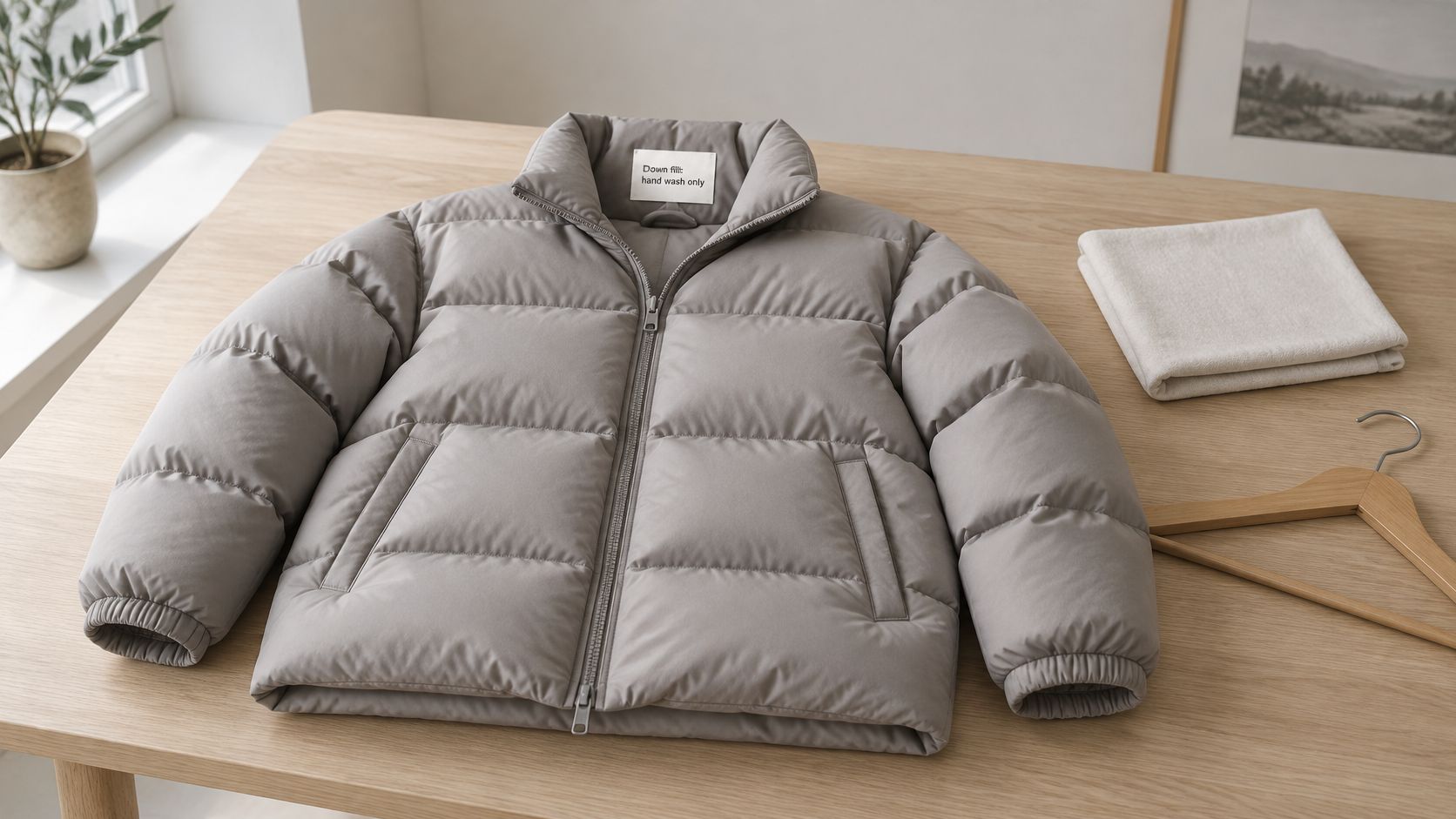
Down-filled jackets need a compatible process that preserves the filling and restores its distribution. Down is the soft plumage that traps warm air; its fluffy volume is called loft. Incompatible solvents can remove oils from plumage, while incomplete drying can leave clumps and cold patches.
Synthetic insulation uses manufactured fibres to hold air. Excessive heat and compression can flatten the filling or leave a shiny, heat-damaged surface. A suitable drying programme must respect the manufacturer's limits rather than relying on hotter drying to finish faster.
Weatherproof layers and trims need separate decisions
A membrane is a thin barrier that helps resist liquid water while allowing moisture vapour to escape. Durable water repellency, often shortened to DWR, is the surface treatment that helps droplets bead and roll off the shell. They aren't the same thing.
- Coated or membrane shells: Confirm that the proposed process suits the coating, adhesives and sealed seams. Ask whether restoring water repellency is appropriate and whether that work is included.
- Leather, suede and fur: Assess these separately. They can change colour, stiffen or react differently from the surrounding textile.
- Damaged construction: A failing zipper, torn cuff or lifting seam tape needs a repair decision before the jacket enters a cleaning machine.
Say a commuter's parka has a salt line and a torn cuff. Treating the salt without addressing the tear could allow movement in the machine to enlarge the opening. Repairing the cuff first protects the jacket during the subsequent clean.
A cleaner's refusal to process a peeling shell can be a protective decision, not a lack of cleaning ability.
Delamination means bonded layers are separating. Cleaning won't bond them together again, and a cleaner may decline a jacket whose coating is shedding or whose filling is escaping.
A localised stain may justify spot cleaning rather than full immersion. Professional wet cleaning, a controlled water-based process, is another option when permitted; the differences between wet cleaning and dry cleaning help explain why neither method suits every garment.
What Happens During Professional Winter Jacket Cleaning
A good cleaning plan begins before the machine starts. The cleaner needs to identify the jacket's materials, distinguish stains from damage and select a process that addresses the soil without sacrificing the garment.
The Competition Bureau's textile-labelling requirements require disclosure of each fibre present at 5% or more of total fibre mass, with specific terminology and percentage requirements for down and feathers. That information helps the cleaner distinguish the shell's needs from the filling's needs.
From inspection to finishing
The overall workflow is straightforward, but the cleaning and drying stages must change with the jacket's construction.
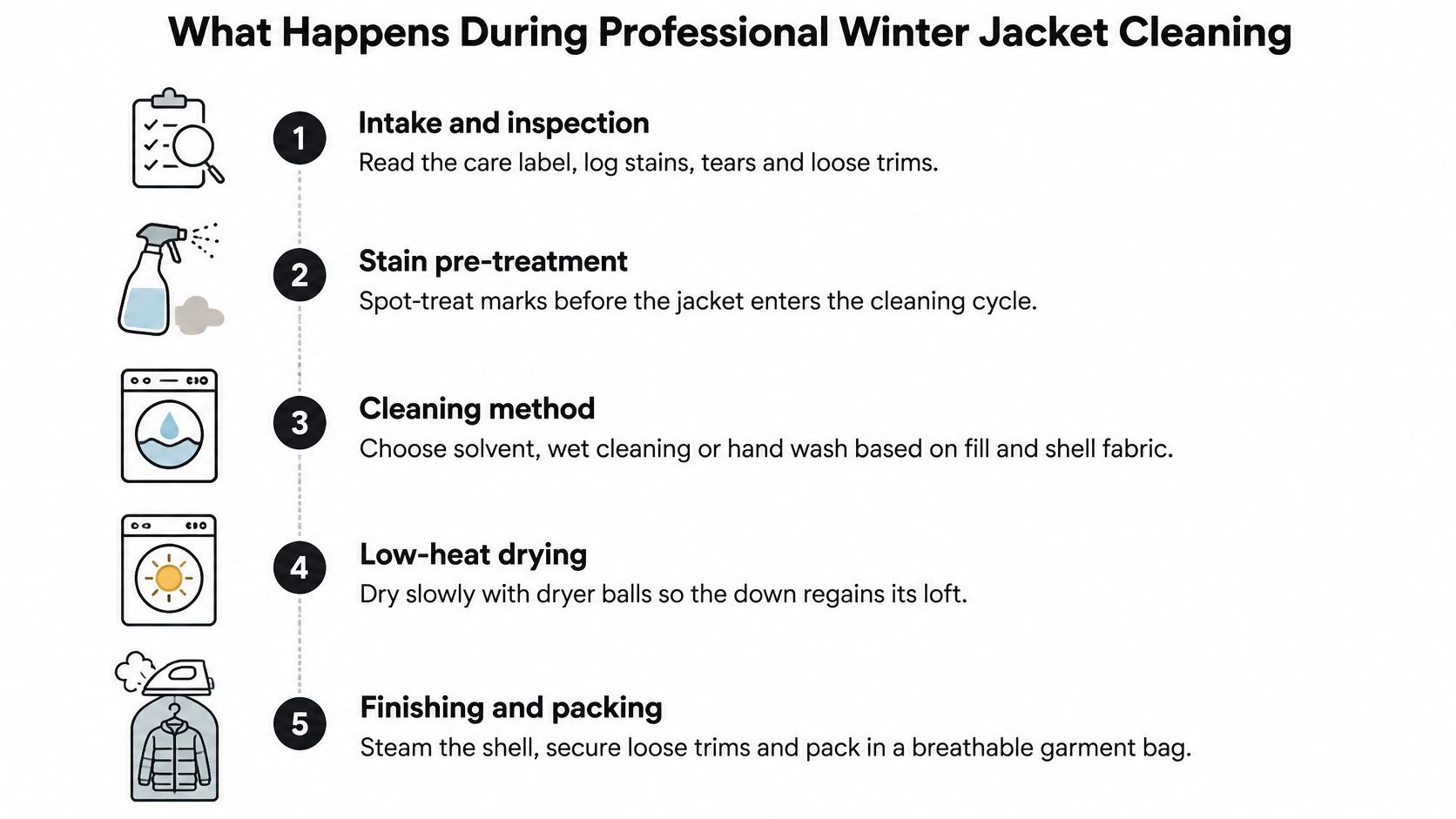
Intake and inspection. The cleaner reads the labels, records the fibre and insulation types, and checks stains, tears and loose trims. Photographs of existing damage help distinguish pre-existing wear from changes during treatment.
Component separation. Detachable hoods, liners and collars are removed when their instructions require separate handling. The cleaner identifies the pieces so they can be reunited correctly.
Stain pre-treatment. Grease receives a compatible oil-removing treatment, while salt, mud and other water-soluble residue need a different approach. Identifying the stain matters because a solvent cycle alone won't necessarily remove a salt line.
The selected cleaning cycle. If dry cleaning is appropriate, the cleaner uses the permitted solvent and suitable mechanical settings. If the assessment calls for wet cleaning or local treatment instead, the jacket shouldn't enter a conventional solvent cycle.
Controlled drying. The cleaner controls temperature and movement according to the garment, rather than applying a universal low-heat setting. Down needs thorough moisture removal and redistribution; synthetic filling needs protection from excessive heat and compression.
Finishing and reassembly. Appropriate light steam or reshaping restores the shell's appearance without crushing insulation. Direct pressing isn't suitable for every coated fabric, reflective detail or puffy panel.
Final inspection. The cleaner checks for remaining marks, puckering, lifting seam tape, coating changes and trim deterioration. The jacket must be fully dry before it's prepared for storage.
Why the intake record matters
A useful garment record includes more than “winter coat”. It identifies the filling, shell finish, removable components, stain locations and treatment restrictions.
That record supports repeatable decisions when the jacket returns for seasonal care. The cleaner should still inspect it again, since a previously sound coating or seam can deteriorate between visits.
What Winter Jacket Dry Cleaning Costs in Toronto
Published prices are useful comparison points, not a personalised quote. The table includes a Toronto cleaner alongside other Canadian providers, so it shouldn't be read as a Toronto-wide average.
Published 2026 winter jacket and coat cleaning prices
| Provider and item | Price (CAD) | Terms |
|---|---|---|
| Park Lane Cleaners (Toronto), winter coat | From $48.35 | Published starting price |
| Park Lane Cleaners (Toronto), down coat | From $65.95 | Published starting price |
| Mint Dry Cleaning, short coat | $43.92 | Before GST |
| Mint Dry Cleaning, three-quarter coat | $49.94 | Before GST |
| Mint Dry Cleaning, long coat | $55.95 | Before GST |
| WeDoLaundry, long coat or winter jacket | $39.99 | Excludes taxes and service fees |
| WeDoLaundry, parka jacket | $64.99 | Excludes taxes and service fees |
Compare the work, not just the headline price
Length affects the amount of shell and lining that must be cleaned, handled and finished. A long coat also takes more space and care during finishing than a short jacket.
Insulation and construction affect processing time. Down needs careful drying and redistribution, while a substantial parka may include a hood, multiple layers and detachable components. Brand names alone don't describe that workload.
Taxes and fees affect the amount you really pay. A price before GST or excluding service fees isn't directly comparable with an all-in quote.
Before approving the job: Get a written total for your actual garment, not just the price category that sounds closest.
A useful quote names the item type and identifies any separate charges for stain treatment, trim handling, repairs or restoration of water repellency. Specialist leather treatment and an alternative cleaning method may also need separate pricing; don't assume they're included in a basic coat listing.
Describe the jacket accurately when requesting the quote. “Long down parka with detachable fur trim and grease on the sleeve” gives the cleaner much more useful information than “winter jacket”. Send photos of the whole garment and its problem areas so the initial estimate reflects the work being considered.
Confirm the Cleaning Plan Before You Drop Off
Book a process, not just a category called winter-jacket cleaning. If the jacket is structurally sound, its instructions permit dry cleaning and it has accumulated seasonal soil, a compatible professional clean is a sensible choice.
If the label prohibits dry cleaning, the shell is peeling or a fastening is failing, request an assessment before authorising a full cycle. The immediate job may be a repair, a local treatment or a permitted water-based method.
Prepare a useful booking message
- Identify the jacket: Send clear label photos and describe the shell, filling and removable parts.
- List the problems: Name known spills and point out tears, loose stitching or damaged fastenings.
- Prepare the pockets: Remove tissues, receipts, pens and personal items, including anything in hidden inside pockets.
- Confirm component handling: Establish whether detachable pieces should travel with the jacket or remain at home.
- Approve the scope: Get the item category, treatment, extras and applicable taxes in writing.
At CleanOnline, our listed winter-jacket cleaning price is $39.99, while a heavy or long winter jacket is $49.99. Confirm the correct category and any additional work before approving the order.
Leave enough time for assessment and any agreed repairs rather than assuming the jacket will be ready immediately. Our guide to how long dry cleaning takes can help you plan the booking around when you'll need it.
CleanOnline offers seasonal coat cleaning, outerwear care and alterations, with doorstep pickup and delivery. Visit CleanOnline, North York's Premium Dry Cleaners to arrange care for your winter jacket, and send label photos and a description of any stains or damage with your booking.