How Does Wash and Fold Work from Pickup to Return
How does wash and fold work from pickup to folded return, including sorting, temperature, drying and a 24 to 48 hour doorstep delivery.
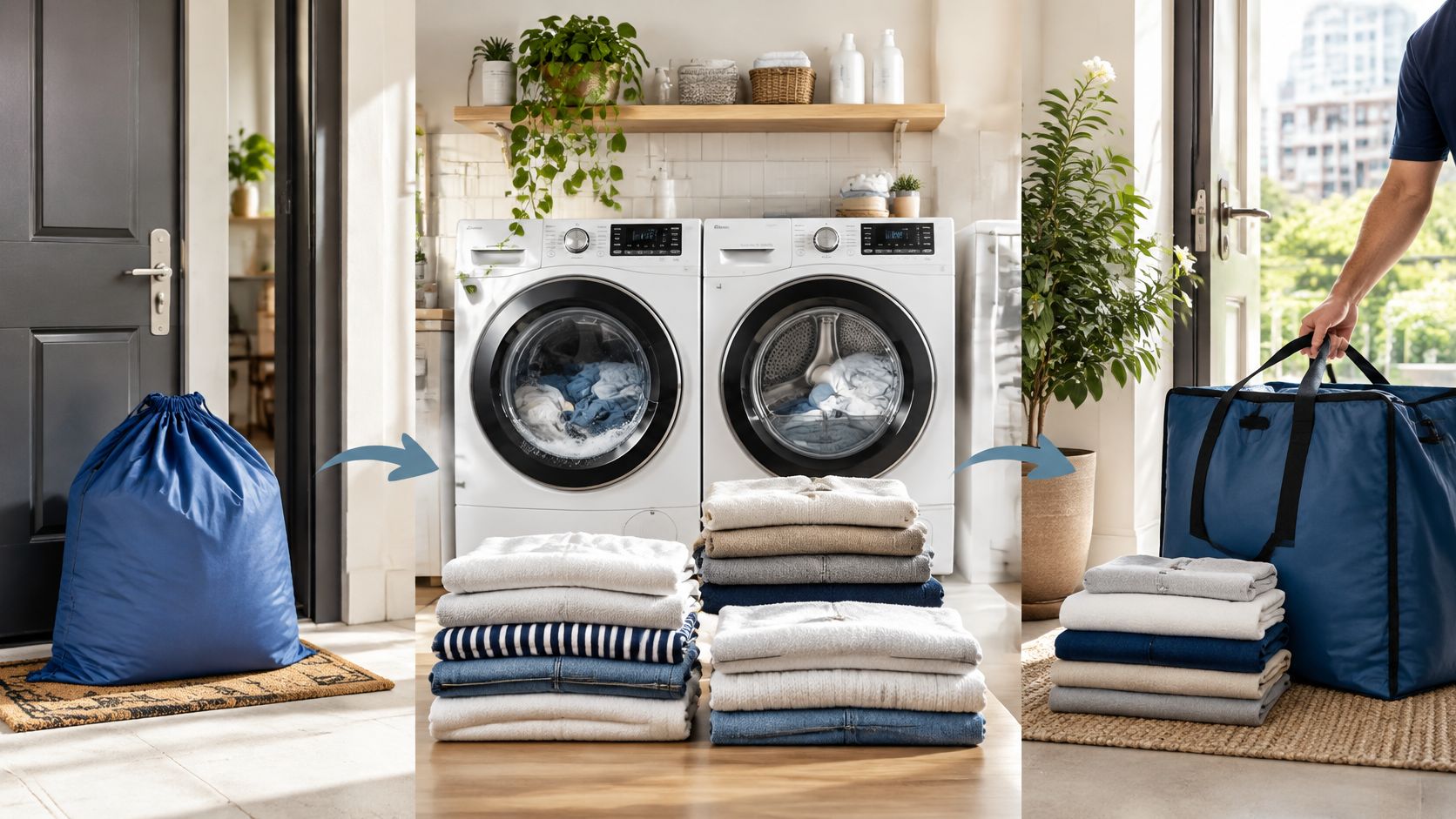
Wash and fold means collecting, sorting, washing, drying and folding everyday washable clothes, then returning them to your doorstep, usually within 24 to 48 hours, without a crisp press. You hand over the laundry bag instead of spending your evening moving loads between machines and matching socks.
Perhaps your hamper is full, the apartment laundry room is busy, and tomorrow's clothes are somewhere near the bottom. The useful question isn't just how does wash and fold work, but how someone else can handle your clothing without guessing about labels, detergent or delivery instructions. A reliable service needs a controlled cleaning process and a clear record of whose laundry is whose.
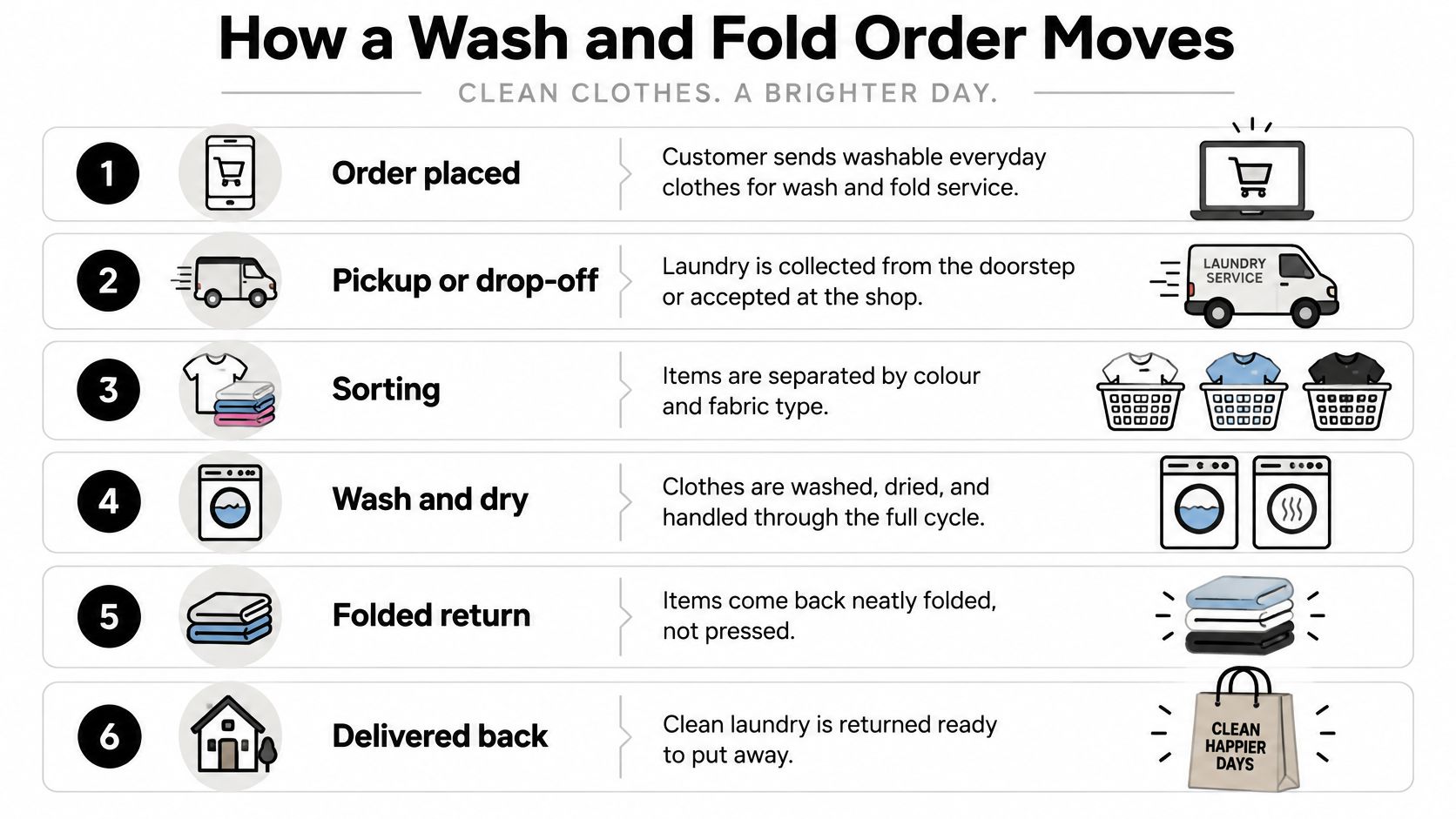
How a Wash and Fold Order Moves
| Stage | What happens | Customer role | Typical timing |
|---|---|---|---|
| 1. Bag and book | Everyday washable clothes go in a laundry bag and a pickup is scheduled | Sign up and request the earliest suitable slot | Before collection day |
| 2. Doorstep pickup | The bag is collected and taken to the nearest outlet | Leave the bag out before 8 a.m.; being home is optional | Morning of pickup |
| 3. Sort | Pieces are separated by colour, fabric and soil level | Note allergies or items to keep out | Before washing |
| 4. Wash and dry | Clothes are washed and dried, with finished items checked | No action unless instructions need clarification | During the service window |
| 5. Fold into sets | Garments are folded in sets of five and bundled | Choose folded return for this service | After drying |
| 6. Return | Bundles come back in a reusable laundry bag, ready to store | Arrange a suitable doorstep receiving location | Within 48 hours; the app also describes a 24-hour return |
From your hamper to a finished order
Bag and book. Empty pockets, remove valuables and set aside anything that doesn't belong in an everyday washable load. Sign up with your contact details through our website or mobile app, then schedule the earliest pickup that suits your household. Give stain information while it's still fresh in your mind, especially what caused the mark.
Doorstep pickup. For our morning collection arrangement, leave the laundry bag outside before 8 a.m. You don't need to stay home for collection. The team takes the bag to the nearest outlet, so clear building access instructions matter as much as the street address.
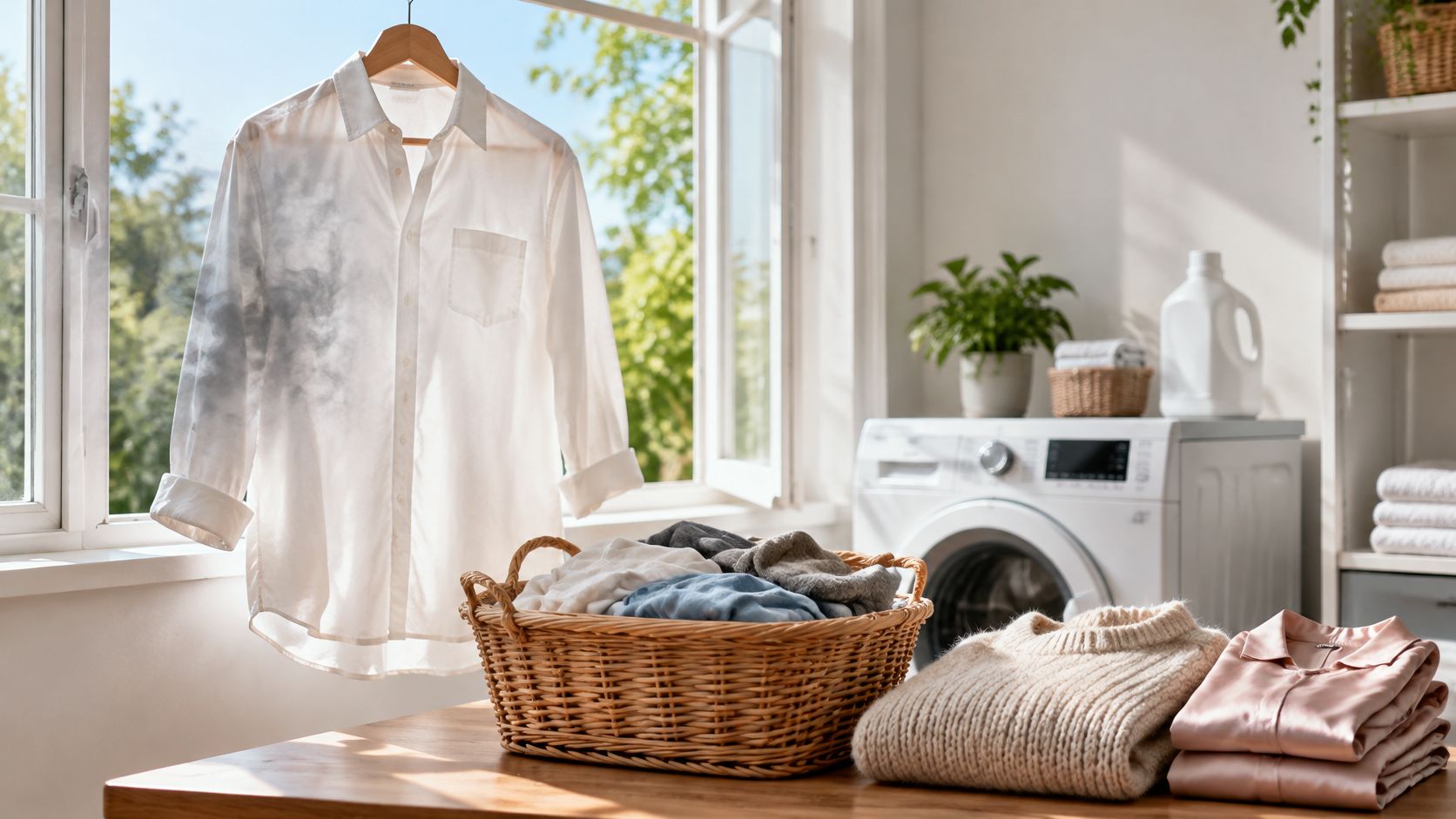
Sort. Staff separate clothing by colour and material rather than putting the entire household bag into a single mixed wash. Soil level and care requirements also guide sensible load decisions. A muddy cotton garment shouldn't automatically receive the same treatment as a lightly worn stretch top.
Wash and dry. Cleaning requires an appropriate detergent, washing action, and drying method, not just a strong cycle. A finished-item inspection should check for remaining marks, retained moisture, and anything that needs attention before packaging. Stain removal isn't a reason to ignore a garment's limits.
Fold into sets. Our process folds garments in sets of five, then stacks them into tidy bundles. Consistent folding makes the return easier to put away and helps prevent the bag from arriving as a loose pile.
Return. We deliver the finished order in a reusable laundry bag, ready for storage. Our doorstep service states return within 48 hours of pickup, while the app also describes delivery within 24 hours. Confirm the booked return arrangement before sending clothes you need for a particular event.
Starch and a crisp press belong to shirt laundering, not this cycle.
Before collection: Put unusual care instructions on the order, not only on a loose note inside the bag. Staff need to identify exceptions before the clothes reach a machine.
Why Households Hand Off the Whole Cycle
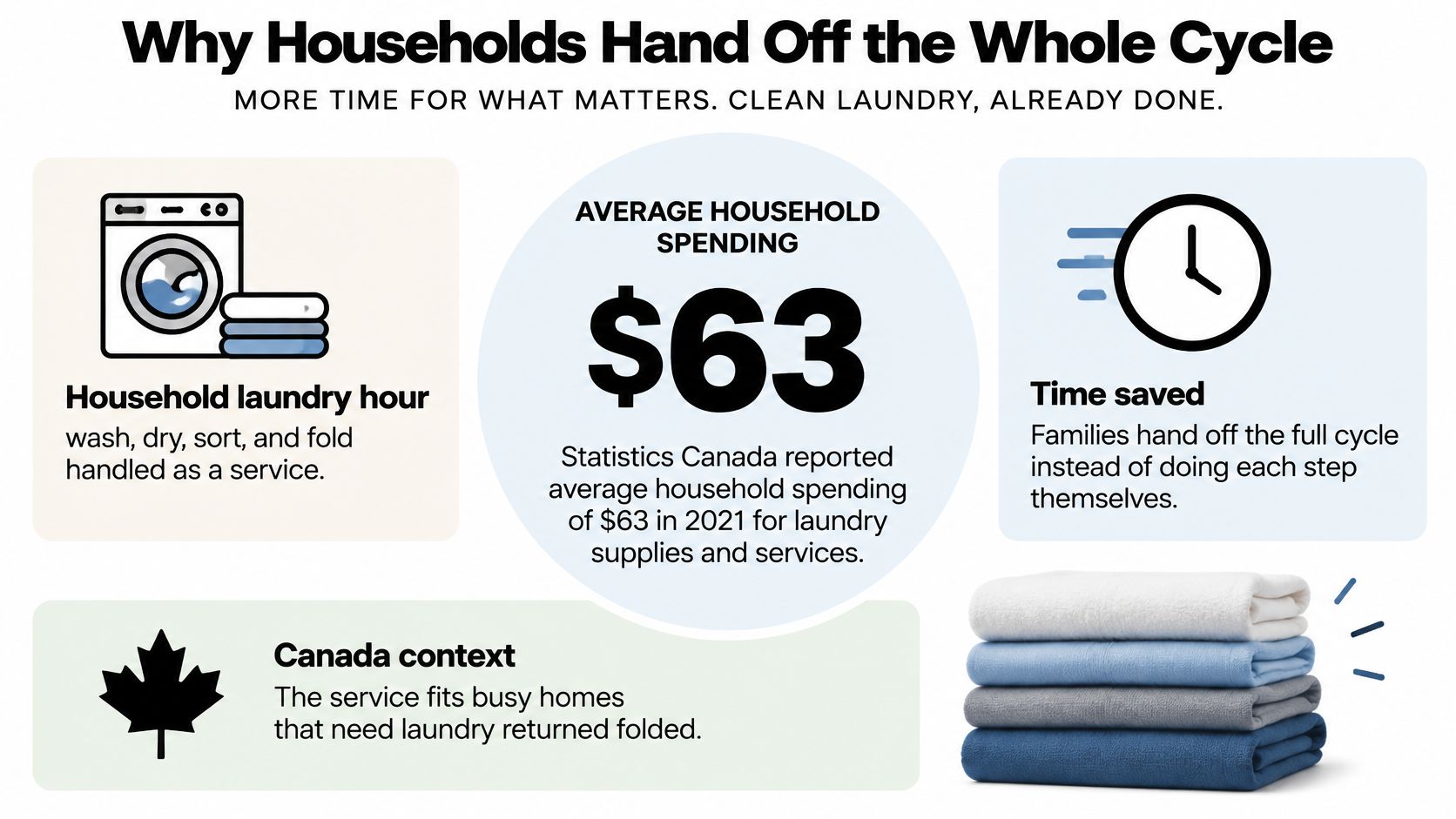
A week of laundry is really five small jobs in a row: gathering clothing, separating loads, treating marks, moving wet laundry between machines, then folding everything at the end. Owning a washer completes one of those jobs. Handing off the cycle completes all of them.
Equipment access isn't the whole decision
Many households own laundry equipment, yet access in practice looks different from access on paper. Statistics Canada's household-equipment table recorded 75.9% washing-machine ownership and 76.5% clothes-dryer ownership in Ontario in 2009. Those figures come from a historical snapshot rather than today's rates, but they show private equipment was never something to take for granted.
For a Toronto apartment household, even machines down the hall can mean carrying a basket, waiting for availability and returning before someone needs the dryer. Limited space for air-drying adds another practical constraint. Outsourcing can make sense whether the problem is access, physical effort or an evening already committed elsewhere.
Consider a household that washes its own towels but sends out accumulated everyday clothes during a demanding week. It doesn't need to stop doing laundry entirely to benefit. The useful comparison is which tasks the household wants to keep and which it wants someone else to complete. At $3.00 per pound, that calculation becomes concrete: weigh the bag, compare it against the hours the same pile would consume at home.
- Keep at home: Small, urgent loads or garments whose handling you prefer to supervise.
- Hand off: Repeat washable loads that otherwise sit waiting for sorting and folding.
- Use a different service: Clothing needing specialist treatment rather than routine washing.
Our guide to whether wash and fold is worth it helps frame that decision around the work being transferred, not merely machine access.
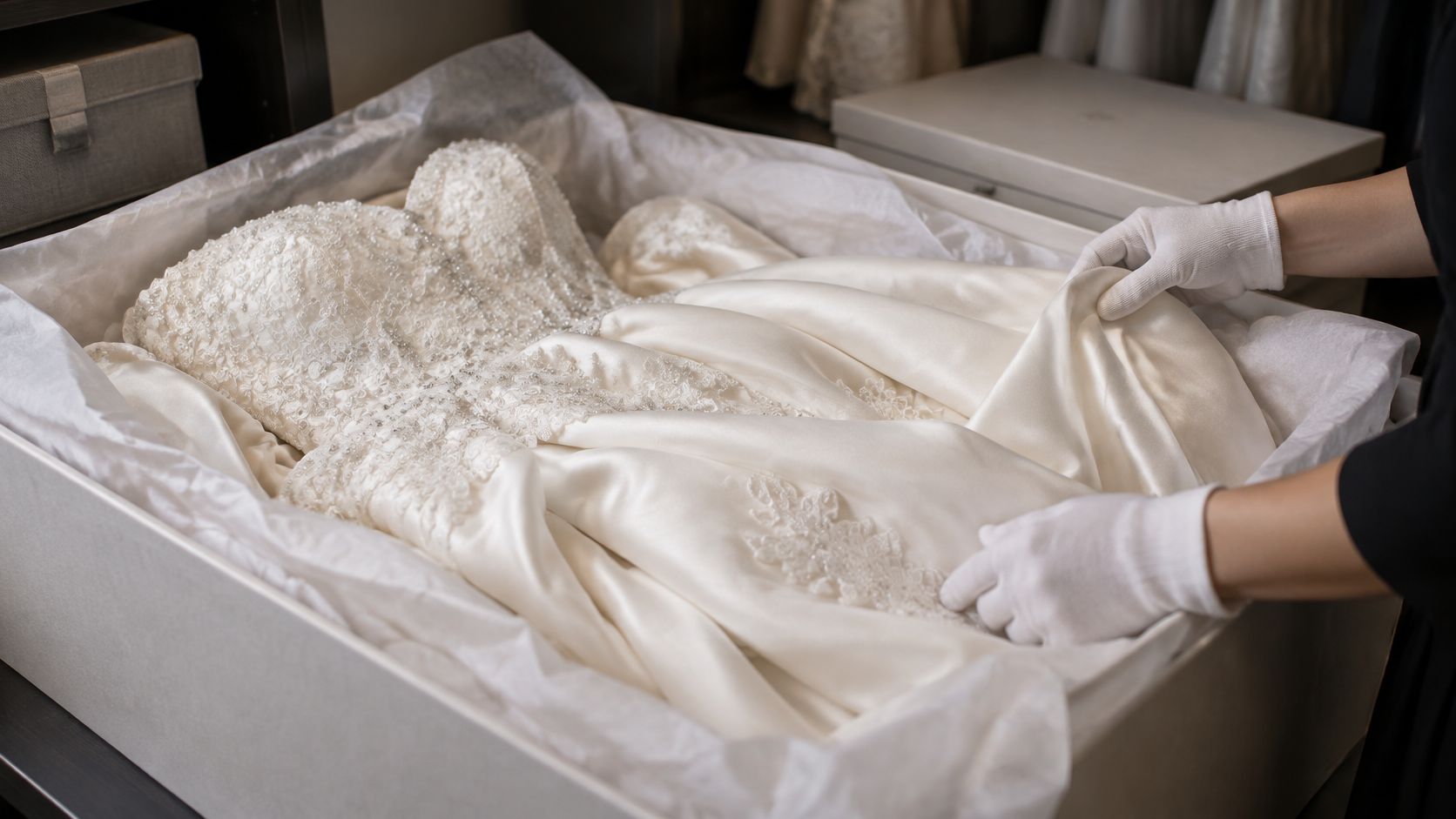
The same reasoning applies to a salon or daycare with recurring washable textiles: employees can focus on their primary duties rather than managing laundry. Everyday washable items fit the routine cycle, while a dry-clean-labelled dress, wedding gown or fire-damaged textile needs assessment through a different garment-care pathway.
Sorting by Colour Fabric and Care Label
Start with the care label, not the drum. A bag describes how clothing travelled to the outlet, not how every piece should be washed. Compatible items can share a process; incompatible care requirements need separate handling.
The Canadian textile-care standard distinguishes washing, bleaching, drying, ironing or pressing, and professional care, with testing procedures that include 30–60°C washes, different levels of mechanical action and drip, flat, line or tumble drying. These are testing conditions, not permission to wash every cotton or synthetic item at the highest temperature.
How common loads are sorted
| Load | Wash approach | Drying | Main risk if mixed in |
|---|---|---|---|
| Everyday cotton tees and underwear | Use the care-label temperature and suitable mechanical action | Suitable tumble heat if permitted; avoid overdrying | Shrinkage from exceeding the label |
| Dark colours | Separate from lights; avoid an unnecessarily aggressive wash | Tumble only when permitted | Dye transfer onto pale clothes |
| High-lint towels and fleece | Keep away from dark, smooth knits; assess fabric compatibility | Label-permitted lower heat or air-drying | Embedded lint and fibre shedding |
| Wool, rayon or elastane | Flag for fibre-specific assessment and a gentler or separate pathway | Flat, drip or another label-approved method; avoid excessive heat | Felting, stretching or loss of shape |
| Professional-care or dry-clean label | Keep out of routine wash and fold; assess for specialist care | Follow the specialist process | Damage from unsuitable water exposure and agitation |
Colour is only the first separation. Staff should also consider fibre sensitivity, soil level and drying method. A pale wool knit and a pale cotton towel may look compatible in the bag, but they don't necessarily tolerate the same action or dryer setting.
High-lint towels also need separation from dark smooth garments, where loose fibres become conspicuous. Heavily soiled clothing deserves assessment before it joins lightly worn pieces. Sorting is damage prevention, not an optional finishing touch.
Read the whole label
For a visual reference before you pack, Quote My Wall's clothing care label symbols explained can help you identify washing and drying restrictions. Read every relevant symbol: permission to machine-wash doesn't automatically mean permission to tumble-dry.
Hotter water and stronger agitation can improve cleaning, but they can also increase dye transfer, distortion and shrinkage; excessive tumble heat adds another risk of dimensional change. The aim is enough cleaning action for the soil without exceeding what the garment can withstand.
A special-care item shouldn't become an experiment simply because it arrived inside an ordinary laundry bag.
Record exceptions before washing and keep compatible finished garments in identifiable bundles. If you're uncertain about an outerwear piece, our guide to cleaning a wool coat explains why fibre and construction deserve attention before choosing a cleaning method.
Heat Detergent and Drying That Protect Clothes
The hottest cycle isn't automatically the right cycle. Ordinary residential laundry needs an effective detergent, an appropriate wash programme and a temperature that stays within the care label's limit. The label sets a ceiling, not a requirement to use maximum heat every time.
Hygiene claims need more precision than deep clean. The North Bay Parry Sound District Health Unit's guidance for group homes and shelters specifies a detergent hot-water cycle reaching at least 71°C for 25 minutes, or a detergent formulated for lower-temperature washing. That's a higher-risk shared-living benchmark, not a universal instruction for a bag of household clothing.
Separate ordinary soil from elevated risk
A sweaty T-shirt and laundry affected by bodily waste don't present the same handling problem. Tell the service about contamination before collection so staff can decide whether the order is suitable and what separation is required. Don't hide a higher-risk item beneath routine clothes.
A lower-temperature wash can be an appropriate garment-care choice, but temperature alone doesn't establish hygienic performance. Detergent chemistry, cycle time, soil removal and handling all matter. Equally, a hotter setting isn't acceptable if it damages the textile.
- Detergent choice: Identify fragrance sensitivities and distinguish a fragrance-free request from a request for stronger cleaning.
- Cycle choice: Establish whether routine loads use cold water or another label-compatible setting.
- Risk handling: Describe contaminated items clearly and confirm acceptance before including them.
Drying completes the job
Clothing needs to be dry before it's folded and packaged. Damp waistbands, thick seams and towel edges deserve attention because the outside of a load can feel dry while denser areas retain moisture. Overdrying, however, unnecessarily exposes fibres and elastic to more heat.
Equipment care matters too. BacteriaFAQ.com's guide to cleaning washing machine seals and drawers provides useful background on the less visible parts of washing-machine maintenance, alongside routine cleaning of accessible surfaces.
A useful distinction: Clean-looking, fresh-smelling and processed for a specific hygiene requirement aren't interchangeable descriptions.
If a returned item smells stale, don't mask it with fragrance or put it straight into a crowded cupboard. Keep it separate, document the condition and raise the concern promptly. Our guide to removing musty smells from clothes explains practical next steps without treating perfume as a remedy for retained moisture.
A Doorstep Order When You Cannot Be Home
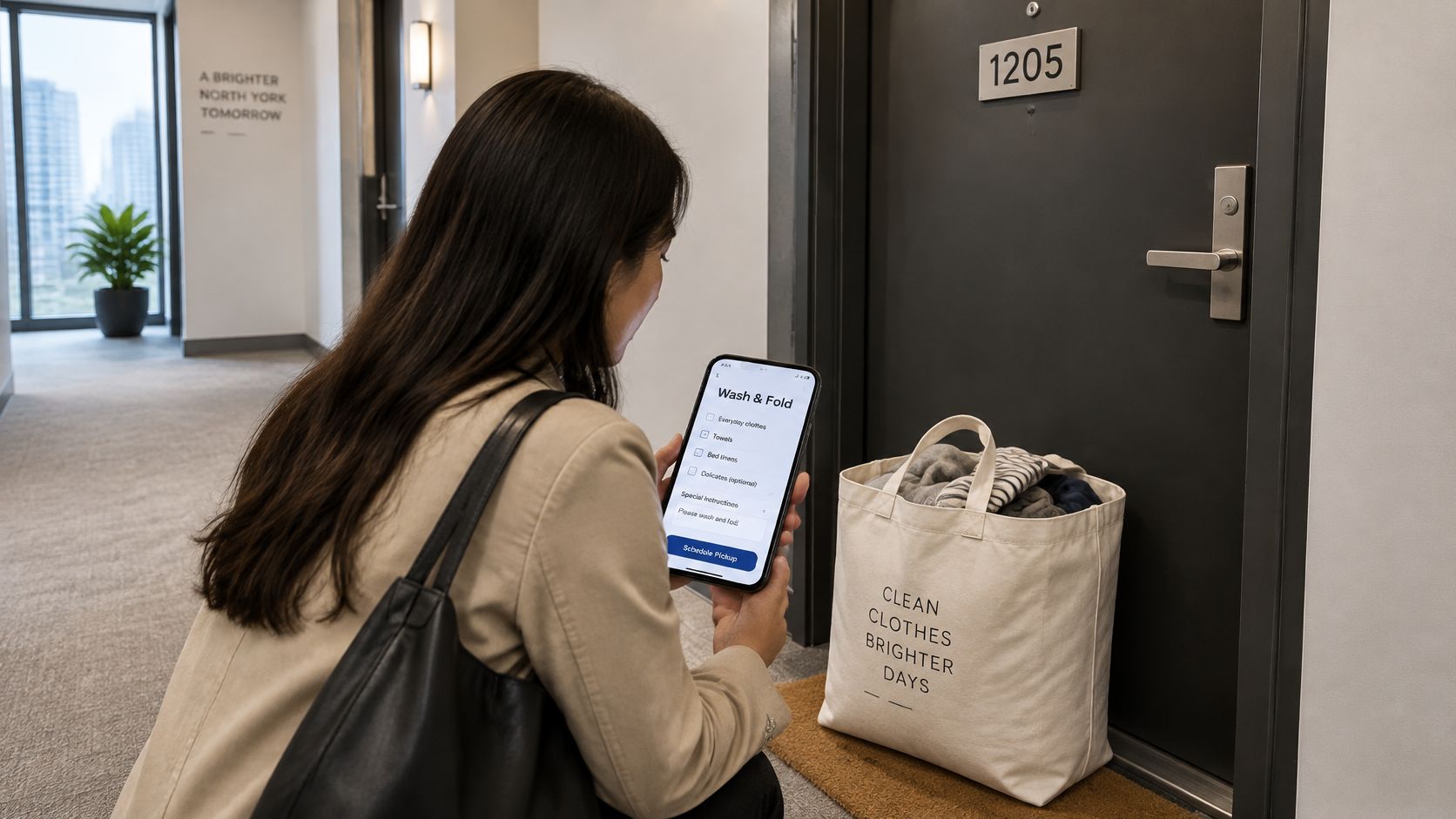
Say you live in a North York apartment and carrying a full basket to the laundry room is difficult. You can prepare a bag at home, enter your details through our website or app and arrange collection without waiting at a shop counter. For our morning pickup arrangement, the bag goes outside before 8 a.m., and you don't need to be home.
The access issue is substantial: Toronto Community Housing reported in 2025 that 54% of its households include at least one person with a disability, compared with 28% across Ontario, and identified laundry rooms among spaces needing accessibility improvements. Those figures describe the housing provider's households and the provincial comparison, not all Toronto households.
Make the handoff traceable
For this apartment order, start with a securely closed bag and clear collection instructions. Confirm building access, the permitted collection spot and how you want to receive messages. A doorstep arrangement still needs to respect building rules and keep the bag out of walkways.
Before booking, understand whether the order is charged by weight or item count. Our explanation of laundry pickup and delivery prices helps identify the pricing questions to settle before collection.
A sound chain of custody connects the bag to the customer's order through receiving, sorting, cleaning, folding, inspection and packaging. Order identification should remain available throughout that handoff. Don't assume that placing a name on a bag alone answers how separated garments are tracked inside a facility.
Write instructions that staff can act on:
- Scent sensitivity: Request fragrance-free handling and confirm what can be accommodated.
- Separate handling: Identify the specific items and the reason for separation.
- Incontinence-related laundry: Disclose the condition before collection and confirm acceptance.
- Communication needs: Request an accessible digital message, large-print instructions or another usable format.
- Excluded items: Keep valuables and unapproved delicates outside the laundry bag.
Close the loop after delivery
One customer's account illustrates a completed handoff without a counter visit. In her website review, Beverly Garmon wrote:
“I was beyond amazed by the quality they put into the process of washing drying and folding. It was packaged and put back into the bin I delivered my dirty clothes in, and was notified through email and text when it was ready!”
That's an individual experience, not a guarantee about every order's packaging or notification method. Confirm your own receiving arrangements, especially if you can't retrieve a bag immediately.
Photograph unusual existing damage before pickup. If something returns missing, damaged or belonging to someone else, retain the packaging and order details, photograph the issue and report it promptly. Accurate descriptions help staff trace the order without guessing.
Fleece Polyester and Microfibre Shedding
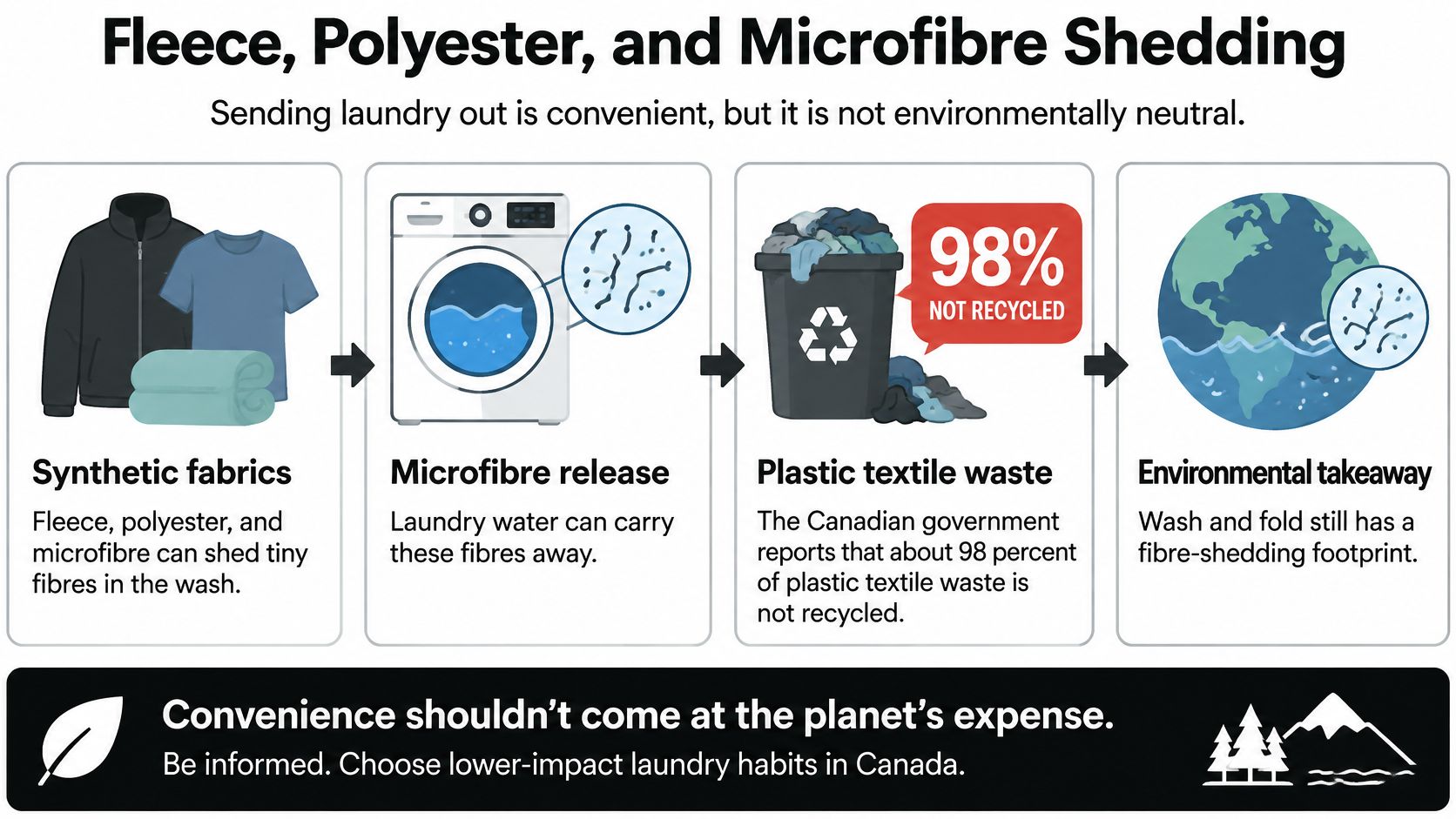
Outsourcing laundry doesn't remove its fibre footprint. The Government of Canada reports that approximately 98% of plastic textile waste ends up in landfills, while synthetic garments can release microfibres during washing. Landfill disposal and wash-water shedding are different problems, so addressing one doesn't resolve the other.
Fleece, polyester athleticwear and synthetic blankets deserve deliberate handling rather than an automatic high-throughput cycle. A reusable delivery bag is useful, but it doesn't tell you what happens to fibres inside the washer or dryer. Environmental claims need to reach beyond packaging.
Turn concern into handling instructions
For a bag dominated by synthetic clothing, discuss a lower-impact handling request before collection. These are practical questions, not assumptions that every service offers every option.
- Load size: Can compatible garments form a properly filled load without overloading the drum?
- Wash action: Can the service use a gentler programme that still removes the actual soil?
- Temperature: Is a cooler, label-compatible wash suitable for these items?
- Drying: Can the garments receive lower heat or an approved air-drying option?
- Detergent: What product suits the fabric and soil without unnecessary additions?
Don't pack incompatible items together merely to create a fuller load. Nor should a cooler wash become a reason to leave clothing inadequately cleaned. The objective is a suitable process with less unnecessary stress on the textile, not a single environmental setting for everything.
For blankets that leave fibres on surrounding clothing, On Pins & Needles Quilting Co.’s guide to stop blankets from shedding offers a useful starting point for assessing handling. Distinguish visible lint from microscopic fibre release, because a garment can shed fibres without leaving an obvious trail.
Convenience isn't an environmental guarantee
Drying choices deserve particular scrutiny when a service prioritises rapid machine turnover. A careful wash followed by unsuitable heat isn't a complete fibre-care strategy. Request handling that staff can provide, rather than relying on a general eco-friendly description.
For household budgeting, Statistics Canada reported that Canadian household electricity prices increased 15.0% between July 2020 and July 2024, so home washing and drying aren't cost-free either. That cost comparison doesn't establish which option has the smaller environmental footprint.
Outsourcing can save your evening. It still needs a thoughtful policy for shedding fabrics, garment longevity and eventual disposal.
Choose Wash and Fold for Everyday Clothes
Choose wash and fold when the care label permits washing and you want daily clothes returned folded for the drawer or wardrobe. It's a practical fit for repeat household loads and suitable small commercial textile loads, provided any special handling needs are agreed before collection.
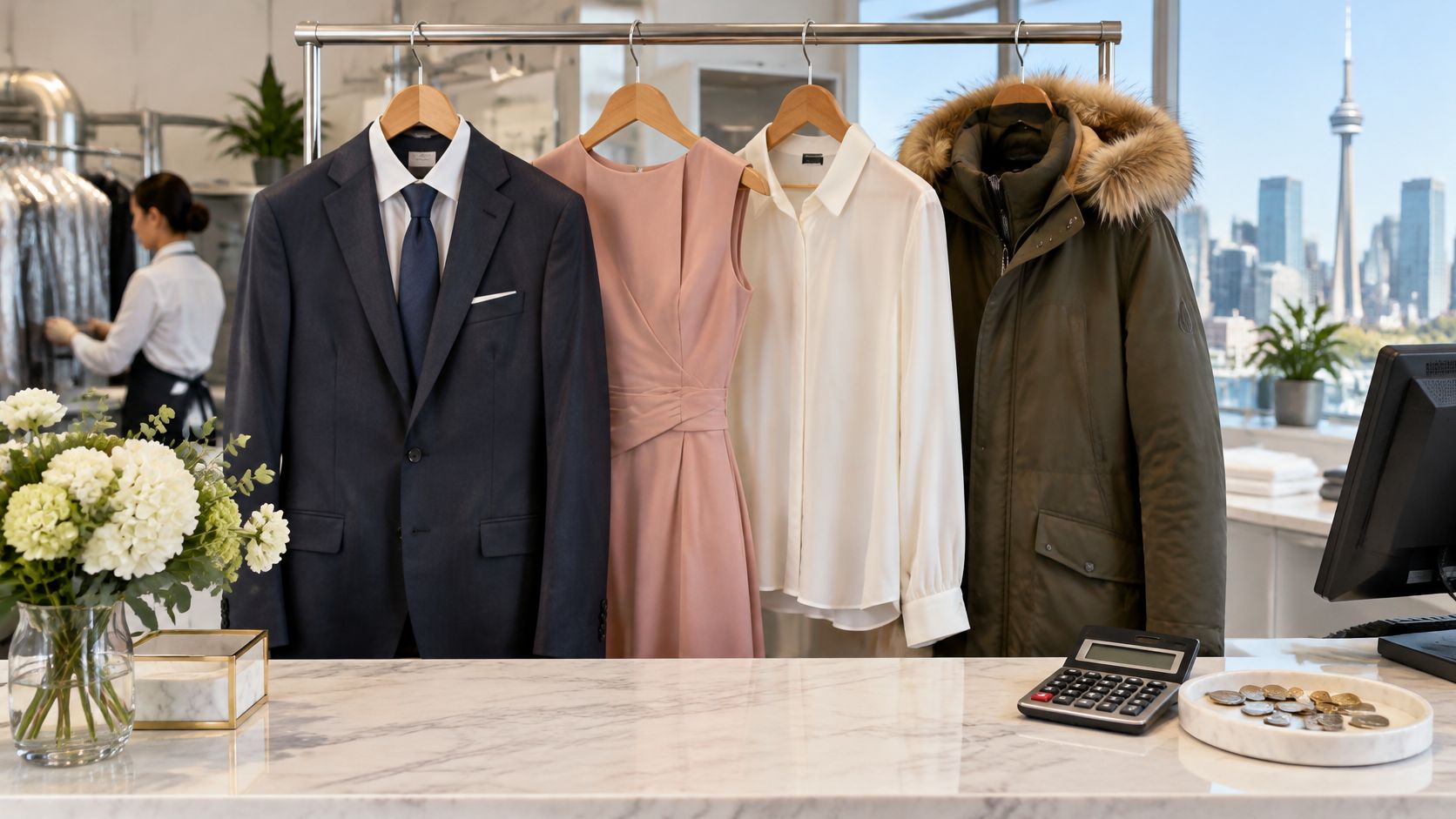
Choose another pathway when the required result is different. A jacket that needs a shaped finish, a dry-clean-only dress or textiles affected by fire or water shouldn't enter an ordinary household load. Our comparison of wet cleaning and dry cleaning helps explain why choosing a method involves more than deciding whether an item looks dirty.
Match the finish to the job
Our North York wash-and-fold price is $3.00 per pound, with folding included and pressing excluded. Laundered shirts receive a crisp press and can be returned folded or hung according to preference. That distinction matters if you need a shirt ready for a formal appointment rather than clothing ready to put away.
Before booking, make a simple fit check:
- Washable: The items belong in an everyday water-wash process.
- Documented: Scent sensitivities and separate-handling requests are written on the order.
- Ready for collection: Pockets are empty and the bag contains no valuables or unapproved specialist items.
Reusable bags and doorstep pickup make the handoff practical, but the result should remain clear: an intense wash and a tidy fold, not a pressed shirt.
CleanOnline, North York's Premium Dry Cleaners offers wash-and-fold care with doorstep pickup and return in reusable laundry bags. Visit CleanOnline, North York's Premium Dry Cleaners to schedule through the website or app, record your handling requests and prepare a bag of everyday washable clothes. If you book morning collection, leave the bag at your agreed doorstep location before 8 a.m.