How to Preserve a Wedding Dress for Years
Learn how to preserve a wedding dress: clean only when the fabric allows, pack it flat in acid-free materials, and store it cool and dark.

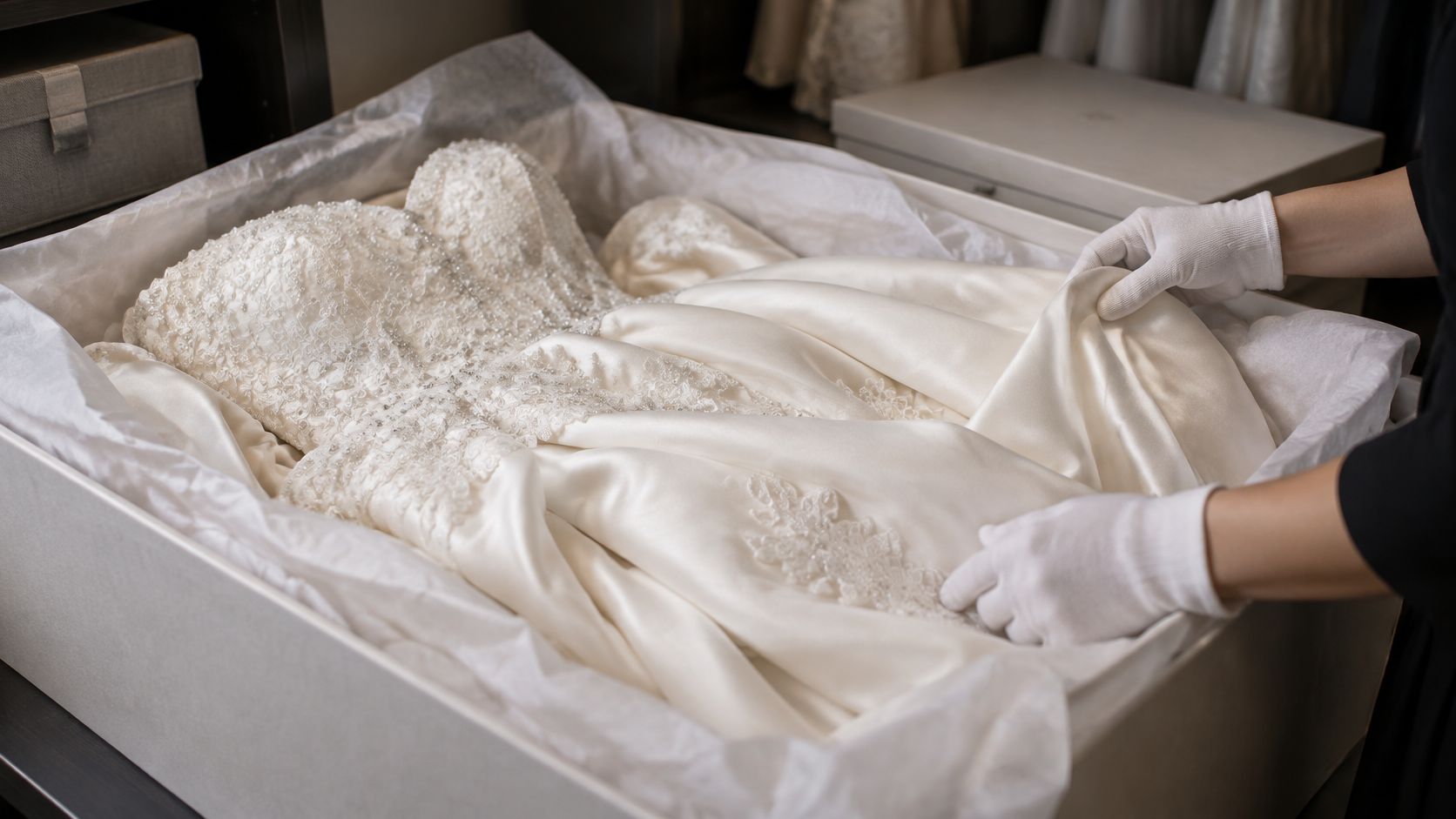
The most repeated advice about a wedding dress is a two-step recipe: get it cleaned the week after the wedding, then seal it in an acid-free preservation box. Both steps are worth taking. Neither is safe for every gown, and together they still don't decide whether the dress survives thirty years. A bias-cut silk with glued beadwork can be wrecked by the same routine solvent cycle that rescues a polyester satin ballgown, and the best box on the market will grow mould on a damp basement floor in a Toronto August.
Preservation is a material-specific risk check, then a room decision, then a container. The material check comes first because everything downstream depends on it: what the shell fibre is, how the trims are attached, whether the cloth is still strong. The room comes second because a box can only hold a microclimate, not fix one. The container is last and cheapest to get right.
Get the order right and what's left is maintenance twice a year.
Materials and Rooms That Keep a Gown Safe
Judge any kit, service or do-it-yourself plan against five conditions, and you can do it the same afternoon you buy the gown's storage. A gown has been stored properly when insect-attracting residue is gone, the fabric is completely dry including the lining and padded cups, the whole garment is supported rather than hanging from two seams, folds are few and padded, and both the container and the room stay chemically stable and dark. Fail any one of those and the packaging has failed, whatever it cost.
| Choice | Safe option | Avoid | Risk if skipped |
|---|---|---|---|
| Lining and interleaving | Unbuffered acid-free tissue or prewashed cotton sheeting | Coloured tissue, newspaper, regular paper | Dye transfer and acid yellowing |
| Outer container | Lidded archival box sized to limit folds | Ordinary cardboard, wood, sealed plastic against the fabric | Acid fumes, trapped moisture, mould |
| Folds | Accordion-pleated acid-free tissue or inert polyethylene pads | Sharp creases, adhesive tape, weight stacked on the box | Permanent creases and crushed beadwork |
| Room | Cool, dark, ventilated interior closet | Basement, attic, heating vent, fireplace, sunny window | Mould, fibre stress, fading |
| Support | Flat layers for bodice, skirt and train | Thin hanger for long-term storage | Shoulder distortion and seam failure |
The chemistry behind that table is simple. Ordinary paper, cardboard and untreated wood give off acids that migrate into whatever they touch, and fabric that has absorbed acid yellows from the inside. Plastic sheeting sealed against a gown traps whatever moisture was in the room that day. Neither problem is visible in the first year, which is why so many gowns come out of storage looking fine and then don't. The Canadian Conservation Institute's basic care guidance for textiles sets the same baseline: clean and dry, a cool dark ventilated location, flat storage where possible, minimal folds padded with acid-free tissue or muslin, and no regular paper, cardboard, wood products or adhesives in contact with the cloth.
The closet test for a Toronto apartment
A North York condo gives a clean test case. An interior closet, one that doesn't back onto an exterior wall, can work well: the box sits on a shelf or a plastic riser rather than on the floor, the door stays shut, and the space stays within a few degrees of the living room all year. A storage locker in the garage, a locker room off an underground garage, or a locker on a balcony does not work, even with perfect tissue inside, because those spaces swing with the weather and the humidity never settles.
Collectors in other fields reach the same conclusion. The reasoning behind how collectors store cinema posters safely is identical: neutral-pH interleaving, flat support, and a dark room, because the paper fails from acid and light long before it fails from handling.
Practical rule: if the box would make you uncomfortable storing a leather jacket, it's the wrong room for silk.
The packing sequence further down follows this order deliberately, because the cleaning decision comes before the box opens. Some trims should never be cleaned at all, and no amount of archival tissue rescues a gown that went through the wrong process. If you're deciding what the clean itself should involve, our explanation of the dry cleaning process covers where solvent, spot treatment and pressing each sit.
Which Gowns Should Not Get a Standard Clean
"Clean it before you store it" is the one instruction nearly every preservation guide gives without qualification. For a meaningful share of gowns it's the riskiest step in the whole plan. The Canadian Conservation Institute's guidance on washing non-coloured textiles advises against washing fragile, fragmenting or powdering textiles at all, and specifically against washing garments with linings or facings that may shrink, along with items containing beads, sequins, feathers, wool, silk or early synthetic fibres. Its separate guidance on solvents is just as specific in the other direction: dry cleaning suits greasy or oily stains, airborne soiling, soot, wax, tar and some paints, and that list is not the same as food, drink, dye transfer or perspiration.
Two lists, two different jobs. That's the whole argument against the automatic clean-and-box package.
Match the gown in front of you to a row before you agree to anything.
| Gown or soil | Prefer | Do not assume | Escalate when |
|---|---|---|---|
| Grease, soot, wax, tar, some paints | Solvent or dry cleaning after a test | Home spotters or heat | Colour bleeds or trim loosens |
| Food, drink, dye transfer, perspiration | Targeted treatment only if colourfast and sturdy | Dry cleaning removes every mark | Stain sits on silk, bias panels or linings |
| Beads, sequins, feathers, fragile trims | Document and test; often minimal or no wash | A standard wash or hard agitation | Pieces are loose, powdering or fragmenting |
| Linings and facings | Check shrinkage before any wet clean | Washing mixed or lined areas is harmless | Previous repairs or mixed fibres are present |
| Powdering or fragmenting textile | Leave untreated and stabilize | Any wash is safe if gentle | Fibre loss is already active |
What to put in front of a cleaner before you ask for a quote
A specialist can only make a good decision with good information, and most of it lives with you rather than on a care label. Bring these five things and the quote becomes a real assessment instead of a guess:
- Fibre of shell and lining. Silk, wool, acetate and early synthetics behave differently from polyester, and the lining is often the more fragile of the two.
- How the decoration is attached. Beads stitched through the ground fabric survive agitation that glued or heat-set sequins do not.
- Feathers, fur or fragile trim, including whether they're dyed, and whether the dye transfers onto a white cloth.
- Previous alterations, because stitching lines, fusible tape and let-out seams create weak points and mixed fibres.
- Where the makeup, wine, champagne and hem dirt landed, including spills you can't see on the day.
Photograph the front, back, stains, losses and repairs, and keep a written treatment record with the gown. That file earns its keep at insurance time, at resale, when the gown is handed to another family member, and when a conservator years from now needs to tell old damage from new.
Take a bias-cut silk gown with glued beadwork along the neckline. It should be photographed and spot-tested, not sent through a routine silk cycle, because the two failure modes are different: water can move the bias panels and shrink the lining, while solvent and agitation can lift the adhesive and leave a line of loose beads. Neither failure shows up until the gown is dry.
When to stop and call a conservator
Three signs end the standard process. Colour that moves from the trim into the ground fabric during a spot test. Trim that is already loose, lifting or crumbling. Active fibre loss, meaning the cloth sheds powder when you handle it. Any of those moves the job to a textile conservator, whose toolkit includes stabilization and support rather than cleaning alone.
Choose the treatment by the cloth in front of you, not by the price list. A cleaner who refuses a gown is giving you information worth having.
If you're weighing the two main routes, our comparison of wet cleaning vs dry cleaning explains what each method does to a fibre and where the boundary sits for lined and decorated garments.
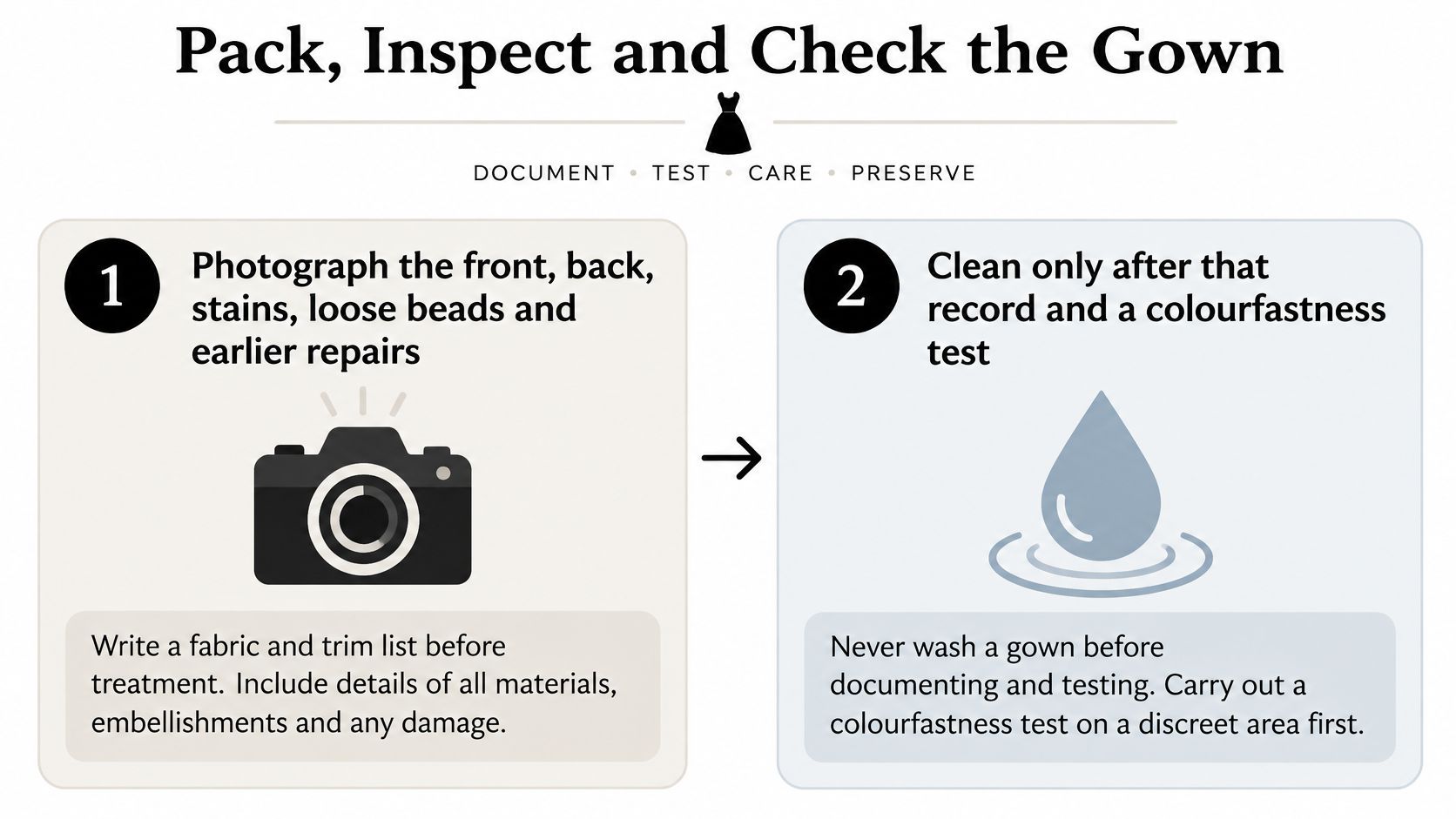
Pack, Inspect and Check the Gown
The sequence matters because each step protects the one before it. Work through it in order and the common failures close off one at a time.

- Photograph and list everything first. Front, back, hem, underarm, every mark, every loose bead, every earlier repair, plus a written note of shell fibre, lining fibre and trims. Without that record, nobody can later separate pre-existing damage from damage that happened in storage.
- Test colourfastness, then clean. An inconspicuous inside seam gets a damp white cloth and a gentle blot. If colour lifts, or the cloth is fragile or powdering, cleaning stops here and a conservator takes over.
- Dry the gown completely. Linings, padded cups, the hem facing and beadwork thread hold water longest. A closed box with damp inside is a mould chamber, and the gown's own weight is enough to keep a lining damp at the folds.
- Inspect seams, lace, beadwork and lining for mould or insects before enclosing. Perspiration, food and makeup residue attract insects, and the CCI's guidance for textiles and costumes treats professional cleaning and complete drying as the starting condition for storage, not a finishing touch. Any activity you find gets treated now, because a sealed box hides it perfectly.
- Line a lidded archival box sized to the gown. Prewashed cotton sheeting or unbuffered, acid-free, neutral-pH tissue. Undersized boxes force folds; oversized boxes let the gown slide.
- Lay the bodice and skirt in with as few folds as possible, and pad the ones you can't avoid. Accordion-pleated acid-free tissue or inert polyethylene supports stop a soft crease becoming a permanent one. Never tape, and never compress three-dimensional beadwork to make the lid close.
- Place the train and skirt in broad, gently padded layers, and keep the lid clear. Heavy objects stacked on the container press creases through everything underneath.
- Label the outside with the date, the known stains and the treatment record, then move the box to the room. The label saves the next person from opening the box out of curiosity.
Steps three and four are where most home attempts fail. A gown that went to the cleaner on Thursday and into the box on Friday still has damp in the bodice structure, and the same box that should have protected it becomes the reason a grey bloom appears along the fold lines by spring.
The one case where hanging is acceptable
For heavily beaded, structurally weak or very full gowns, hanging is the single biggest avoidable risk. The CCI's note on hanging storage for costumes points out what gravity does over years: the gown's weight concentrates at the shoulder seams and the whole garment distorts, sometimes to the point of seam failure. Flat storage avoids that entirely, which is why a lidded box beats a hanger for anything beaded or heavy.
Temporary hanging has one defensible version. Use a broad, padded support rather than a wire or narrow wooden hanger, stuff the sleeves with crumpled unbuffered acid-free tissue to take the strain off the shoulder line, keep the garment inside a closed cupboard, and cover it with prewashed cotton rather than plastic. That's for a move or a fitting, not for a decade.
Before the lid goes on for good, put the photographs, the cleaning paperwork and the material list in an envelope taped to the outside. A conservator reading that file in twenty years can tell what was already there. If you want the cleaning side explained before the box comes out, our guide to how to clean a wedding dress walks through the stains worth naming at intake.
What done looks like: lid on, nothing plastic touching the silk, no weight on top, and tissue that is still white and dry at the next inspection.
The twice-yearly check
Open the box twice a year, in spring and again in early autumn when the indoor air changes. Look for odour, insect activity, damp patches, new staining and folds that have pressed themselves in. Run a pH pen over a corner of the tissue: if it reads acidic, replace it. Refold along slightly different lines so no crease sets permanently in one place, and rehouse the gown completely if the container has taken on moisture or a smell.
One caution about shopping. A commercial "preservation box" is a purchase, not an outcome, and the CCI's specification is about neutral-pH materials, adequate dimensions, minimal folds and periodic inspection, not a brand. Nothing in the Canadian guidance sets a guaranteed lifespan for a stored gown, so a service promising "guaranteed preservation" or a fixed number of years is guessing. If a provider tells you that opening the box voids the guarantee, ask what the guarantee covers.
Climate and Light Limits for a Toronto Closet
A good box cannot correct a poor room. In a Toronto home, a gown's storage risks depend on humidity, temperature swings and light, so choose the closet before choosing the container.
The Canadian Conservation Institute's note on textiles and their environment explains how quickly damp conditions can become unsafe: at 70% relative humidity, mould may take three months or more to develop; at 90%, it can appear within a few days. A basement, garage or humid closet is therefore a poor choice for long-term storage.
| Condition | Typical benchmark | What it means for a gown |
|---|---|---|
| Relative humidity near 70% | Mould may take three months or more to develop | Too damp for long-term textile storage |
| Relative humidity near 90% | Mould can appear within a few days | Avoid storing the gown there |
| Visible light | At most 150 lux; lights off when unused | Fading may occur over time |
| Dimmer light for sensitive trims | About 50 lux; darkness is preferable | Lower exposure reduces fading risk |
| Ultraviolet | No higher than 75 microwatts per lumen | Can fade dyes and weaken fibres |
| Placement | Away from windows and exterior walls; raised off cold floors | Helps limit temperature swings and condensation |
Textile fibres take up and release moisture as room conditions change. A damp spring followed by dry, heated winter air can stress fibres and affect dyes, glued trims and metal beads. Acid-free tissue helps with contact and folds, but it does not control the room's humidity.

Light exposure is cumulative. The CCI's precautions for storage areas recommends keeping storage lighting at or below 150 lux, with ultraviolet at or below 75 microwatts per lumen, and switching lights off when the room is not in use. Sensitive trims call for dimmer light, about 50 lux, or darkness where possible. Fading cannot be reversed, so a window-facing shelf is a poor display spot even if the gown is boxed.
Where the box actually lives
Under-bed storage in a condo may suit a gown if the box is raised off the floor, the bed is away from a sunny window and the area stays dry. Stable room conditions matter more than a costly container: a box cannot make a damp room safe. For another example of how room conditions affect stored belongings, see the TLC Moving & Storage furniture guide.
A basement bin is a poor choice when the air feels damp or smells musty. That odour can be a warning sign of a moisture problem; the guide to removing musty smells from clothes explains why the smell may appear after the underlying issue has begun.
The CCI's storage precautions also recommend keeping stored items away from windows and exterior walls, and raised above cold floors. These simple placement choices reduce exposure to sunlight, temperature changes and possible condensation.
Display is a different job from storage
A gown on a padded form in a lit room is on display, not in storage. Each viewing adds light exposure and handling. If you choose to display it, keep it out of direct sun and return it to a dark, suitable storage space afterward.
Practical rule: If you can see the gown from the sofa, it is on display. Limit the viewing time and protect it from direct light.
Book a Clean Before the Stains Set
The day after the wedding is a practical time to arrange cleaning. Champagne, white wine, clear soda, body oils and foundation can mark a gown; some stains are hard to see at first and may become more difficult to remove over time. Prompt stain treatment can make the cleaning job simpler.
CleanOnline charges $180.00 for wedding dress dry cleaning and $250.00 for multi-layered or embroidered gowns. The service includes stain removal, cleaning with green earth solvents and storage in an acid-free airtight box with a display window. The box can also hold the veil, shoes and bouquet.
What the box does and doesn't do
A display window makes it easier to inspect a gown, but it does not control the room around it. Keep the box in a cool, dark, ventilated closet, raised off the floor and away from a window. The window is for viewing, not for leaving the gown in daylight. If the fabric has beads, feathers, glued trim or powdering areas, mention them when arranging service so the gown's care can be considered before cleaning.
Packaging and cleaning are separate choices in the wider market. For example, a Canadian provider's 2025 gown-preservation quote page lists a muslin-wrapped museum-grade kit at CAD 350 and a platinum acid-free memory box at CAD 250. A box can support storage after cleaning; it cannot remove stains or replace suitable room conditions.
Price the cleaning and the storage materials as distinct parts of the decision. The guide to wedding dress cleaning costs explains what affects the price.
Preservation is a material-specific risk check, not a lifetime guarantee. Cleaning and boxing help, but the room, how the gown is folded and periodic checks also affect its condition.
CleanOnline, North York's Premium Dry Cleaners, sorts garments by fabric, colour and soil level, removes spots, then cleans wedding gowns with green earth solvents. The gown is stored in an acid-free airtight box with a display window that can also hold the veil, shoes and bouquet. Wedding dress dry cleaning costs $180.00, or $250.00 for multi-layered or embroidered gowns. Customers can drop off a gown the day after the wedding to address stains promptly. Visit CleanOnline, North York's Premium Dry Cleaners to arrange service.