Wet Cleaning vs Dry Cleaning: Which to Choose in 2026
Wet cleaning vs dry cleaning compared by process, fabric suitability, stain handling and care labels, so you can pick the right method for each garment.

“Choose wet cleaning because it's greener” is incomplete advice. So is “follow the care label and you can't go wrong.” A cleaning method can reduce solvent exposure yet demand more drying energy, and a permitted process can still damage an ageing lining or an unstable trim.
The useful question in wet cleaning vs dry cleaning is narrower: which process will remove this garment's soil without shortening its useful life, and what resources will the cleaner use along the way? Neither method wins everywhere. Fabric, construction, stain chemistry and finishing all belong in the decision.
Wet Cleaning vs Dry Cleaning at a Glance
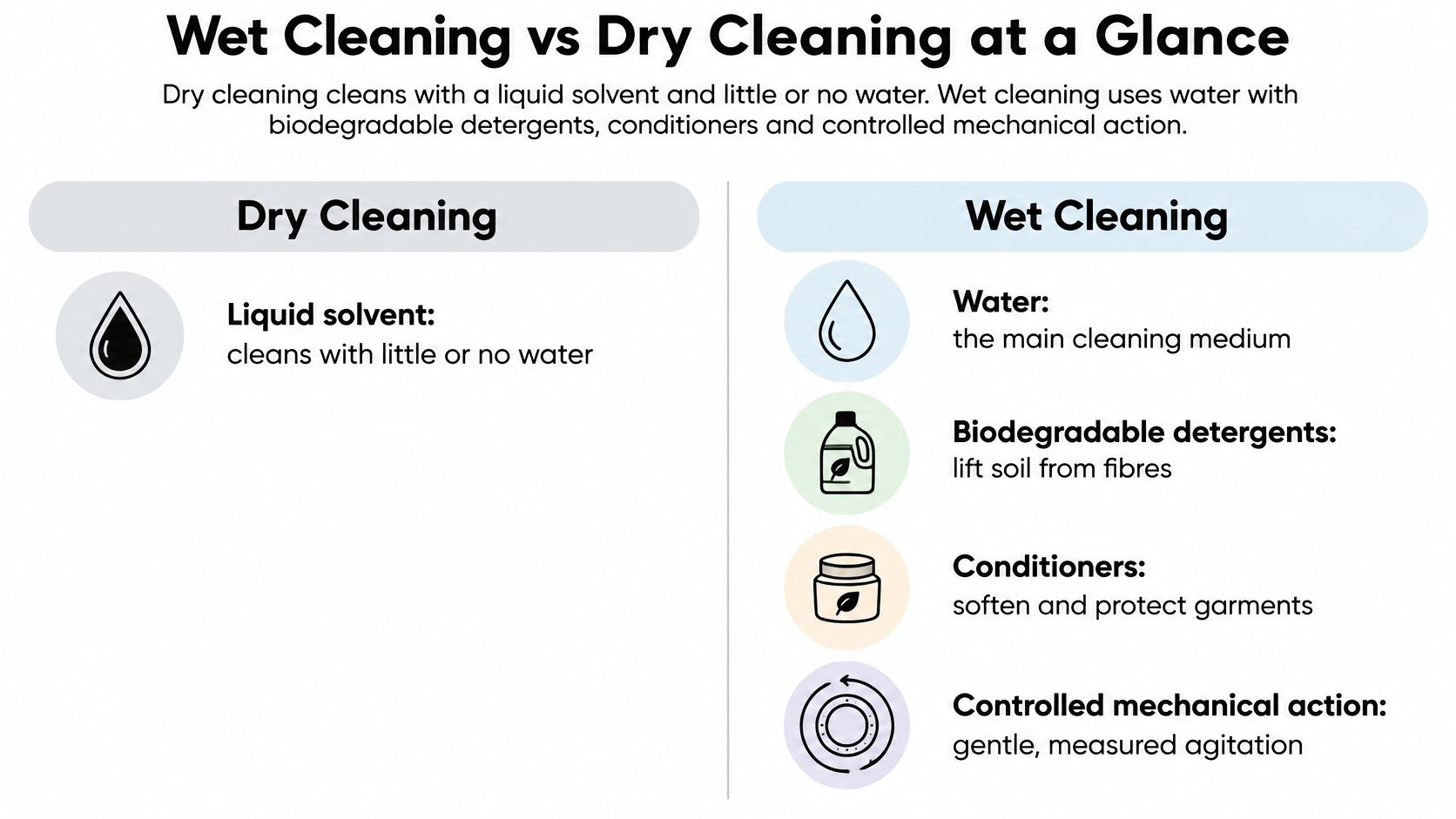
Dry cleaning uses a liquid solvent with little or no water. Wet cleaning uses water, biodegradable detergents, conditioners and controlled mechanical action, as described in Toronto's professional wet-cleaning demonstration. “Dry” describes the cleaning medium, not the absence of liquid.
Wet cleaning and dry cleaning compared by key factor
| Factor | Dry cleaning | Wet cleaning |
|---|---|---|
| Cleaning agent | Liquid solvent, such as hydrocarbon, liquid carbon dioxide or silicone | Water with biodegradable detergents and conditioners |
| Machine process | Solvent wash, solvent recovery and controlled drying | Computer-controlled water wash, moisture extraction and low-heat drying |
| Best suited to | Structured tailoring, wool coats, silk, velvet and assessed embellished formalwear; leather needs specialist handling | Washable shirts, cottons, uniforms and linens validated by testing |
| Shrinkage and dye risk | Avoids many water-related risks, but isn't risk-free | Requires careful testing and control of temperature, agitation and drying |
| Stain approach | Usually favours oily and greasy soils | Usually favours water-soluble soils |
| Finishing | Pressing and steam finishing | Pressing after controlled drying; starch where appropriate |
| Care-label symbol | Circle with A, P or F | Circle with W |
Dry cleaning doesn't automatically mean perchloroethylene, commonly called PERC or perc. Hydrocarbon, liquid-carbon-dioxide and silicone systems are also part of the garment-care field; we use solvents such as liquid silicone in our dry-cleaning service.
Professional wet cleaning isn't just a household wash with a gentler programme. The cleaner selects detergents, mechanical action, moisture extraction and finishing for the garment, rather than relying on a general-purpose cycle.
Practical rule: Compare the actual process, not just the service name. A carefully controlled wet-cleaning cycle and an ordinary machine wash aren't interchangeable.
The table gives useful defaults, not permission to put every silk blouse into solvent or every cotton garment into water. A cotton jacket with bonded interlining may need a different approach from an unstructured cotton shirt.
How Each Process Cleans Your Clothes
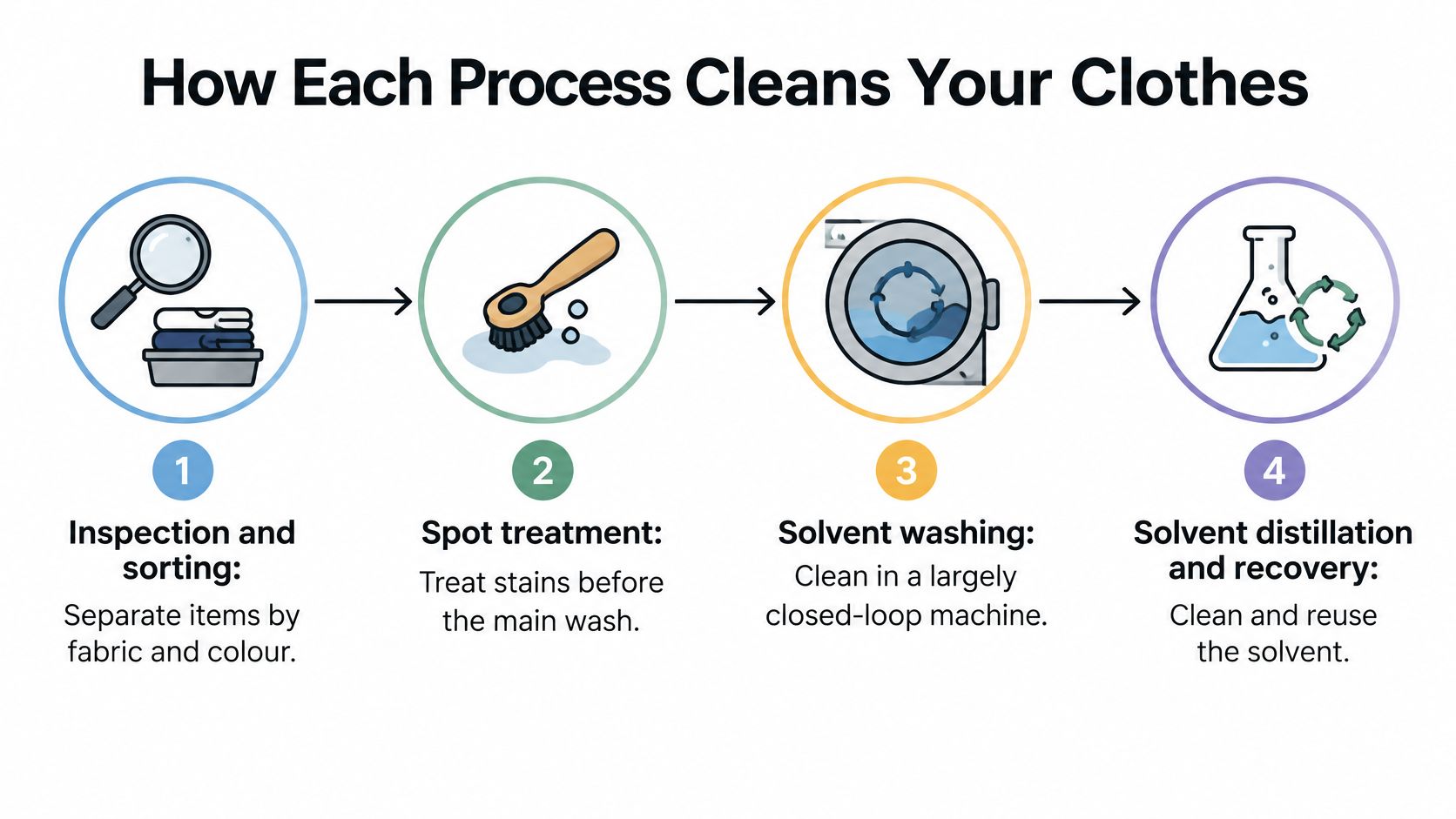
A competent cleaning cycle starts before the machine runs. The cleaner examines the garment, separates items by fabric and colour, identifies vulnerable components and assesses the soil. That inspection determines whether the main cleaning process can proceed safely or needs modification.
The solvent route
Dry cleaning generally follows this sequence:
- Inspect and sort: Separate incompatible fabrics, colours and soil levels, and identify existing damage.
- Treat individual stains: Apply appropriate spotting agents before the main cycle rather than expecting the solvent bath to remove everything.
- Wash in solvent: Clean in a largely closed-loop machine that manages the cleaning liquid.
- Recover and dry: Remove solvent from the garment, recover it for reuse and complete controlled drying before pressing.
Solvent cleaning is useful where aqueous swelling could disturb the garment's dimensions or construction. It doesn't remove the need for judgement: dyes, surface finishes and trims still need assessment, and the drying stage must suit the item.
The process must also be distinguished from the particular solvent. California's dry-cleaning regulatory history established January 1, 2023, as the deadline for removing remaining PERC machines, illustrating why “dry cleaning” and “PERC cleaning” aren't equivalent terms.
The water-based route
Wet cleaning begins with the same inspection and soil assessment, but the cleaner then chooses a fibre-appropriate detergent and water programme. Pre-spotting addresses concentrated stains; conditioning and controlled mechanical action help manage the fabric during cleaning.
Moisture extraction comes next, followed by carefully controlled drying or tumbling. The cleaner must decide how much moisture to remove mechanically, how much heat the garment can tolerate and what finishing will restore its intended shape.
Drying isn't an afterthought. A suitable wash programme can still produce a poor result if the garment is over-dried, handled roughly or pressed incorrectly.
Laundering is a water-based process, while dry cleaning uses non-aqueous solvents rather than wetting clothes with water as the principal cleaning medium. Professional wet cleaning adds garment-specific controls that ordinary laundering may not provide.
Before handing over a difficult item, establish what solvent or detergent will be used and how the garment will be dried. Those answers reveal more than a “gentle cleaning” description on a sign.
Reading Care Labels for Wet or Dry Cleaning
Treat the care label as the first filter, not a complete diagnosis. It describes the manufacturer's care guidance, but it can't account for every stain treatment, previous repair or change in the garment's condition.
Read the whole label rather than isolating a single symbol. Any restrictions accompanying a cleaning symbol also matter.
Care label symbols and what they mean for the choice
| Symbol | Label meaning | What it means for your choice |
|---|---|---|
| Circle with A | Any solvent permitted under that care instruction | Dry cleaning is acceptable; wet cleaning needs separate assessment |
| Circle with P | Perchloroethylene or suitable hydrocarbon solvents | Dry clean within the stated restrictions; establish which solvent is used |
| Circle with F | Petroleum-based solvent cleaning | Request compatible hydrocarbon cleaning rather than substituting water |
| Circle with W | Professional wet cleaning permitted | Wet cleaning is an option within any stated restrictions |
| Crossed-out circle | Do not dry clean | Avoid solvent dry cleaning; check whether a water-based process is permitted |
| Tub with hand | Hand washing instruction | Don't assume a machine wet-cleaning programme is equivalent |
| Crossed-out tub | Do not wash | Avoid ordinary water washing; obtain professional assessment of the remaining instructions |
A W symbol provides clear guidance for professional wet cleaning. Its absence doesn't prove that water-based treatment will fail, but it isn't permission to experiment at home with a dry-clean-only garment.
What the symbol can't settle
A cleaner should inspect more than the outer fabric:
- Fibre blend and interlining: Components may respond differently to moisture and drying.
- Dyes and coatings: Test vulnerable colours and surface treatments.
- Buttons and trims: Check attached decorations and their method of attachment.
- Previous damage: Note weak seams, repairs, worn areas and earlier staining.
Toronto Public Health's review of alternative cleaning technologies recognises that different technologies suit different materials. That distinction matters more than treating one permitted method as universally preferable.
For household textiles, our guide to cleaning heavy drapes provides a related starting point. Drapery, like clothing, needs assessment as a complete item rather than as an isolated piece of fabric.
An old or repaired garment deserves closer inspection. Its original label won't describe a replacement lining, altered hem or weakened decorative panel.
Which Fabrics Suit Each Method
Construction can outweigh fibre content. Water-related swelling and dimensional change matter particularly in structured, dye-sensitive or adhesive-bonded garments, while solvent compatibility matters for coatings, trims and finishes.
Use the following matches as screening guidance. “Usually better” means the method worth considering first, not a guarantee that every item in that category can tolerate it.
Suitable cleaning method by fabric and garment
| Fabric or garment | Usually better method | Main risk | Check first |
|---|---|---|---|
| Cotton shirts | Wet cleaning | Residual stains and dimensional change | Colourfastness of dyed or printed areas |
| Linen | Wet cleaning when permitted | Creasing and shrinkage during drying | Washable finish and care restrictions |
| Polyester and synthetic blends | Either, after assessment | Heat damage and dye migration | Heat limit, coating and blended fibres |
| Wool suits and coats | Dry cleaning | Felting, distortion and lining damage | Construction and whether wet care is permitted |
| Washable wool knits | Wet cleaning | Shrinkage from unsuitable agitation or heat | Wool-safe programme and drying method |
| Silk | Often dry cleaning | Water marking, dimensional change and altered lustre | Washable designation and dye stability |
| Rayon and viscose | Often dry cleaning | Swelling and distortion when wet | Permission for wet treatment |
| Velvet | Often dry cleaning | Crushed pile and water marks | Fibre content and specialist pile handling |
| Leather and suede | Specialist cleaning | Stiffening, staining and finish loss | Finish type and attached trims |
| Structured tailoring with fused interlining | Often dry cleaning | Adhesive failure and loss of shape | Interlining, padding and bonding |
| Denim and fleece jackets | Either, after assessment | Dye transfer and trim damage | Colour stability, lining and fastenings |
| Embellished formalwear | Often specialist dry cleaning | Loose decorations and adhesive damage | Beads, sequins, glue and finishing needs |
| Bedding, drapery and rugs | Wet cleaning where construction permits | Shrinkage, fill distortion or backing damage | Filling, backing, lining and drying capacity |
The exceptions deserve the attention
A washable wool knit and a wool coat with custom fit shouldn't be routed together just because both contain wool. The knit may tolerate a controlled water process, while the coat's lining, shoulder structure and interlining introduce additional risks.
Silk also needs a garment-level decision. A washable silk item doesn't justify wet cleaning a contrasting-colour silk dress with unstable dye or delicate embellishment.
Leather and suede require specialist handling in either route. Don't interpret their appearance in a dry-cleaning service list as permission for a standard solvent cycle.
Our special-fabric dry-cleaning service covers leather, silk, rayon and velvet. We also clean outerwear including jackets, coats, sweaters, overalls, woollens, denim and fleece jackets, with the item's construction remaining part of the choice.
Preserving the intended shape and finish is part of cleaning successfully. Removing the soil isn't enough if the garment no longer fits.
Bulk alone doesn't make wet cleaning suitable. A large washable blanket differs from a backed rug or lined curtain, even when the machine can accommodate both; sporting textiles bring their own construction concerns, as our guide to washing hockey gear discusses.
For uncertain fabrics, testing should precede the decision. The least conspicuous area is preferable, but a test still needs to represent the vulnerable material or trim.
How Each Method Handles Stains
Water-soluble soil generally favours water-based treatment; oily soil generally favours solvent treatment. That's a starting point for stain removal, not a promise that either full cleaning cycle will remove every component without pre-spotting.
Coffee with cream, salad dressing and foundation aren't chemically simple stains. Their different components may need different treatments before the cleaner selects the main process.
Stain type and the method that usually responds better
| Stain | Usually better method | Reason | Caveat |
|---|---|---|---|
| Coffee and tea | Wet cleaning or water-based spotting | Water-soluble components | Prompt treatment is preferable; the fabric must tolerate it |
| Red wine | Wet cleaning or targeted pre-treatment | Water-responsive staining components | Dye stability can restrict treatment |
| Oil, butter and salad dressing | Dry cleaning | Solvent-compatible oily components | Dressing may also contain water-soluble ingredients |
| Ballpoint ink | Specialist spotting, sometimes followed by dry cleaning | Ink formulations can contain solvent-responsive components | Don't assume every ink behaves alike |
| Makeup and foundation | Pre-spotting, often followed by dry cleaning | Oil and wax components | Pigment may require separate attention |
| Blood | Cold-water treatment where permitted | Protein-based soil needs careful temperature control | Avoid hot treatment |
| Sweat and deodorant | Wet cleaning with appropriate pre-treatment | Salts and mixed residue | Antiperspirant build-up may need additional work |
| Mixed or unknown stain | Assessment and pre-spotting first | More than one treatment may be needed | Describe its origin and any attempted treatment |
What to do before the cleaner receives it
The safest immediate action depends on the garment, not just the spill. Don't rinse a water-sensitive silk or structured jacket merely because the stain would normally respond to water.
- Blot gently: Use a clean cloth without scrubbing the stain into the fabric.
- Use cold water only when permitted: A washable item may tolerate rinsing; a restricted-care garment needs professional advice.
- Avoid improvised treatments on delicate finishes: Powders, solvents and stain-removal mixtures can complicate treatment.
- Keep it away from heat: Don't iron or tumble-dry a stained item before assessment.
- Record what happened: Tell the cleaner what spilled, approximately when, and what you've already applied.
Stain-removal priority: Preserve the cleaner's options. Aggressive home treatment can create another problem alongside the original stain.
Our cleaning process includes sorting by fabric, colour and soil level, spot stain removal, selecting custom detergents, repairs as needed, pressing and folding. Those preparatory steps matter because the machine cycle isn't the entire treatment.
For an unknown stain, resist choosing the process yourself. Let the cleaner assess the soil and garment together, pre-spot where appropriate, and then choose the main cleaning route.
Water, Energy and Waste Trade-offs
Wet cleaning isn't automatically greener across every environmental measure. It can reduce reliance on conventional cleaning solvents while changing water, electricity, natural-gas and wastewater demands.
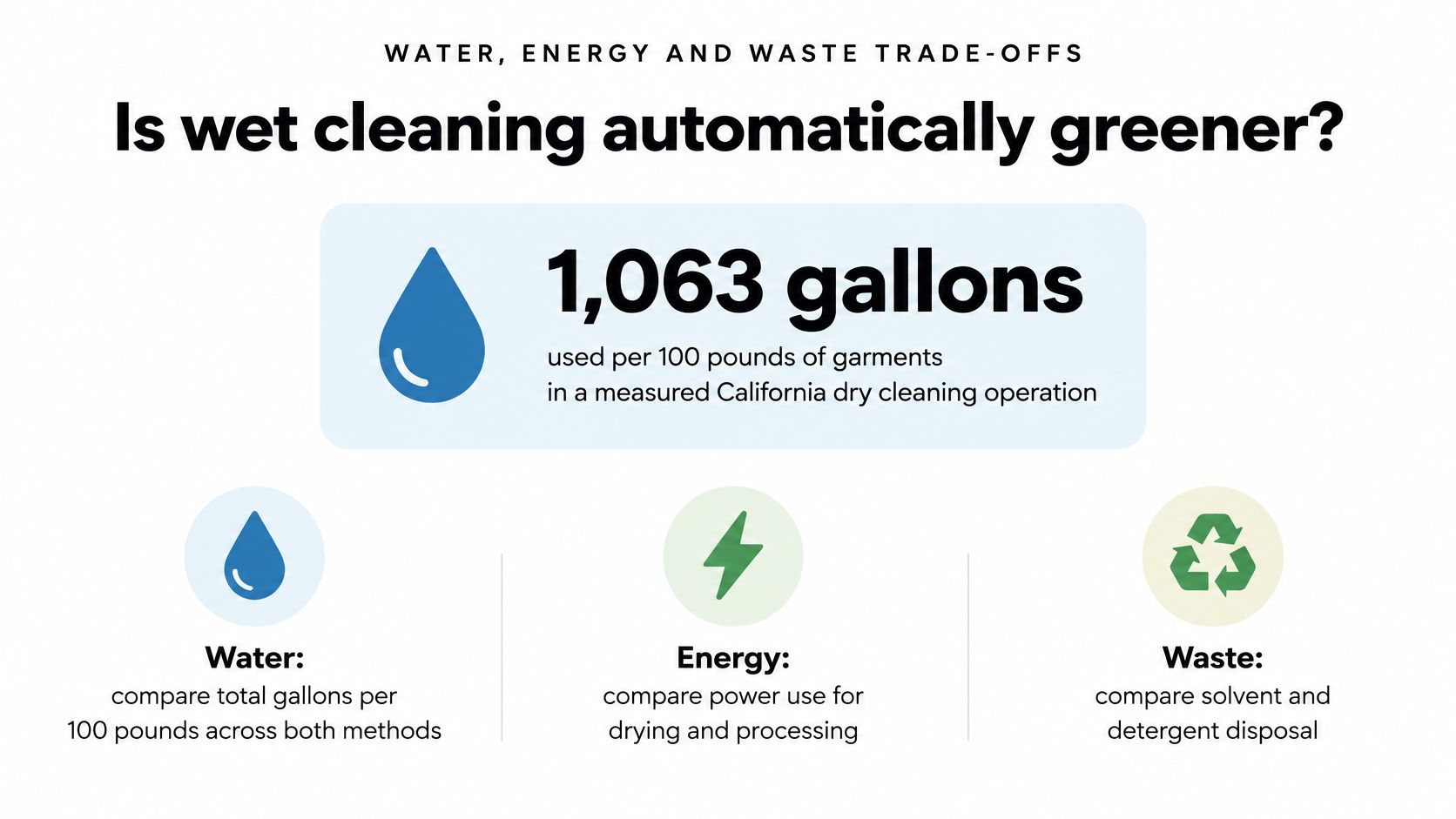
A California comparative wet-cleaning report reported approximately 1,063 gallons per 100 pounds of garments for dry cleaning versus 308 gallons for wet cleaning, about 71% less water in that comparison. The apparent contradiction disappears when the boundary includes cooling, steam generation and related equipment rather than only the liquid inside the cleaning drum.
Energy savings can come with a gas trade-off
Toronto's pollution-prevention guidance reports an Environment Canada benchmark in which wet cleaning used 75% less electricity but 43% more natural gas; a separate UCLA comparison cited there found 24% less electricity and 23% more natural gas. Those are different comparisons, not interchangeable predictions for every cleaner.
The Toronto demonstration cited earlier also found greater water and natural-gas use alongside lower electricity use. That doesn't invalidate the California result; it shows why equipment, operating conditions and measurement boundaries matter.
A useful comparison should establish:
- What was measured: The cleaning machine alone or the complete operation, including solvent recovery and finishing.
- How machines were loaded: Underfilled cycles can distort a per-garment comparison.
- How drying was controlled: Extraction, moisture targets and drying temperature affect resource demand.
- Which energy sources were used: Local electricity generation and gas use influence the environmental judgement.
Wastewater and garment life belong in the calculation
Wet cleaning isn't chemical-free. Detergents and conditioners remain part of the process, and Toronto's dry-cleaner and commercial-laundry pollution-prevention requirements address wastewater contaminants including nonylphenols and nonylphenol ethoxylates.
The earlier Toronto demonstration found its wastewater met applicable sewer-bylaw requirements. That's evidence about the demonstrated operation, not proof that every water-based process has negligible wastewater impact.
Fibre shedding also belongs in the assessment, especially when comparing professional cleaning with repeated home washing. Without operation-specific measurements, neither “no solvent” nor “uses recycled solvent” establishes a complete environmental result.
The business calculation is similarly broader than the ticket price. Our dry cleaning starts from $3.00, but item type and required treatment determine the relevant service; labour, drying, rework and the risk of damage also matter.
A well-managed solvent process may sometimes compare favourably with repeated home washing on water use or fibre release. A poorly managed wet process can still leave a wastewater footprint, and either method can become wasteful if unsuitable treatment shortens the garment's life.
Choosing the Right Method for Your Garment
Run through these questions before selecting a service:
- What does the complete label permit? Include restrictions, not just the main cleaning symbol.
- What is the garment made from and how is it built? Consider linings, bonding, coatings and trims.
- What is the stain, and how long has it been there? Include any home treatment.
- Is the item structured, embellished or irreplaceable? The consequences of a poor result should influence the level of assessment.

Match the service to the situation
For routine washable household clothing and commercial linens, water-based cleaning is usually the practical starting point. Sort the exceptions out first rather than expecting a bulk load to accommodate a delicate trim, unstable dye or restricted-care item.
For a structured dry-clean-only garment, begin with professional solvent-cleaning assessment. Embellished formalwear needs additional scrutiny because an appropriate cleaning medium doesn't automatically make the decorations or adhesives safe.
An unknown or mixed stain calls for diagnosis before process selection. Refer to the fabric and stain tables together rather than letting either one decide the outcome alone.
For a bridal gown, cleaning and preservation are separate requirements. Our wedding-dress service includes stain removal, dry cleaning with GreenEarth solvents, and preservation in an acid-free airtight box with a display window; storage requirements therefore belong in the service discussion from the beginning.
Settle the handling and timeline before collection
Request an appropriate hidden-area test where uncertainty remains, recognising that no small test can guarantee the behaviour of every component. Then establish the treatment plan:
- Process and cleaning agent: Which route will be used, and what solvent or detergent is involved?
- Drying and finishing: How will the cleaner protect the item's dimensions, texture and shape?
- Collection and timing: Can the required assessment and treatment fit the deadline?
We provide doorstep pickup and delivery, and same-day dry cleaning is available on special request for urgent needs. Our guide to how long dry cleaning takes can help with planning, but an urgent deadline shouldn't override a difficult garment's handling requirements.
The best choice isn't the method with the simplest environmental claim. It's the suitable process, competently controlled, that removes the soil and keeps the item useful.
For dry cleaning, shirt laundering, wash-and-fold laundry or specialist garment care, visit CleanOnline, North York's Premium Dry Cleaners to review services and arrange pickup. Include the care-label details, stain history and any deadline with your enquiry so we can discuss the appropriate service before collection.
Prepared with Outrank tool