Dry Cleaning Process from Drop-Off to Pickup
Follow the dry cleaning process from inspection and stains to solvent recovery, pressing and pickup, including Canadian solvent rules.


You've got a navy wool blazer on a hanger by the door, a lunch stain on the lapel, and a North York pickup window that closes before you finish work. The care label shows a circle, so the maker wants a solvent clean, not a spin in your washer. What happens after the counter is a sequence of checks, not a magic bath.
The dry cleaning process is garment care in a closed solvent system. Water would felt that wool and pull the canvas inside the shoulders out of shape. Solvent lifts oil without soaking the cloth, then the plant has to get that solvent back out of the garment and back into a tank. You still control the first clues: the fibre, the stain, and anything that might snap.
Six Stages of the Dry Cleaning Process
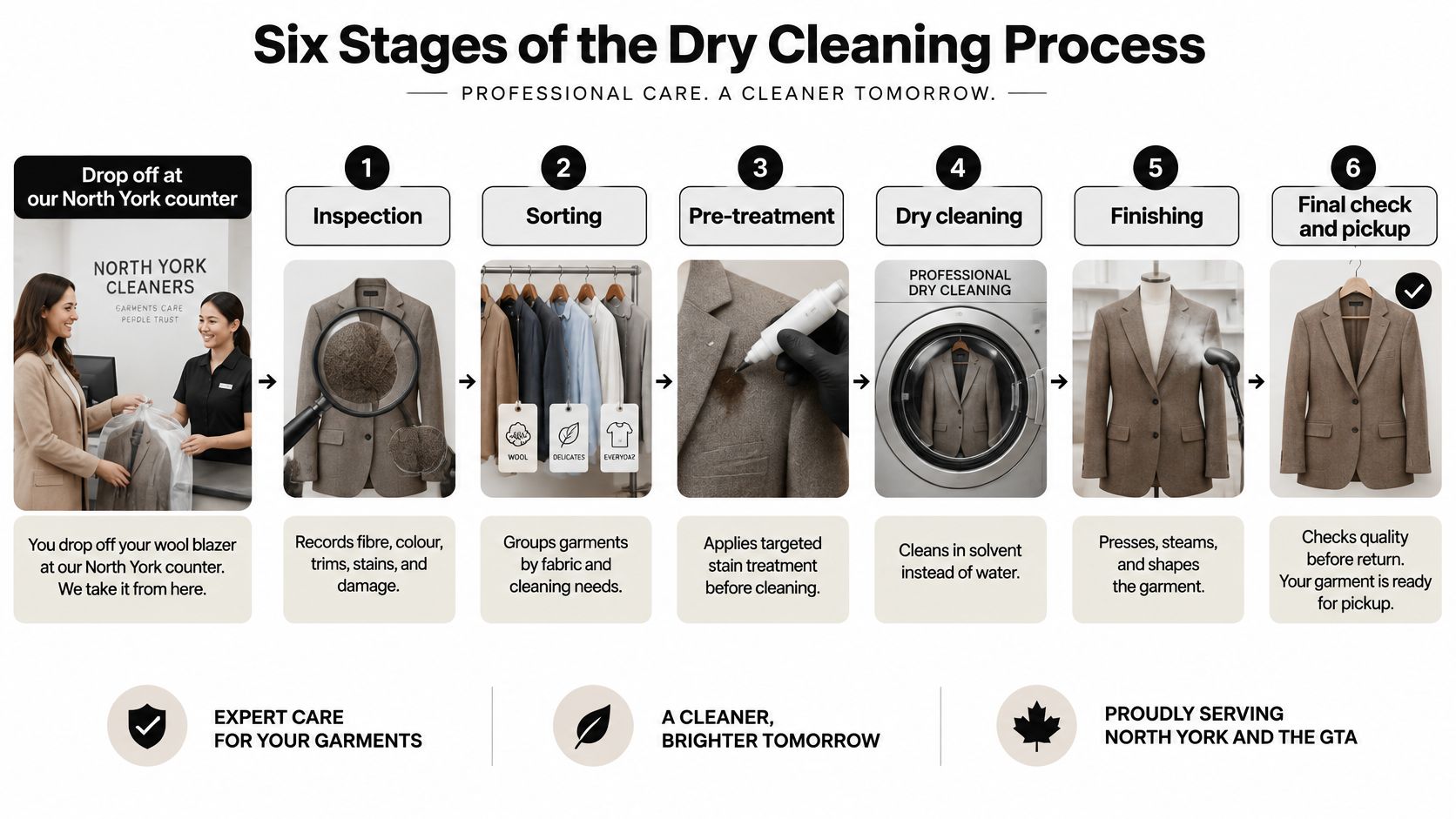
Six separate checks stand between the counter and the collection rack, and most of them exist to control one thing: the solvent that does the actual cleaning. Ordinary pieces are usually returned on a standard turnaround, and same-day dry cleaning is available on special request for urgent needs. Leather, wedding gowns, and bulky household textiles leave this standard path and are handled on their own cycles.
| Stage | What happens | What is checked |
|---|---|---|
| 1. Inspection | Fibre, colour, trims, care label and existing damage recorded | Tears, loose buttons, beads, linings, prior repairs |
| 2. Sorting | Loads grouped by fabric, colour and soil | Dye transfer risk and whether the piece can share a wheel |
| 3. Stain treatment | Visible marks pre-spotted by stain family | Oil, protein, tannin or dye, and whether heat would set the mark |
| 4. Machine cycle | Solvent wash, extraction, drying and aeration | Solvent recovery, load size and cycle length |
| 5. Finishing | Steam, press and small mends | Collar roll, pleats, hems, buttons and pile |
| 6. Collection | Hanger bag or doorstep bundle | Odour, missed stains, shape and that the right garment returns |
What you still control
Inspection creates the written record: fibre, colour, trims, the care label, and any damage already there. That record also decides whether the piece can go into a solvent bath at all. You help by naming the fibre and pointing at the stain. Out of sight, the note stops a later hole from being blamed on the cycle.
Sorting groups the load by fabric, colour, and soil level, because every garment in the wheel shares the same solvent. One bath has to suit them all, so pale silk never runs with oily workwear. You do decide whether a heavily soiled coat is flagged before it sets the cycle for everything else.
Stain treatment happens on the board, before the bath. Solvent lifts grease well, but many water-based marks survive it, so each visible stain gets its own agent first. Your job is naming the spill. The plant's job is choosing the chemistry.
The machine washes in solvent rather than water, then extracts, dries, and aerates while the solvent is recovered for reuse. You never see the tank. You can still check the result: a garment that comes back smelling of chemicals has not been fully dried.
Finishing restores shape with steam and pressure once the solvent is out. Collar roll, pleats, and hems go back in place, and a loose button can be tightened before a hard crease locks a fault in.
Collection is a hanger bag at the counter or a pressed bundle at the door. Check odour, missed stains, shape, and that the right garment came home.
Practical rule: If you can't name the fibre, bring the care label. If you can't name the stain, say when it happened and what you ate or spilled.
Plants that run this sequence well treat the wheel as one tool among several. Guidance on choosing commercial laundry machines makes a useful contrast: a washer extracts water, while a dry-cleaning machine has to recover its solvent as well as clean the cloth. That recovery burden follows the solvent whatever its label says. A solvent sold as eco-friendly still has to be captured, dried out of the garment, and disposed of correctly, so a green claim describes the chemistry rather than the footprint of the whole cycle.
Inspection Sorting and Stain Treatment
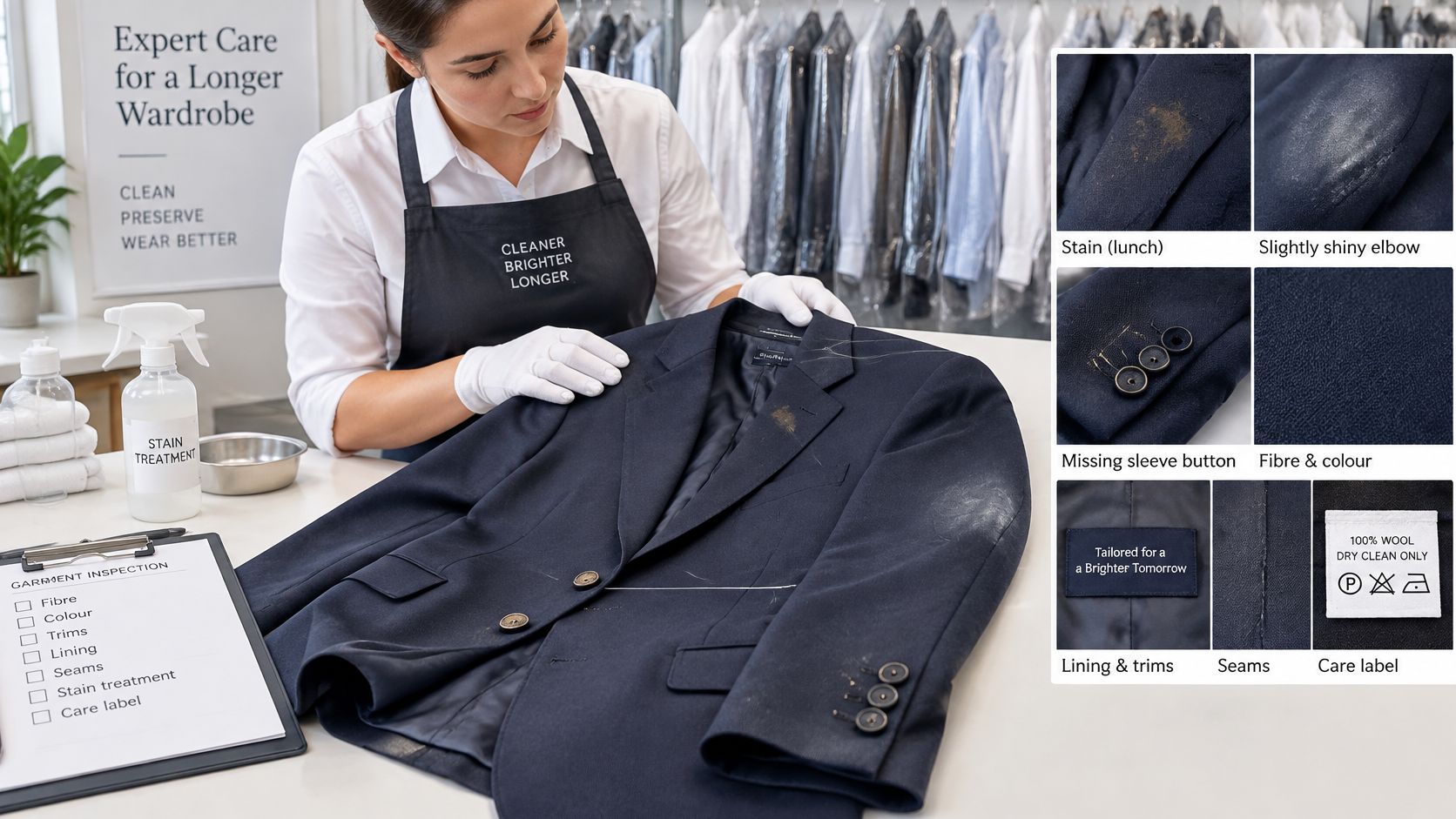
The intake is the quality gate. Take a navy blazer with a lunch stain on the lapel, a missing sleeve button, and a shiny elbow. The cleaner records fibre, colour, trims, and that shine, so a thin spot noticed later is not mistaken for new damage from the wheel.
From there the load is sorted intensely by fabric, colour, and soil level, with spot stains treated and small repairs handled on the go before detergents are matched to the batch. A heavily soiled raincoat does not set the cycle for a lightly worn blazer. Dye transfer is checked the same way, because a damp black lining can mark a pale blouse even when both pieces look clean enough to share a drum. Pressing and folding into neat bundles come at the end, but everything downstream depends on this first pass.
Match the mark to a family
A stain is a chemistry problem before it is a laundry problem. Heavily soiled clothes go through modern spot-removal treatment, yet the agent still has to match the mark. Dry cleaning uses dry solvents and never wets the garment with water, so grease dissolves in the bath while water-soluble soils like sugar and sweat need a targeted pre-spot first. Skip that step, and the bath finishes with the stain still in the yarn.
- Oil and grease: Salad dressing and butter respond to solvent. Pre-spotting helps, then the bath finishes the job. Don't rub the lapel with a wet cloth first. Water spreads the oil into a ring.
- Protein: Egg, blood, and dairy often need a careful water-based pre-spot, then full drying before any heat. Heat cooks the protein into the yarn.
- Tannin: Coffee and red wine can spread if flushed hard. A gentle, directed treatment beats a soaked blot.
- Dye transfer: Colour that moved off a damp dark garment is not dirt. Solvent may lighten it and still leave a ghost.
- Sugar under a collar: Invisible until heat sets it. Your note about the spill is what stops a dryer from baking it in.
On the board, a cleaner can apply a spotting agent, replace or tighten a button, and catch a loose hem before pressing locks the fault. Pen ink is its own family, and InchBug's practical pen stain removal tips show how easily a household attempt spreads it into a ring before a plant ever sees the shirt.
Some marks never fully leave. Old, oxidized, or bleached stains may lighten and not vanish, and a good intake says so plainly. A week-old wine halo is a different job from dressing spilled at lunch.
At drop-off, name the fibre if you know it, point to every stain, and mention beads or a previous poor repair. The same honesty applies to household textiles: cleaning heavy drapes follows a different path from a blazer, because weight, lining, and hardware change both the pre-spot and the dry.
Inside the Solvent Cycle and Canadian Controls
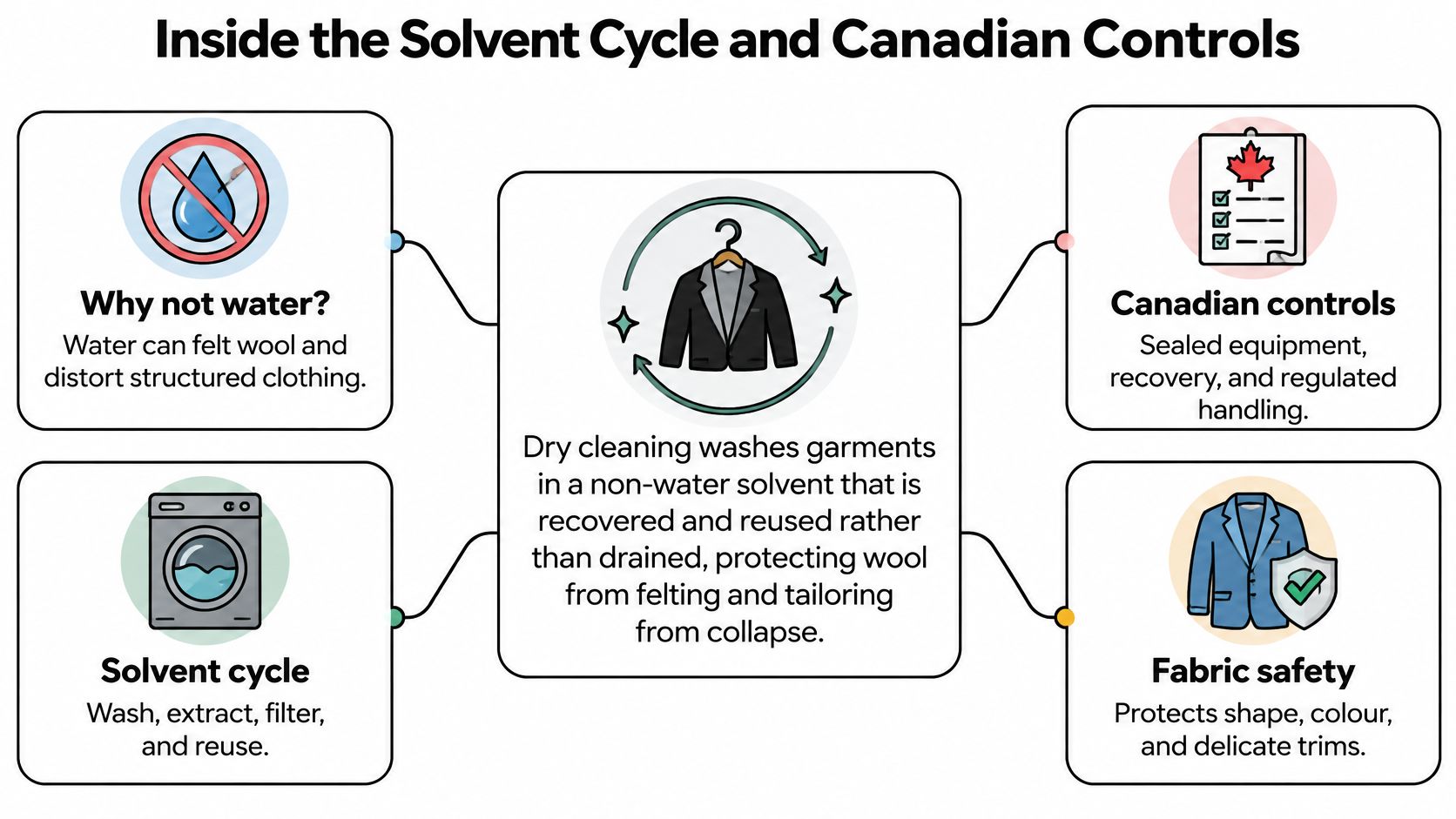
Dry cleaning washes garments in a non-water solvent that circulates through the machine, gets cleaned, and goes back into a tank for the next load. The "dry" in the name means the cleaning liquid contains no water, which is why structured wool keeps its shape instead of felting. Nearly every stage of that loop exists to answer one question: where did the solvent go?
Seven steps inside the wheel
- The sorted load goes into a closed wheel.
- Solvent carrying a small dose of detergent circulates and loosens soil. Oils dissolve into it. Water-soluble sugar does not, which is why pre-spotting happened before this step.
- Extraction spins free liquid out of the garments and back toward the tank.
- Drying and aeration evaporate what remains. A refrigerated condenser works like a cold lid held over a steaming pot: vapour hits a cool surface, turns back into liquid, and returns to the tank instead of escaping as fumes.
- A PERC-water separator splits solvent from any water the cycle picked up, keeping contact water out of ordinary drains.
- Filters and a still strip out the soil and dye the solvent carried off, so the next load starts with clean fluid.
- Residues, still bottoms, and wastewater stay in closed containers until an authorized facility collects them.
The cycle is finished only when solvent is back in the tank and waste is contained. A garment that still smells of solvent hasn't finished aeration.
What Canadian rules sit beside those steps
Tetrachloroethylene, called perchloroethylene, PERC, or PCE, is the traditional solvent these controls were written for. The Government of Canada's dry-cleaning sector page identifies the sector as a major source of PERC releases because most solvent losses historically occurred through air emissions, spills, or improper waste disposal. Federal rules target machine emissions, spills, contaminated wastewater, residues, and waste disposal, and they require recovery rather than escape during cleaning, drying, or maintenance.
Environment and Climate Change Canada's overview of the tetrachloroethylene regulations sets the hardware standard: an integrated refrigerated condenser, a PERC-water separator, and non-venting operation during washing, extraction, drying, and aeration. The same regulation caps design consumption for machines installed after 31 July 2003 at no more than 6.2 L, or 10 kg, of PERC per 1,000 kg of clothing cleaned. PERC, residues, and PERC-containing wastewater stay in closed containers, and secondary containment must hold at least 110% of the largest tank or container's capacity.
| Control | Requirement | Why it matters |
|---|---|---|
| Refrigerated condenser | Integrated recovery during drying and aeration | Turns solvent vapour back into liquid |
| PERC-water separator | Separates solvent from contact water | Stops contaminated wastewater leaving unmanaged |
| Non-venting cycle | Closed during wash, extraction, drying and aeration | Cuts fugitive air emissions |
| Consumption benchmark | At most 6.2 L or 10 kg PERC per 1,000 kg of clothing for machines installed after 31 July 2003 | Judges solvent use against garment mass |
| Closed containers | PERC, residues and wastewater kept closed | Limits evaporation between loads |
| Secondary containment | At least 110 percent of the largest tank or container | Holds a spill from the biggest vessel |
A plant is judged by solvent used per mass of garments, not by how many loads went through the door.
Every requirement above names tetrachloroethylene. A plant running a different solvent can sit outside this particular rulebook, so a PERC-free or eco-friendly sign answers only what is absent from the machine. It leaves open the questions this section was built around: where the solvent ends up, how the vapour is recovered, and how the residues leave the building.
Which Solvent Your Garment Gets
Four routes can leave the same counter. Ask the same three things of each: what carries the soil, what a claim really covers, and what you still have to confirm.
PERC is the traditional dry-cleaning solvent. In Canada it sits under federal rules for machine operation, consumption, wastewater, residues, and records, plus Ontario's trained-operator requirement. It is strong on oil. It is also the solvent those containment rules were built around.
Liquid silicone is what some cleaners, including our shops, use as an eco-friendly solvent. “Eco-friendly” on a sign can mean the solvent, the machine, the energy, the packaging, or only the marketing. Ask which of those the claim covers, and ask for the solvent name in plain words.
Hydrocarbon solvents are another non-PERC option. Public descriptions of PERC controls do not automatically describe them. Confirm both the product and how residues are handled before you treat the word “alternative” as a full answer.
Wet cleaning uses water and controlled drying. It suits fibres that can take water. It is not a solvent cycle with the water swapped out. A side-by-side of wet cleaning vs dry cleaning helps when the care label allows either route and the stain is the tie-breaker.
| Process | Cleaning medium | What rules or claims cover |
|---|---|---|
| PERC | Perchloroethylene solvent | Federal machine, consumption, waste and records rules; Ontario trained-operator rule |
| Liquid silicone | Silicone solvent | Verify the cleaner's eco claim; PERC rules do not describe this solvent |
| Hydrocarbon | Hydrocarbon solvent | Ask which hydrocarbon and how waste is handled |
| Wet cleaning | Water with controlled drying | Used only where water is safe for the fibre |
PERC-free describes the solvent only. It does not, by itself, describe energy use, packaging, or how still bottoms leave the building. Match the medium to the fibre and the stain. A wool blazer with salad oil wants solvent. A cotton shirt with a coffee splash may be better as a wet clean with a starch choice you set yourself. Treating every non-water clean as equal is how the wrong wheel gets the wrong cloth.
When Fabric and Stain Change the Cycle
The standard path bends as soon as the cloth or the mark changes. These are the adjustments that matter at the counter.
Navy wool suiting with salad oil stays in solvent. Water would felt and shrink the cloth. Finishing is steam and a shaped press, not a hot crush that shines the elbow further. Fresh oil often leaves. A ground-in, week-old patch may only fade.
A white silk blouse with red wine is pre-spotted gently and run with low mechanical action. Nobody wrings it like cotton. Water spots and dye bleed are the risks. A fresh splash can clear. A set, oxidized halo often lightens and stays visible. Say that at intake.
Rayon is weak when wet, so seams are supported and the cycle stays short. A long tumble that a sturdy trouser would ignore can open a rayon seam.
Velvet and other pile skip a hard press. Steam comes from the reverse so the pile isn't crushed flat. If you see a shiny track, the press was wrong, not the solvent.
Leather and suede leave the ordinary wheel for a specialist solvent and a conditioning step. A normal dry-cleaning load can dry them stiff. Don't promise them on a shirt timetable.
A beaded gown needs hand spotting, net support, and no ordinary tumble. Loose stones and a soiled train are the failure points. A bleach spot, on any of these, cannot be cleaned back into colour. Cleaning removes soil. It does not dye cloth.
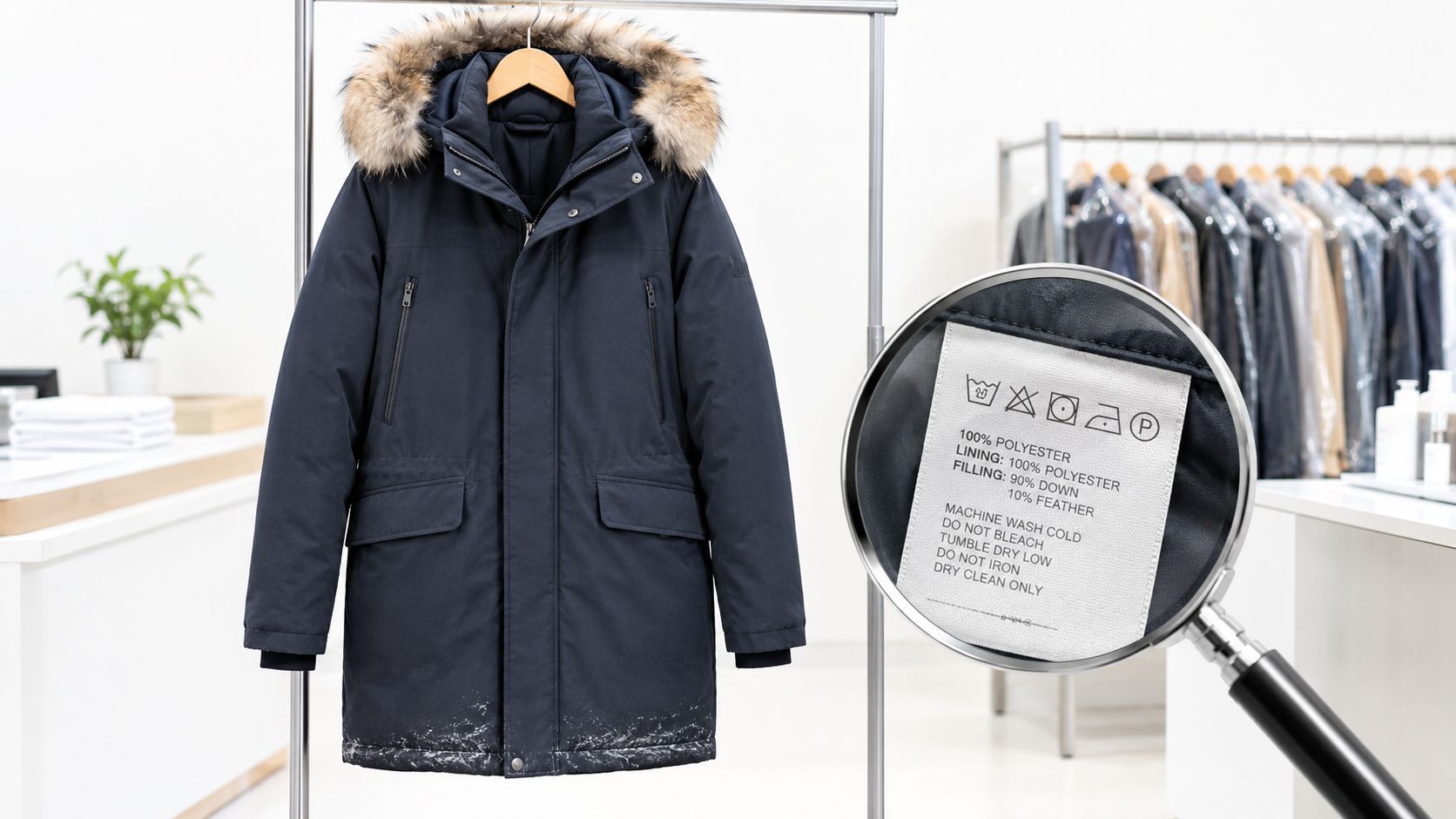
A down coat or a set of drapes may need a different machine and a longer dry. Use the table when you're unsure whether to request dry cleaning or a wet process, and see how we handle a winter jacket before you book outerwear on the same clock as a blouse.
| Fabric or item | Risk if washed in water | Process adjustment |
|---|---|---|
| Wool suiting | Felting and shrinkage | Solvent clean, low moisture, shaped steam press |
| Silk | Water spots and dye bleed | Gentle solvent cycle and minimal mechanical action |
| Rayon | Fibre weakens when wet | Short cycle and supported seams |
| Velvet or pile | Crushed pile | Steam from the reverse, no hard press |
| Leather or suede | Drying out and stiffening | Separate specialist solvent and conditioning |
| Beaded gown | Loose stones and train soil | Hand spotting, net support, no ordinary tumble |
Fresh oil often leaves. A week-old wine stain may only lighten. A bleach spot stays.
Pressing Packaging and Collection
Finishing starts once the garment is dry and free of solvent odour. Three tools do most of the work, and they are not interchangeable.
A steam press sets trousers and skirts: crease, pleat, and hem in one controlled shot. A puff or form fills shoulders and sleeves so the chest of a jacket rounds out instead of going flat. A hand iron takes collars, cuffs, and any edge a press would shine. Good finishing restores collar roll, crease, pleats, and hem, with buttons fastened and pockets empty.
A dry-cleaned jacket should look shaped, not stiff. A laundered shirt is a different job. Starch level is a wet-cleaning choice, not part of this solvent cycle. Don't judge a blazer by how a dress shirt feels.
How it leaves the plant
Packaging is part of care. Custom pieces go on hangers. Tissue goes around beads so stones don't snag the next garment. Silk is folded so the crease doesn't crack the yarn. On a doorstep route, our delivery team picks the clothes up, drops them at the nearest outlet for cleaning, and brings cleaned, pressed clothes back in tidy bundles inside a reusable bag.
At the counter, check before you leave. At home, do the same four checks the day the bag arrives.
- The stain: It is lighter or gone, matching what was promised at intake. A mark that was flagged as permanent should look the same, not worse.
- No new damage: No fresh shine, pulled seam, or crushed pile.
- No solvent smell: Odour means aeration wasn't finished. Air it, and tell the plant.
- Trims still attached: Buttons, beads, and belts came back with the garment.
If something failed, ask for a prompt re-clean while the cleaner still has the stain history. A home wash can set what the plant could still treat. Timing for ordinary loads sits in how long dry cleaning takes. Leather and beaded gowns need longer than that shirt clock, so don't book a Friday event on a Thursday gown.
Ask Which Solvent Before You Book
The decision is made at the counter, before the tag goes on. Four questions sort a real process from a slogan.
- Which solvent will this garment see: PERC, silicone, hydrocarbon, or wet cleaning?
- Why is that choice right for this fibre and this stain?
- How are residues and wastewater handled, and who collects them?
- What is the turnaround, including leather and beaded gowns, not only shirts?
Federal PERC rules apply to every Canadian dry cleaner using PERC and require controls for machine operation, solvent consumption, wastewater or residue, and recordkeeping. Ontario also requires a trained full-time person at a commercial dry-cleaning establishment and requires operations to minimize releases to the natural environment. A PERC-free label is not automatically impact-free. The federal FAQ on tetrachloroethylene in dry cleaning states that Canada currently has no regulations governing the use of non-PERC solvents in dry cleaning. A specific answer to each question is the only reliable way to judge a claim. “Green” might mean the solvent, the machine, energy use, packaging, or all of them.
Match the process to the fabric and the stain. Don't treat every non-water clean as equal. We clean with eco-friendly solvents such as liquid silicone, and same-day dry cleaning is available on special request for urgent, simple loads. Ask which solvent your piece will be exposed to, and check current pricing, same-day options, and pickup at cleanonline.ca before you book.
CleanOnline, North York's Premium Dry Cleaners handles the full dry cleaning process for everyday clothes, delicate fabrics, and doorstep bundles across North York and the wider Toronto area. Bring the fibre, the stain, and your questions about the solvent, and we'll match the cycle instead of forcing every garment through the same wheel. Visit CleanOnline, North York's Premium Dry Cleaners to book pickup or check a service before the next blazer sits by the door.