Clean a Wedding Dress: Assess, Avoid Risks, Hire Well
Learn how to clean a wedding dress safely: check fabric and trims, skip risky home spot treatments, and arrange professional cleaning with confidence.

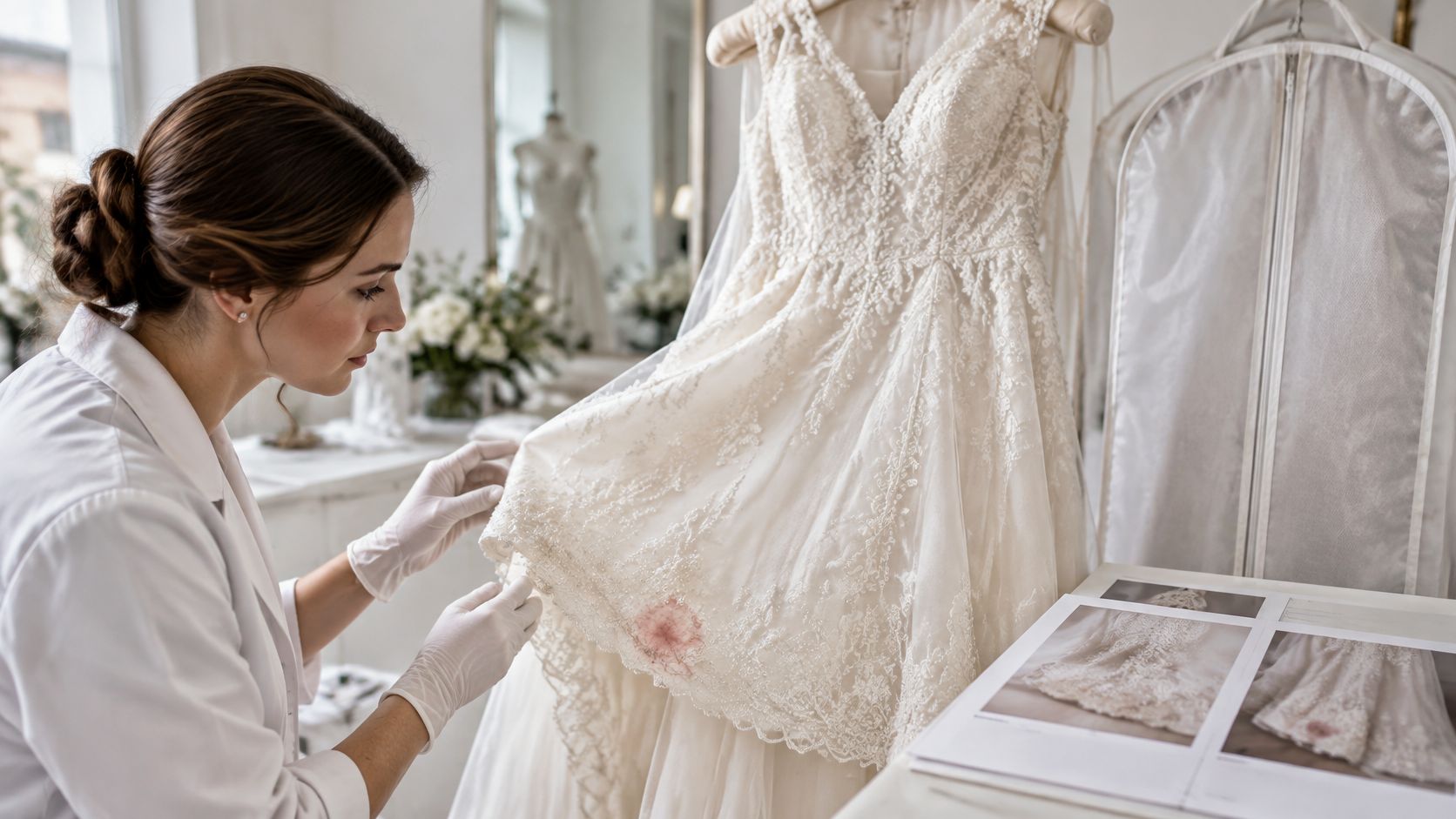
Your dress looks lovely in the wedding photos, but this morning there's wine along the hem and a damp patch inside the waist. Most wedding gowns shouldn't be washed at home. The safest way to clean a wedding dress starts with protecting it, recording what happened and choosing a treatment that its fabric and decorations can tolerate.
The First Week After the Wedding
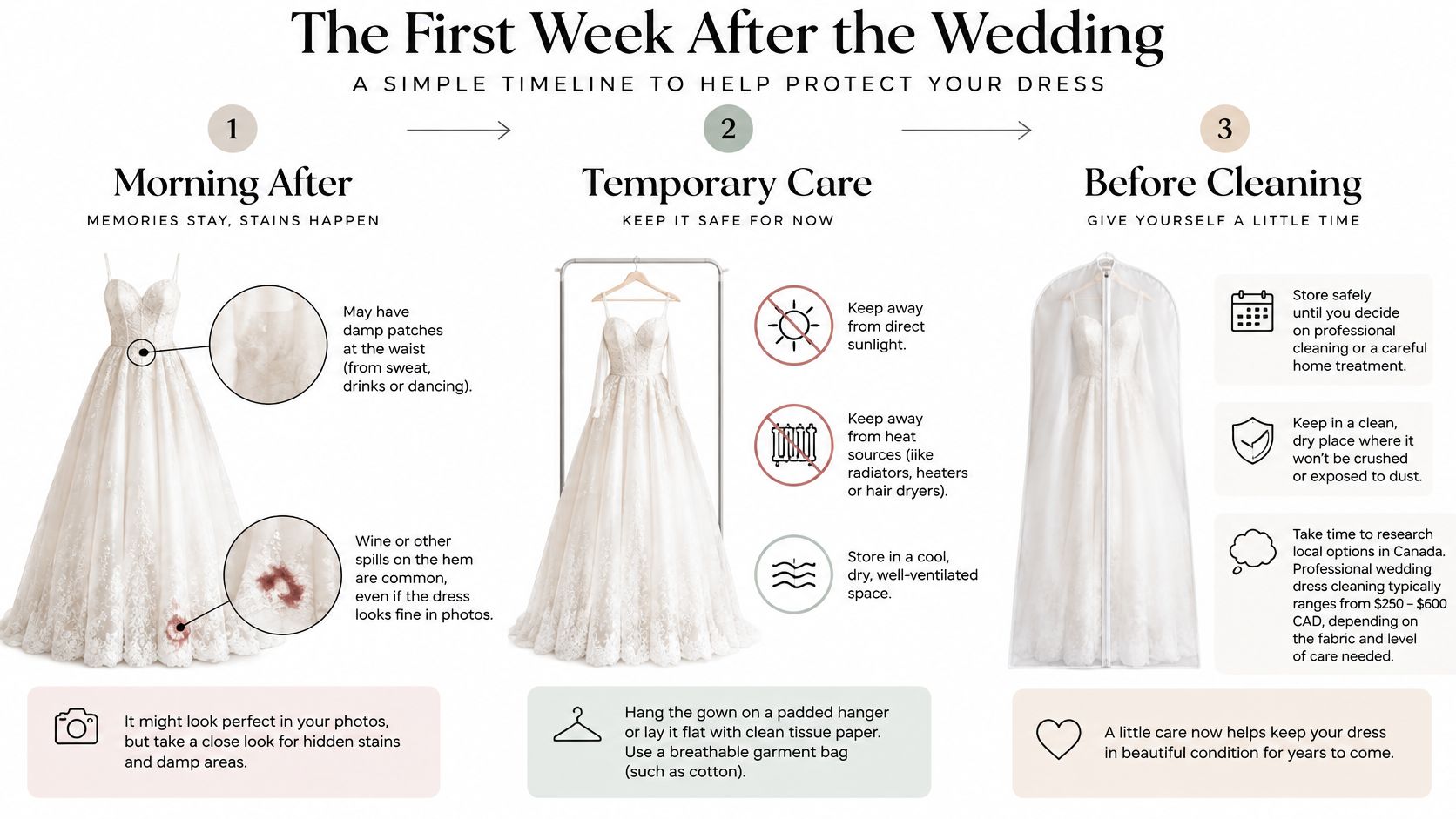
Say you've brought the gown home, draped it over a chair and noticed that the lining is still damp. Don't fold it into its storage bag yet. Move it into a clean, shaded room with gentle airflow, away from radiators, sunlight, food and pets.
The morning after
Lay a heavy or embellished gown flat on a clean, supported surface. Hang a sound, lighter gown only if its internal hanging loops can carry the weight without pulling on the neckline or straps. Keep the skirt clear of the floor.
Photograph the front, back, hem and inside bodice, then take close-ups of stains, damp areas and loose decorations. Write down what spilled and where, even if the mark has disappeared. Those details are more useful to a cleaner than a guess based on the stain's colour.
Love Your Dress's wedding-dress preservation guidance supports prompt assessment and cautious temporary care rather than improvised stain removal. For now, leave the household cleaning products alone.
Before the week gets busy
Use the next available opportunity to decide whether the gown needs a bridal cleaner or a textile conservator. Book the assessment before honeymoon travel, work and unpacking push it aside. Don't treat an apparently invisible spill as proof that nothing needs attention.
- Returning from a destination wedding: Use a breathable garment bag and support the skirt during transport. Never pack the gown while it's damp.
- Living in a condo: Choose an interior room rather than a balcony, parked car or basement locker. Limited space isn't a reason to use an exposed storage location.
- Arranging pickup: Keep the covered gown indoors until the handoff. It shouldn't sit outside where rain, condensation or temperature changes can reach it.
Ask for a gown-specific completion estimate, especially if you're planning resale or another fitting. Our guide to how long dry cleaning takes explains the scheduling considerations, but a bridal assessment should determine the actual turnaround.
Assess the Fabric and Trims Before Any Cleaning
White isn't a fabric type, and satin isn't a fibre. A satin gown might contain silk or polyester, and those materials don't necessarily tolerate the same treatment. Cleaning decisions must account for the outer fabric, lining, structural layers and decorations together.
The Canadian Conservation Institute's guidance on basic textile care says commercial dry cleaning is appropriate only for very strong textiles in excellent physical condition. It calls for preliminary testing and control over solvent, temperature, agitation, cleaning time, extraction and finishing. That's a warning against treating an intricate gown like an ordinary dress, not a blanket instruction to dry-clean every wedding garment.
Inspect without stressing the dress
Work under strong, diffuse light. Read the care label and retain any fabric information from the bridal shop. Photograph the complete gown before gently opening accessible layers to look for split seams, brittle lace, missing beads and lifting appliqués.
Don't tug a seam to prove it's strong. Support it from underneath and look for broken stitches or fabric separating beside the stitching. Leave colourfastness and solvent testing to the professional: a hidden seam test must check for colour transfer, rings, adhesive softening and texture changes, not just whether the fabric looks wet.
Fabric and embellishment risk by cleaning route
| Fabric or trim | Risk level | Likely route | Check before cleaning |
|---|---|---|---|
| Polyester or polyester blend, no embellishment | Lower | Professional dry or wet cleaning | Colour bleed on a hidden seam |
| Silk or satin | High until fibre is confirmed | Specialist dry cleaning, custom process if suitable | Water rings, dye bleed, fibre strength |
| Chiffon or tulle | Medium to high | Professional, low agitation | Tears, fragile layers, sheer areas |
| Lace, cotton, silk or synthetic | High | Professional with trim assessment | Brittle lace, loose edges, glue lines |
| Beading, sequins or crystals | High | Experienced bridal cleaner or conservator | Loose or missing beads, broken threads |
| Metallic embroidery or adhesive appliqués | High | Conservator assessment first | Tarnish, lifting edges, softening glue |
| Vintage or heavily dyed gown | High | Conservator assessment first | Colour transfer, existing weakness |
These are screening categories, not permission to select a cleaning cycle. A sound polyester shell can still have vulnerable glue, lining or trim.
Match the method to the whole garment
Dry cleaning is particularly useful for oily soils; it isn't automatically the answer to every spill. Our explanation of wet cleaning versus dry cleaning helps distinguish the methods without treating either as universally gentler.
Fit and construction deserve separate attention too. For another structured ceremonial garment, Clerkmans' guide to find the right judge robe fit is a useful fit resource, not a substitute for textile-care instructions.
Assessment rule: The most vulnerable component sets the treatment limit, even when the main fabric appears robust.
A sound, unembellished polyester gown can usually start with a professional cleaner. Silk, metallic work, extensive beading, unstable dye or weakened vintage fabric warrants a bridal specialist or conservator's assessment first.
Home Spot Treatments That Make Stains Worse
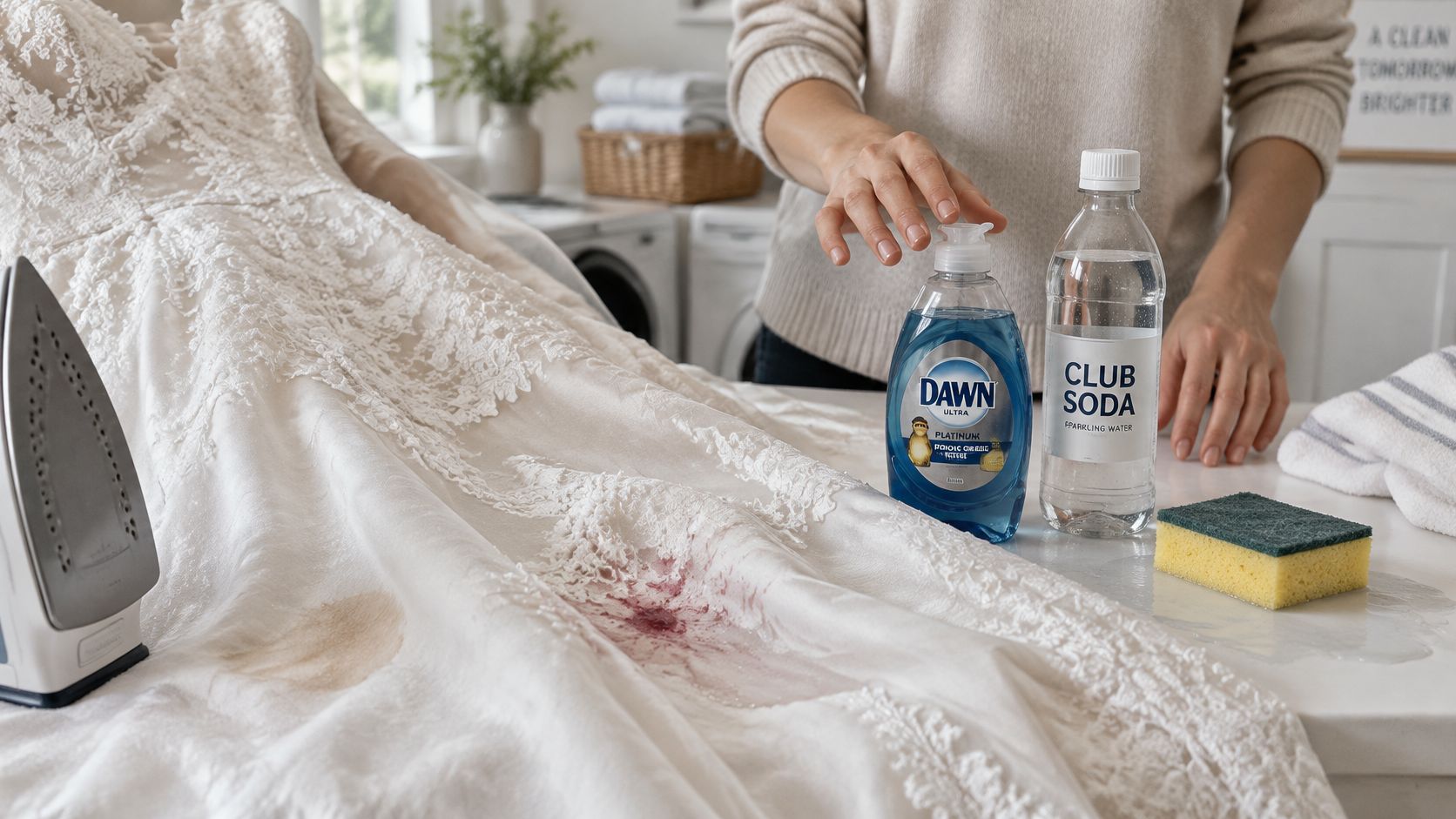
The common mistake is reaching for dish soap, club soda or a damp sponge before identifying the fabric. Added liquid can spread a stain or leave a ring; rubbing can roughen the surface and catch decoration threads. Heat adds another risk before anyone has established what caused the mark.
The products pictured below are not a recommended treatment kit.
Stain triage: safe first step and when to stop
| Stain | Safe first step at home | Stop and call a professional if |
|---|---|---|
| Fresh wine, juice or coffee | Blot with a dry white cloth, lifting without pressing | The stain spreads or colour moves onto light areas |
| Oily or greasy mark, butter, oil or makeup | Lift loose powder with a soft brush on sound, undecorated fabric; add no water | The mark sits on silk, beading or a lined area |
| Perspiration or underarm marks | Air-dry in shade without soap | Yellowing appears or the fabric feels weak |
| Dirt or grass at the hem | Brush loose, dry dirt outward only on sound fabric; leave embedded grass marks | Soil runs through the layers or trims loosen |
| Ink or dye transfer | Do nothing with water or solvents | Any ink mark, always |
| Sticky or sugary residue | Blot fresh liquid dry and leave for assessment | Residue attracts dirt or the fabric stiffens |
The Canadian Conservation Institute's guidance on washing non-coloured textiles limits wet cleaning to sound textiles and explains that mechanical cleaning cannot remove fats, oils or grease bound to fibres. More brushing won't solve an oily stain.
Leave these methods out
- Household washers, dryers and irons: Their mechanical action and heat are inappropriate starting points for delicate bridal textiles.
- Salt, bleach and brightening detergents: Don't introduce untested chemicals to chase a whiter result.
- Perfume and hairspray: They aren't cleaning agents and add residues.
- Plastic around damp fabric: Don't trap moisture while waiting for assessment.
Large size doesn't make a gown suitable for bulk washing. Even cleaning heavy drapes requires attention to construction rather than choosing a larger machine.
For a fresh liquid spill on stable fabric, the limited home move is a dry white cloth, gently lifted away. Don't press liquid through the layers, and stop if the surface or decoration moves.
How a Professional Cleaner Handles the Gown
A professional service should make its decisions traceable. The owner needs to know what condition the dress arrived in, which treatments were approved and what remained afterwards.
The Canadian Conservation Institute's guidance on mechanical surface cleaning cautions against routine treatment of extremely fragile, fragmented or powdering textiles. A responsible workflow therefore includes the option not to proceed.
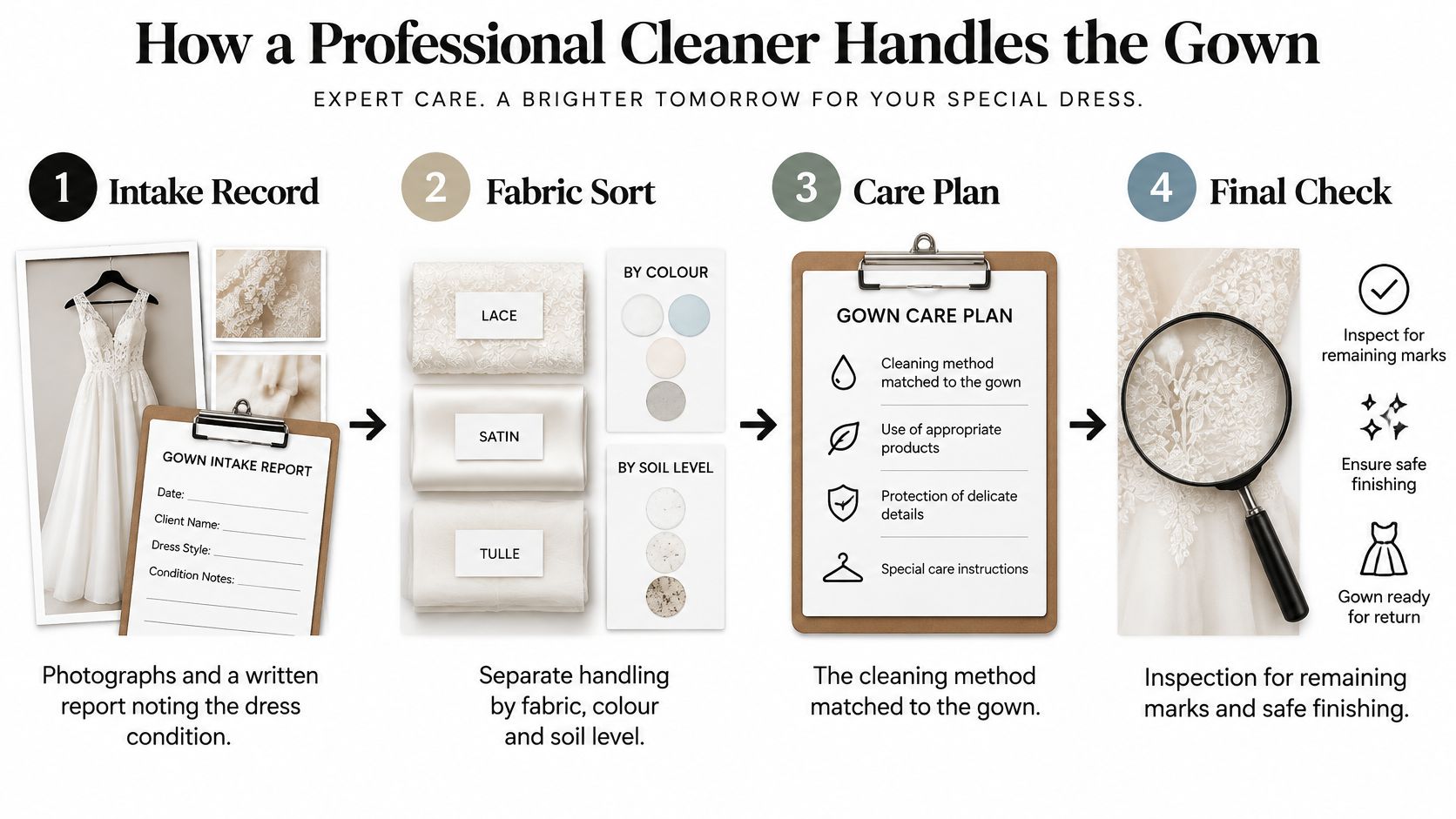
From intake to treatment
Record the condition. The cleaner photographs the gown and writes down stains, damage and missing decoration. This separates pre-existing problems from treatment changes.
Assess fabric, colour and soil separately. A single dress may need different handling at the bodice, lining and hem. Sorting means identifying those needs, not assuming the whole gown needs identical treatment.
Test concealed areas. The selected method must be checked for dye movement, water rings and adhesive response. An adverse test result changes the plan before the visible surface is treated.
Remove loose soil without rubbing. On suitable, sound areas, controlled low suction through protective screening can remove dust. Fragile trims require a different approach or no surface cleaning.
Select and control stain treatment. The cleaner chooses a solvent or aqueous method for the actual soil. Temperature, agitation and contact time remain controlled rather than increased until the mark disappears.
Stabilize approved repairs. Loose threads and decorations need attention before further handling. Repairs should be agreed with the owner, not added without permission.
From drying to return
Dry with support. The gown dries fully in a ventilated position away from direct sunlight. Support prevents wet or heavy sections from pulling on weaker areas.
Inspect the result. Check for tidelines, remaining stains, distortion and displaced trim. Compare the gown with the intake photographs rather than relying on memory.
Prepare padded folds. Clean, acid-free tissue supports folded areas and prevents hard creases. The arrangement should accommodate the dress rather than compress it into an undersized box.
Return the gown with its record. Document remaining marks, repairs and any care restrictions. Packaging shouldn't conceal an unresolved condition issue.
Our overview of the dry-cleaning process explains general garment treatment; a bridal plan needs this additional material-specific scrutiny.
Stop treatment when fibres powder, colour transfers or threads break. Escalate to conservation assessment rather than pursuing cosmetic perfection.
A cleaner who can't explain these controls hasn't demonstrated an adequate care plan for your gown.
Questions to Settle Before Handing Over the Gown
Good cleaners expect questions about a valuable, complicated garment. Written answers protect both parties by establishing what the cleaner will attempt, what you've authorised and which risks you've accepted.
Don't assume that a preservation package automatically includes a detailed assessment. Cleaning and preservation are separate decisions: one concerns treatment; the other concerns how the garment will be supported and stored afterwards.
A checklist you can copy
Fibre identification, intake and assessment: Will the intake form identify the outer fabric, lining and any uncertain materials? Supply the bridal shop's fabric details if the label is incomplete.
Embellishment inspection, stabilization: Who checks beads, sequins and appliqués, and what happens to loose pieces before treatment? Record whether repairs need separate approval.
Testing, method selection: Will hidden-area colourfastness and solvent tests be performed, with the results recorded? Establish whether an adverse result triggers a call before work continues.
Stain risks, treatment planning: Which marks may remain, and where could treatment change colour or texture? Ask for the proposed compromise, not just a promise to try harder.
Specialist referral, stop decision: Is a textile conservator available when silk, metallic decoration, vintage construction or unstable dye exceeds the cleaner's capabilities?
Written quotation, authorization: What does the quoted amount cover, and what could change it? Clarify how additional work on layers, embroidery or repairs will be approved.
Final inspection, return: Will you receive post-cleaning photographs and a record of remaining marks before accepting the gown?
Packaging, storage preparation: Which box and tissue materials are included? Confirm that the package suits the gown's dimensions and decoration.
Transport, collection and delivery: How will the gown remain supported, dry and protected throughout the handoff?
Convenience isn't the whole decision
A search for laundry services near you can identify convenient options, but proximity doesn't establish bridal-care competence. Evaluate the written treatment plan as carefully as the collection arrangements.
A credible cleaner can explain what they won't do to your dress.
Treat universal stain-removal guarantees, reluctance to test and the absence of a written condition record as red flags. Agreement on acceptable limits matters more than a confident sales pitch.
Book the Right Assessment Before Long-Term Storage
Store only a completely dry gown. Use an acid-free box large enough to accommodate it without compression, pad folds with clean, acid-free tissue and choose a stable interior room. Avoid attics, basements, direct light and locations with fluctuating humidity.
Ordinary coloured tissue and improvised plastic wrapping aren't suitable substitutes. An airtight preservation box must never become a way to seal in residual moisture.
Choose treatment and storage separately
Your intended use matters. A gown being prepared for resale or another fitting needs an accessible return arrangement; an heirloom needs supported long-term storage.
- Choose a conservator first if the assessment identifies weakened fabric, unstable dye, extensive loose decoration or lifting adhesive-mounted pieces.
- Choose professional bridal cleaning if the gown is structurally sound and stains are the main concern, with photographs and a written treatment record.
- Settle the handoff by recording existing damage, authorising preliminary testing and establishing when the cleaner must stop and contact you.
At CleanOnline in North York, we provide wedding-dress cleaning and preservation, including stain removal, dry cleaning with green earth solvents, and an acid-free airtight storage box with a display window. Wedding-dress dry cleaning costs $180.00, while multi-layered or embroidered gowns cost $250.00. You can drop the gown off the day after the wedding so stain removal can be addressed promptly.
Don't choose a stronger treatment just because a faint mark remains. For a fragile dress, preserving the fabric and construction can be the better outcome.
Write out your questions, photograph the gown and book its assessment this week. Keep the label information and spill notes with the intake paperwork so the person making the treatment decision has more than the dress's appearance to work from.
We offer wedding-dress cleaning and preservation to help you address post-wedding stains and prepare your gown for storage. Visit CleanOnline, North York's Premium Dry Cleaners to arrange an assessment, bringing your condition photographs, fabric details and stain notes so we can discuss the appropriate care route.