How Often Should You Dry Clean a Suit? a Practical Answer
Wondering how often should you dry clean a suit? See intervals by wear pattern, signs to act on, and tips for care between cleanings.


A regularly worn office suit usually needs professional cleaning every 3 to 6 months, or roughly every 8 to 12 wears for wool or wool blends, and sooner when stains or odour appear. That's less often than most owners expect, and cleaning after every wear is usually the fastest way to age a good suit. If you're deciding how often should you dry clean a suit, start with wear count, then let what you can see and smell overrule the calendar.
How Often to Dry Clean a Suit at a Glance
Wear count beats the calendar. A wool suit worn regularly to an office stays healthy on a clean every few months, and each clean is a solvent process rather than a light rinse, so the honest trigger is how many times the suit has been out plus what it looks and smells like today. Pick your row below, then let condition adjust it.
| Wear pattern | Suggested interval | Basis |
|---|---|---|
| Worn once a week in an office | Every 3 to 6 months | Westwood Hart guidance (2025) |
| Wool or wool-blend suit in a typical office | Every 8 to 12 wears | Charles Tyrwhitt Canadian suit aftercare guide |
| Normally worn suit | Every 3 to 4 wears | Gibson's Cleaners recommendation (2026) |
| Regularly worn suit, several times a week | Toward 3 months, the short end of the range | Westwood Hart guidance (2025) |
| Heavy use, commuting, food or sweating | Sooner than the standard interval, set by sweat and odour | Condition overrides the count |
| Any wear with a visible stain | Treat promptly, do not wait for the interval | Stain removal before it sets |
Why the Published Figures Differ
These numbers look contradictory because they measure different things. Charles Tyrwhitt counts wears and lands on 8 to 12 for a wool or wool-blend suit, which fits a rotation where each outing is a standard office day. Gibson's Cleaners counts the same way but lands tighter at 3 to 4 wears, a more protective schedule for owners who want the suit pristine. Westwood Hart counts time instead of wears, and 3 to 6 months is roughly how long 8 to 12 wears takes when a suit comes out once a week or less. All three agree on the underlying point: frequency follows use, not a fixed date.
Start from the row that matches your routine. A suit worn several times a week belongs at the short end of its range, while a once a week office suit usually holds at the longer interval provided you brush and air it between wears. The same condition-first logic applies to other structured garments, which is why guidance on when to dry clean a winter jacket starts with soil and odour rather than a fixed date.
Three-question check: How many times has it been worn since the last clean? Does it look and smell clean today? Does the care label allow cleaning now?
If the count is low, there's no visible soil, and no odour lingers after airing, you don't need a clean yet. If any answer points the other way, the interval stops mattering.
When Condition Overrides the Calendar
A wear count is only a starting point. Every clean costs the suit something, so the deciding factor is condition, not the date on a reminder.

Dry cleaning uses dry solvents rather than water, and each cycle puts a jacket's internal structure, the canvas, padding and fused interlinings, through solvent exposure and mechanical handling. Colour can soften unevenly, the cloth loses some of its hand, and pressing over time can leave shine at the seat and elbows. None of that happens in one clean. It accumulates, which is why unnecessary cleans are the ones I'd cut first.
The City of Toronto background document on PERC identifies tetrachloroethylene, commonly called PERC, as the predominant dry-cleaning solvent used in Toronto and Canada since the 1960s. Gentler options such as liquid silicone exist, but even a mild solvent cycle is still a cycle. Professional cleaning is a regulated chemical process, so it should be purposeful.
Signs That Move the Date Forward
Condition gives you clearer signals than a calendar reminder. Check the collar, cuffs, lapels, underarms, trouser creases and lining in natural light, then smell the jacket after it has aired, not straight after wearing it.
| Sign | What it usually means | Action |
|---|---|---|
| Visible collar or cuff soil | Body oils have built up | Book professional cleaning |
| Fresh spill or food stain | Stain is still easy to lift | Blot gently, then take it to a cleaner within days |
| Odour that lingers after airing | Sweat or smoke has reached the lining | Clean and mention the odour to the cleaner |
| Dampness in the lining | Moisture can encourage mould | Air the suit first, then have it inspected |
| Flat or dull look after heavy wear | Dust and fibre compression | Brush and steam, then clean at the next routine visit |
Urgency differs by sign. A fresh spill shouldn't wait for the wear count, because oily and protein based marks migrate into fibres and become harder to remove. Blot gently rather than rubbing, and get it assessed within days. A flat, dull look after a long week is different. Brushing, airing and a light steam often restore it, and a clean can wait until the next routine visit.
The same distinction separates maintenance from cleaning. A lightly worn suit that stays clean and odour free usually needs only brushing, airing and pressing. Visible soil, spills, embedded body oils, persistent smoke odour and dampness in the lining are the triggers that call for professional assessment. That inspection first habit protects structured suits, where wool cloth, linings, canvas and fused parts don't all respond the same way.
A suit that's clean, dry and odour free after airing doesn't become cleaner because a date arrived. It just gets another solvent cycle it didn't need.
When you do book, check the jacket and the trousers together rather than only the piece that looks dirty. Tell the cleaner the fibre blend, any known finish, and exactly where the soil or stain sits. Fresh contamination is generally easier to isolate than aged, oxidised residue, so that detail improves the result.
For a suit in regular use, an inspection every few months is a sensible habit. Authorise a full clean only when that inspection finds soil, odour or a risk to the cloth or construction. That rule keeps the suit fresh without turning cleaning into a fixed weekly chore.
How Fabric and Construction Change the Schedule
Two suits worn on the same days, in the same office, can need different schedules. What they're made of and how they're built decides how they show soil, hold odour and tolerate repeated cleaning.
- Wool and wool blends: This is the baseline most intervals assume. Wool resists surface dust, releases moisture well and recovers from creasing when rested, so it usually stretches furthest between cleans.
- Blends with synthetic fibres: Synthetics can hold odour more stubbornly and develop sheen under heat and pressure. A blend may smell ready for cleaning before it looks dirty, so check the lining and underarms rather than the outer cloth alone.
- Linen and lightweight summer fabrics: These wrinkle quickly and show perspiration and light soil sooner. They often need pressing more than cleaning, but don't mistake heavy creasing for dirt, and don't ignore sweat marks just because the cloth is pale.
- Structured jackets: Canvas, chest padding, shoulder construction and fused interlinings give a jacket its shape, and they're the parts most affected by repeated solvent exposure and handling. For a highly structured jacket, inspection matters more than hitting a wear number.
- Dark colours: Navy and charcoal show dust, lint and dandruff early, so they can look dirty when they're only dusty. A firm brush in daylight often proves a clean isn't needed yet.
- Linings: A damp, stained or sour smelling lining needs attention even when the outer cloth looks perfect. Linings sit closest to shirts and skin, and they trap moisture that the shell hides.
Construction also affects which process suits a garment, which is why it helps to understand the difference in wet cleaning versus dry cleaning before you assume every suit gets the same treatment.
The Label Comes First
The sewn-in care label outranks every interval in this article. Read it for the fibre content and the permitted cleaning method, then tell the cleaner the exact blend and any finish you know about, such as a water repellent treatment. A trouser and jacket from the same suit should still be checked separately, because linings and trims can carry different instructions.
I'd be more cautious with a fused jacket, a delicate blend or a suit with leather trim than with a plain, sturdy wool two piece. The wear count stays useful, but the garment in your hand sets the limit.
How to Care for a Suit Between Cleanings
A short routine after each wear does more for a suit's lifespan than an extra clean. It removes the surface soil that would otherwise work into the weave, and it lets wool release the moisture it absorbed during the day.
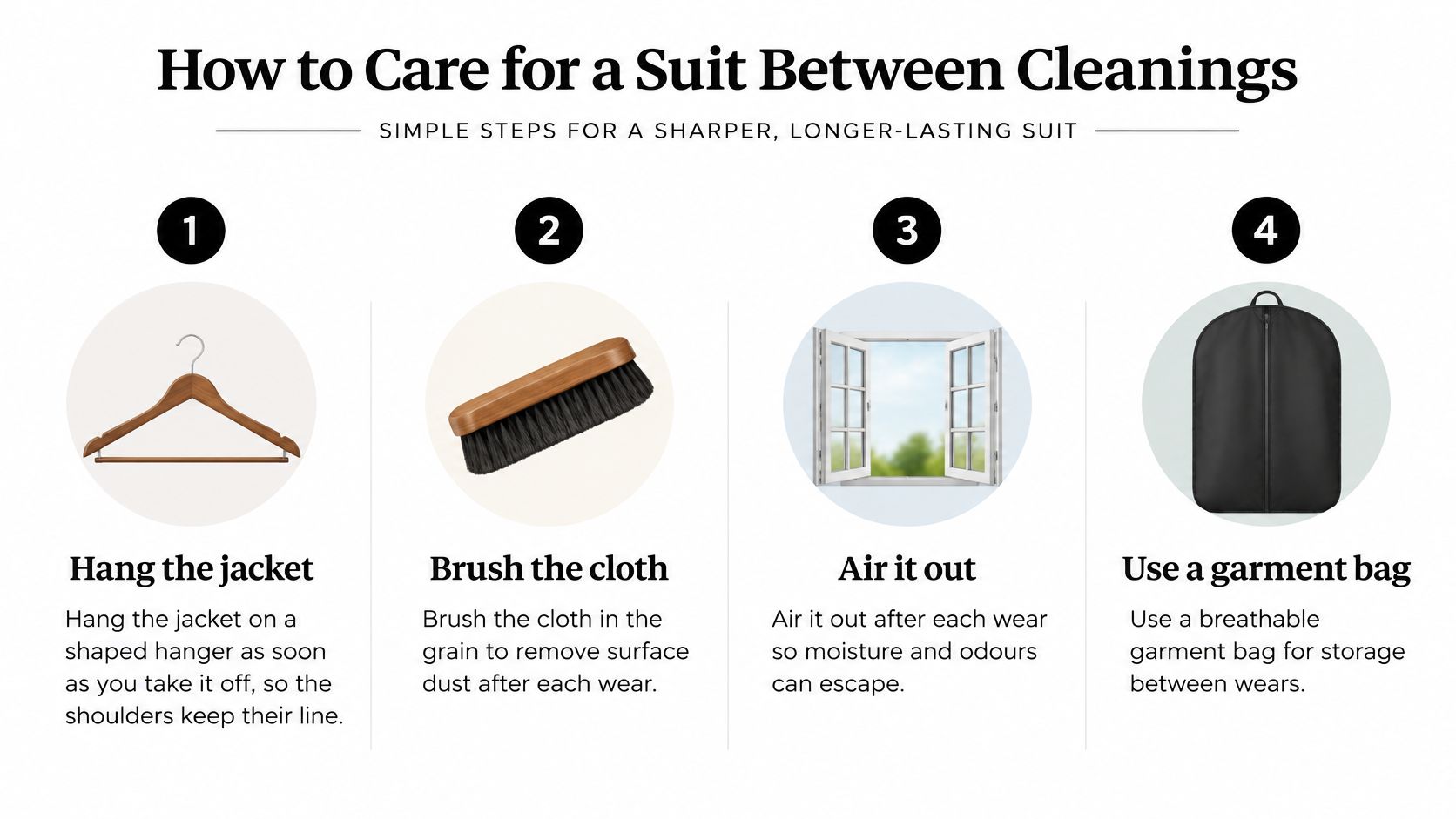
- Hang the jacket: Put it on a shaped, wide hanger as soon as you take it off so the shoulders keep their line. The common mistake is a thin wire hanger, which lets the shoulder collapse and crease.
- Brush the cloth: Use a clean, soft clothes brush in the direction of the nap to lift dust and lint. Skip sticky rollers as your only method, since they leave the dust sitting deeper in the weave.
- Air it out: Leave the suit in a ventilated room, away from direct heat, so moisture and odour dissipate before it returns to the closet. Don't dry a damp suit on a radiator, because heat can set stains and misshape the cloth.
- Rotate your suits: Rest each suit at least a day between wears so the fibres recover from compression. Wearing the same suit on consecutive days is where trousers bag and jackets start to smell stale.
- Blot fresh spills: Use a cold, damp cloth and blot gently without rubbing. Rubbing pushes the stain wider and deeper, and scrubbing with a household cleaner can strip colour.
- Store it breathably: Use a breathable garment bag rather than plastic, and keep it out of damp closets. For wider wardrobe habits, the best methods for storing clothes cover the same moisture and spacing principles that keep suits from going musty.
- Clean both pieces together: When a full clean is due, send jacket and trousers together so colour and finish stay even. Cleaning trousers alone repeatedly is how a matching suit stops matching.
This routine lengthens the interval, it doesn't replace professional cleaning. If you'd rather reduce solvent exposure further, our overview of eco-friendly dry cleaning explains the gentler process options worth asking about.
How Storage Changes the Schedule
Storage changes the schedule more than wear does, because a suit hanging unworn for a season has no wear count at all. Time, leftover soil and closet conditions decide instead.
Before You Put It Away
Clean the suit before long storage if it's been worn since its last clean. Body oils, food residue and dust left in the cloth oxidise over months, turn yellow at the collar and cuffs, and attract pests that clean wool doesn't interest. Air it thoroughly after cleaning and before bagging it, so no moisture gets sealed in with it.
Hang it on a shaped hanger inside a breathable garment bag, not plastic, which traps humidity against the cloth. Purpose made bags give the same protection for other formal garments, as with protective bags for graduation gowns, and the principle is identical. Coverage without airtight plastic.
Keep the bag in a cool, dry closet away from damp basements, exterior walls, direct heat and sunlight. Leave space between garments so air can move and shoulders aren't crushed. If a stored suit comes out smelling stale, our guide on how to remove musty smell from clothes covers what airing can fix and what needs professional treatment.
The Mid Season Check
Check a stored suit every few months. Take it out, brush it, air it, and look along the collar, lining and trouser folds for odour, dampness or pest damage. That five minute check catches a small problem while it's still a brush and air job.
Say a navy wool suit is worn through winter, then stored for summer. It's cleaned before storage, checked once mid season, then aired and brushed before its first autumn wear. It's cleaned again only if odour or soil appears. Stored time alone doesn't earn it another clean.
Three Owners and Their Cleaning Schedules
Intervals make more sense attached to actual routines. These three patterns cover most Toronto area suit owners.

The office worker. Say you wear a navy wool suit once or twice a week for desk work and meetings. You brush it, air it overnight, and hang it on a shaped hanger. Your interval sits around every 3 to 6 months, which matches Westwood Hart guidance published in 2025 recommending dry cleaning a regularly worn suit every 3 to 6 months. A lunch stain is the only thing that moves that date forward.
The daily commuter. Say you ride transit in rain and wear the same suit four days a week. Trouser hems pick up street grime, the lining absorbs perspiration, and the suit rarely gets a full rest day. Your interval shortens to every 1 to 2 months, and rotating a second suit matters as much as the cleaning itself.
The occasional wearer. Say your suit comes out for weddings, funerals and a few formal evenings each year. It shouldn't be cleaned after every outing. Brush it, air it, check for spills, and clean on condition or before long storage. Time since the last wear matters less than whether anything was spilled on it.
Match yourself to the wear pattern first. The right interval follows from that, not from a number meant for somebody else's routine.
Confirm Your Suit Needs Cleaning Before You Book
Run three checks in order before you book anything. First, compare your wear count or time since the last clean with the interval that fits your pattern. Second, look for the condition signs, collar soil, stains, lingering odour and damp lining. Third, read the care label and confirm the method it allows.
If the suit is within its interval, looks clean and smells neutral after airing, don't book. Brush it, air it and put it back in the closet. That decision protects the cloth and saves you paying for a clean that changes nothing. If we clean it for you, a 2-piece men's or women's suit is $21.99, a 3-piece men's suit is $26.99, and a press only suit is $16.99, so a press is sometimes the right spend when the suit is clean but tired looking.
If a sign is present, book the clean and tell the cleaner the fabric blend, the stain history and any finish. Understanding the dry cleaning process helps you describe what the garment needs, and if your schedule is the obstacle, you can reclaim time by outsourcing clothing care with pickup instead of store trips. Same-day dry cleaning is available on special request for urgent needs, and cleaned clothes are delivered back to your doorstep within 48 hours of pickup. Confirm current pricing, turnaround and same-day availability directly before choosing, then make the call today. The suit either goes back in the closet or to the cleaner.
If your three checks point to a clean, book pickup with CleanOnline, North York's Premium Dry Cleaners and tell us the fibre blend, stain history and finish so we treat the jacket and trousers correctly the first time. We'll clean and press the suit as a set, return it to your doorstep within 48 hours of pickup, and help you stretch the next interval with proper aftercare rather than unnecessary cleans.