Laundry Pick Up and Delivery Prices in 2026
Laundry pick up and delivery prices for Toronto in 2026 start near $3 a pound, with free doorstep pickup and the fees that change a real bill.

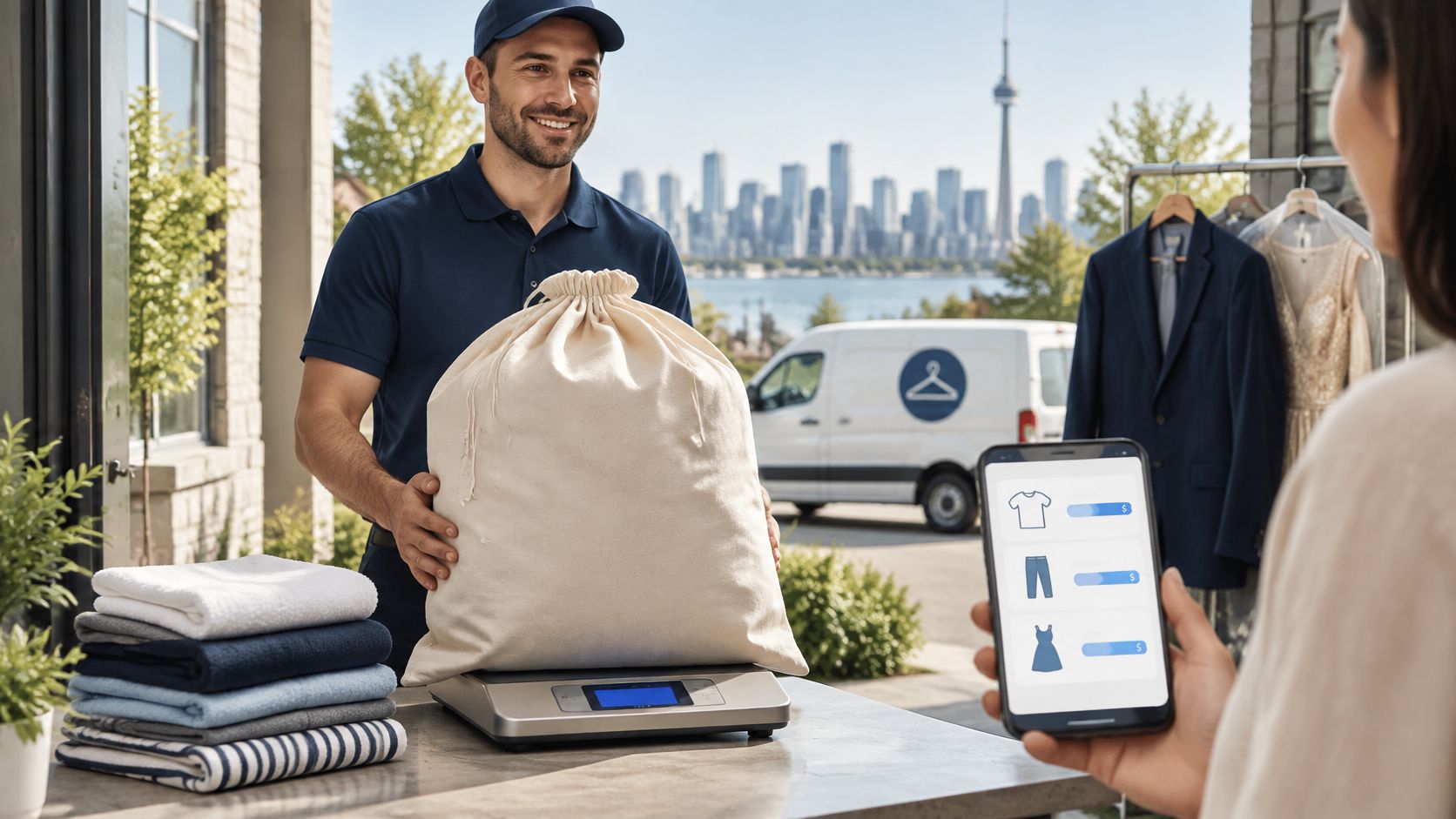
A Toronto wash-and-fold pickup rate starts at $3.00 per pound with free doorstep pickup and delivery, and the rate table below gives you the starting figures to price a normal weekly bag. The popular advice says to shop for the lowest per-pound number and stop there. That's the wrong test. A cheap pound rate tells you nothing about shirts billed by the piece, a dress that isn't wash and fold at all, or what you're already paying for building machines, detergent, trips and time. Judge laundry pick up and delivery prices by building one real order, line by line, then comparing it with the full cost of doing that same load yourself. That's slower than copying a headline rate from another city, but it's the only comparison that predicts your actual bill.
Laundry Pick Up and Delivery Prices at a Glance
A low per-pound rate is only one part of a laundry budget. CleanOnline's wash and fold costs $3.00 per pound, laundered shirts start at $3.49 each, and pickup and delivery are free anywhere in Toronto. Use these figures to price a basic order before comparing it with the cost of washing clothes at home.
| Service | Starting price | Billing unit | What it covers |
|---|---|---|---|
| Wash and fold | $3.00 | Per pound | Everyday clothes washed, dried and folded |
| Laundered shirts | $3.49 | Per shirt | Shirt laundering |
| Pickup and delivery | Free | Per order | Doorstep collection and return anywhere in Toronto |
Do the Plain Arithmetic First
A 10-pound bag of T-shirts, underwear, socks, towels and casual trousers costs about $30 at the wash-and-fold rate. A 15-pound bag costs about $45. To estimate a bag's weight, weigh yourself holding it, then subtract your weight without it.
Shirts are billed by the piece, not by the pound. If four dress shirts are handled separately, count four shirt charges rather than including their weight in the wash-and-fold estimate. The bag weighs less, but the separate shirt charges affect the total.
Practical rule: Weight prices the pile. Piece prices price the garment.
What These Starting Prices Don't Cover
Starting prices apply to routine laundry, not every item in a home. A wedding dress, comforter or leather garment may need different cleaning and handling, so don't estimate it as an ordinary share of a bag.
Per-pound pickup rates advertised in other markets, including the United States, are not a fair benchmark for a Toronto budget. Compare local services using laundry pickup options in your part of Toronto.
For rental-property owners, outsourcing can help while a machine is out of service. The longer-term comparison may include washer repairs for rental properties. At home, machine fees, detergent, travel and time also count. Compare those costs with the laundry service bill, not just its posted per-pound rate.
What Sits Inside a Pickup Laundry Price
A pickup laundry bill has two parts: cleaning and handling the route. Cleaning costs depend on volume and item type. Everyday laundry can be washed, dried and folded together, while dry-clean-only garments require a different process. CleanOnline's laundry pricing is volume-based and depends on the items being dry cleaned. Call for an estimate if your bag includes a mix of everyday clothes and garments that need dry cleaning.
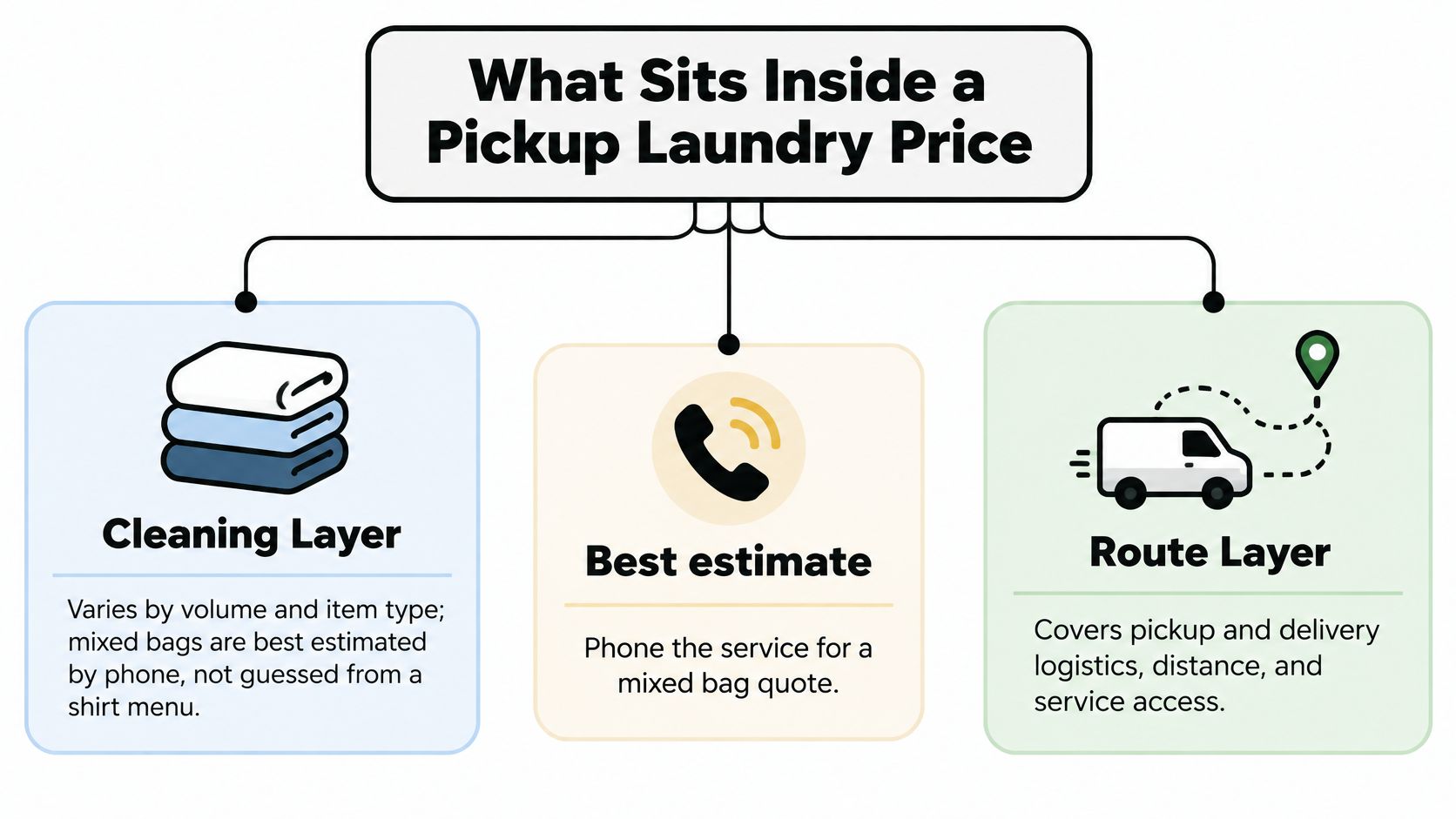
Run the Labour Floor Yourself
Route costs are easier to understand by working through one hypothetical stop. Ontario's general minimum wage is adjusted from time to time, so check the current rate on the Ontario government's minimum wage guide before you run the model.
- Estimate the labour time. Allow 15 minutes to collect, 10 minutes to load and sort, and 20 minutes to deliver. That adds up to 45 minutes, or 0.75 labour-hours.
- Multiply by the hourly wage. At the $17.60 rate listed for October 1, 2025 through September 30, 2026, 0.75 hours equals $13.20 in direct wages.
- Account for other costs. Fuel, vehicle wear, insurance, packaging and plant handling add costs beyond direct wages.
- Share the route. When several stops are close together, the travel time is spread across more orders.
This is why a free pickup can still fit into a service's pricing. The cleaning work is tied to each order, while a clustered route lets several households share the driving portion. For a Toronto apartment, compare the full cost of doing laundry at home too: machine fees, supplies, travel and the time spent handling each load.
Why a Tiny Order Strains the Model
A single shirt can require a pickup and return even though the cleaning itself is a small job. The route still involves travel, loading and handoff. Building access and a concierge handoff can also affect the time needed at a stop.
Seasonal garments illustrate why cleaning and route costs are separate. A winter jacket is priced as a garment, not as extra laundry weight. See how winter jackets are dry cleaned for more on the garment-specific process. Cleaning price and route cost answer different questions: one covers the work on the item, and the other covers getting it to and from the cleaner.
Charges That Change the Posted Rate
The posted rate rarely lies. It just answers a narrower question than many ask. Six levers sit on top of a per-pound price, and any one of them can move your total more than a small difference between two providers.
Billing Method and Fabric
Billing method comes first. Everyday wash and fold follows weight. Dresses, suits, household textiles and dry-clean-only pieces are priced per item. One formal dress can cost more than several pounds of gym clothes because it's inspected, cleaned and finished as a single garment, not tumbled through a shared load.
Fabric comes second. We offer special fabric dry cleaning for leather, silk, rayon and velvet, and those materials can't be treated like cotton. Silk can water-spot. Velvet pile can crush. Leather needs products that won't strip its finish. A press-only job is also a different service from a full clean. If a suit only needs pressing, don't pay for cleaning it doesn't need, and don't expect pressing to remove a stain.
Bulky household pieces sit in this category too. A duvet may be light for its size but still fill a machine by itself, so it leaves the ordinary pound logic. If you're pricing bedding, check the item rules for cleaning a down duvet before you estimate it by weight.
Speed, Scope and Order Design
Speed is the third lever. Same-day doorstep pickup and a standard return are different promises. A rush request asks the plant to reorder work already in progress, so confirm it as its own rule at booking rather than assuming it's included because pickup was fast.
Service scope is fourth. Alterations, shoe repair, wedding dress care and fire or water restoration aren't extra pounds of laundry. They're separate trades sharing a counter. A hem, a resoled shoe and a smoke-damaged curtain shouldn't be squeezed into a wash-and-fold estimate.
Order design is fifth. A minimum, a weekly slot or a commercial batch changes whether the route cost is absorbed.
- One-off small bag: Highest route cost per pound, most likely to meet a minimum.
- Standing weekly pickup: Predictable volume lets the driver plan clustered stops.
- Commercial batch: Quoted by recurring weight or volume, not by counting individual shirts.
Logistics at Your Door
Logistics is the sixth lever, and it's the one people forget. A bag left at the door before 8 a.m., a concierge handoff and an indoor carry from a unit are different arrangements even when the cleaning rate doesn't change. Someone does that lifting and waiting. Clarify who it is before you book, especially in a condo where staff may or may not accept bags.
Two free-delivery quotes match only when the billing unit, fabric care, turnaround and minimums match too.
Use that sentence as your comparison rule. If one quote is per pound with standard return and another is per item with rush service, you're not looking at two prices for the same job. You're looking at two different jobs.
Sample Orders for Homes and Businesses
A rate card becomes useful when you turn it into a bill. Price three baskets and watch where each dollar comes from. The arithmetic is plain, and doing it once with your own laundry teaches you more than reading ten price lists.
Three Household Baskets
Household A sends a plain weekly bag. Twelve pounds of wash and fold at $3.00 per pound comes to $36. There's no separate pickup fee, and the clothes come back folded. This is the simplest order to predict because everything in it shares one process.
Household B mixes units. Eight pounds of wash and fold is $24. Four laundered shirts at $3.49 each add $13.96. The total is $37.96 before any specialty piece. Notice that B sends less weight than A but pays slightly more. The per-shirt handling, not the poundage, pushes it ahead.
Household C leaves the pound rate behind. Dry cleaning a 2-piece women's suit costs $21.99, and a 2-piece men's suit also costs $21.99. Add a dress, with dresses starting from $14.99, and two garments already total at least $36.98. That's a week of everyday laundry spent on two pieces, which surprises people until they see the lines side by side.
| Order | What is in it | Line prices |
|---|---|---|
| Weekly wash and fold | 12 lb everyday clothes | 12 × $3.00 = $36.00 |
| Mixed bag with shirts | 8 lb wash and fold plus 4 shirts | $24.00 + (4 × $3.49) = $37.96 |
| Suit and dress | 2-piece suit plus one dress | $21.99 + from $14.99 = from $36.98 |
| Household textile add-on | One bedding or household textile item | from $4.99 per item |
Suit Prices Worth Knowing Before You Call
Suit variations change the line price, so describe the exact garment. A 3-piece men's suit costs $26.99, a 2-piece tuxedo costs $25.99, and a track suit costs $18.99. A press-only suit costs $16.99, while a special care suit costs $24.99 and a suit with leather trim costs $27.99. A vest only costs $8.99. Household items cleaning starts from $4.99, but a large comforter or gown can still outrun a bag of T-shirts because of size, construction and finishing time.
Specialty loads follow the same logic. Bulky sports equipment, for example, isn't priced like folded shirts, which is why separate guidance on washing hockey gear exists. When an item needs its own process, expect its own line.
Pricing a Small Business Batch
A salon's towels, a daycare's linens or a small restaurant's cloths shouldn't be estimated by multiplying shirt prices. That misstates a batch because recurring volume is sorted and processed predictably. Ask for a quote by weight or standing volume, then confirm it by phone with a realistic week of items. Tell the service how often you need collection, roughly how many pounds arrive each time and whether anything needs stain treatment or pressing.
Before you call for any of these orders, do two things. Weigh one real bag from your home or business. Then count every dry-clean piece separately and name its fabric. Those two numbers turn a vague enquiry into an estimate you can hold the service to.
When Pickup Beats Doing Laundry Yourself
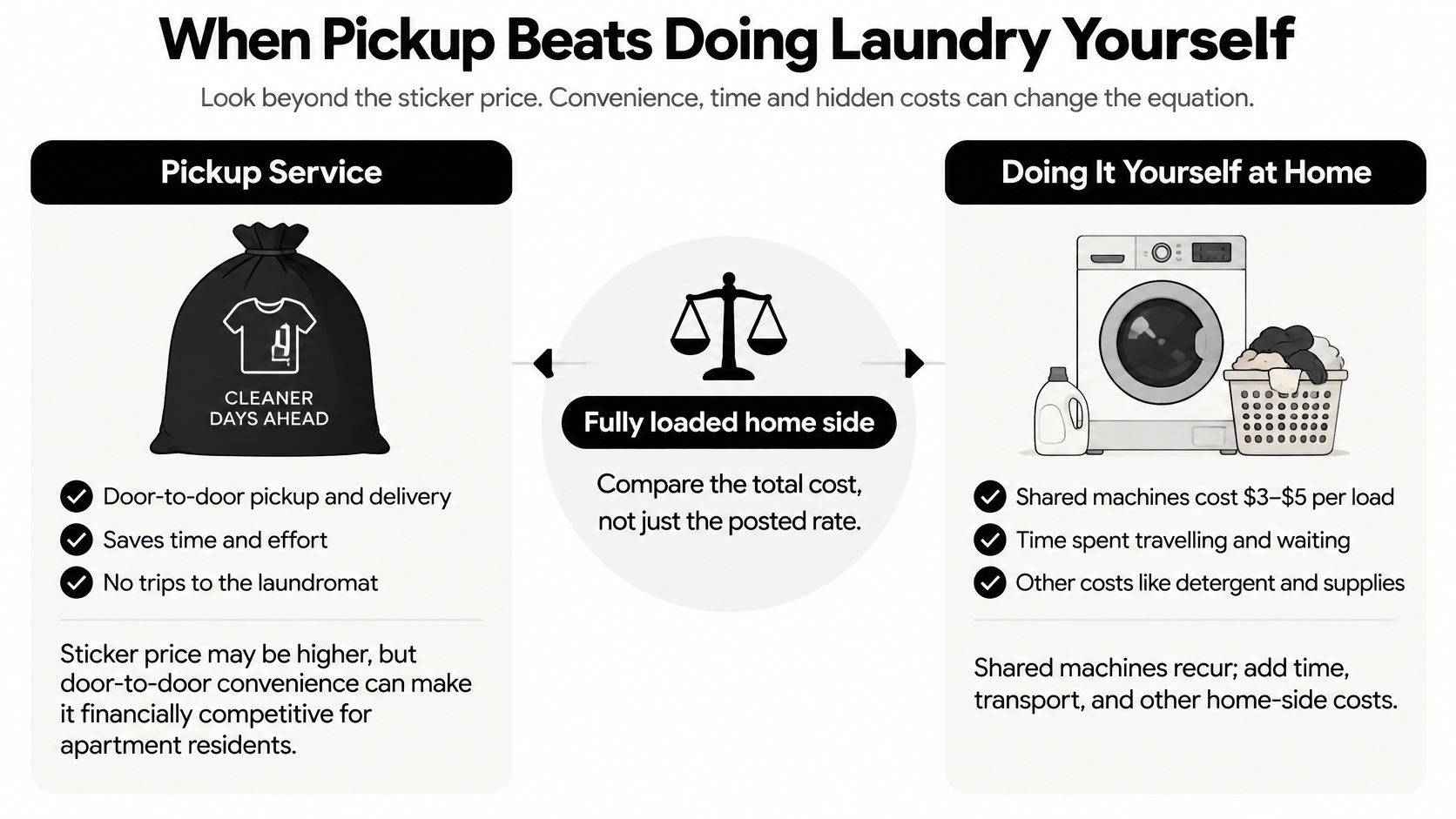
Pickup can cost more at the posted rate and still be competitive for an apartment resident. The comparison changes once you add machine fees, detergent, trips and time. In a Toronto building, the alternative to pickup is rarely a free laundry room.
The Renter With Shared Machines
Shared machines charge for each wash and dry cycle. A guide to costs Canadian students forget before moving out lists University of Alberta residence benchmarks of about CA$2 per wash and CA$1.75 per dry. University of Toronto family housing charges vary by wash cycle, with dryer fees added separately, so check your building's actual rates.
At the Alberta benchmark, two wash-and-dry loads a week cost $7.50 in machine fees; three cost $11.25. That works out to roughly $30 to $45 a month before detergent, trips downstairs or time spent waiting for an open machine. Roommates can coordinate roommate chores with Benny to share the work, though splitting chores does not lower the machine fees.
Compare those costs with a 10-pound wash-and-fold order at $3.00 per pound, or $30. Pickup and delivery are free, but the laundry service still costs more in cash than the shared-machine fees alone. The gap narrows when you count supplies and the effort of carrying, washing and folding each load. For a closer look at that trade-off, read this guide to whether wash and fold is worth it.
The Owner With Efficient Machines
With in-suite machines, the calculation shifts. Running an electric dryer costs relatively little per year, and a heat-pump dryer uses noticeably less electricity than a vented model. Electricity alone is unlikely to make pickup worthwhile for a homeowner with efficient appliances.
The comparison is closer to paying for time than saving on power. Sorting, loading, folding and putting away several loads still take effort, even when the machines are already in the home.
| Situation | What you pay directly | Costs easy to forget | When pickup is competitive |
|---|---|---|---|
| 10 lb weekly pickup | $30 at $3.00/lb; pickup and delivery are free | Specialty items and any minimum | When saving time and avoiding stairs matter more than the cash difference |
| Shared building machines | Per-cycle wash and dry fees; the Alberta residence benchmark is about $2 per wash and $1.75 per dry | Detergent, trips and repeat loads | When two or three weekly loads make fees and errands add up |
| In-home efficient dryer | Mainly detergent and time | Electricity costs relatively little per year; heat-pump models use noticeably less power than vented dryers | When reducing laundry time matters more than lowering the power bill |
There is no single winner. Renters can compare pickup with their building's actual cycle fees, supplies and trips. Homeowners with efficient machines can weigh the service price against the hours spent handling laundry.
What Recurring and Accessible Pickup Really Costs
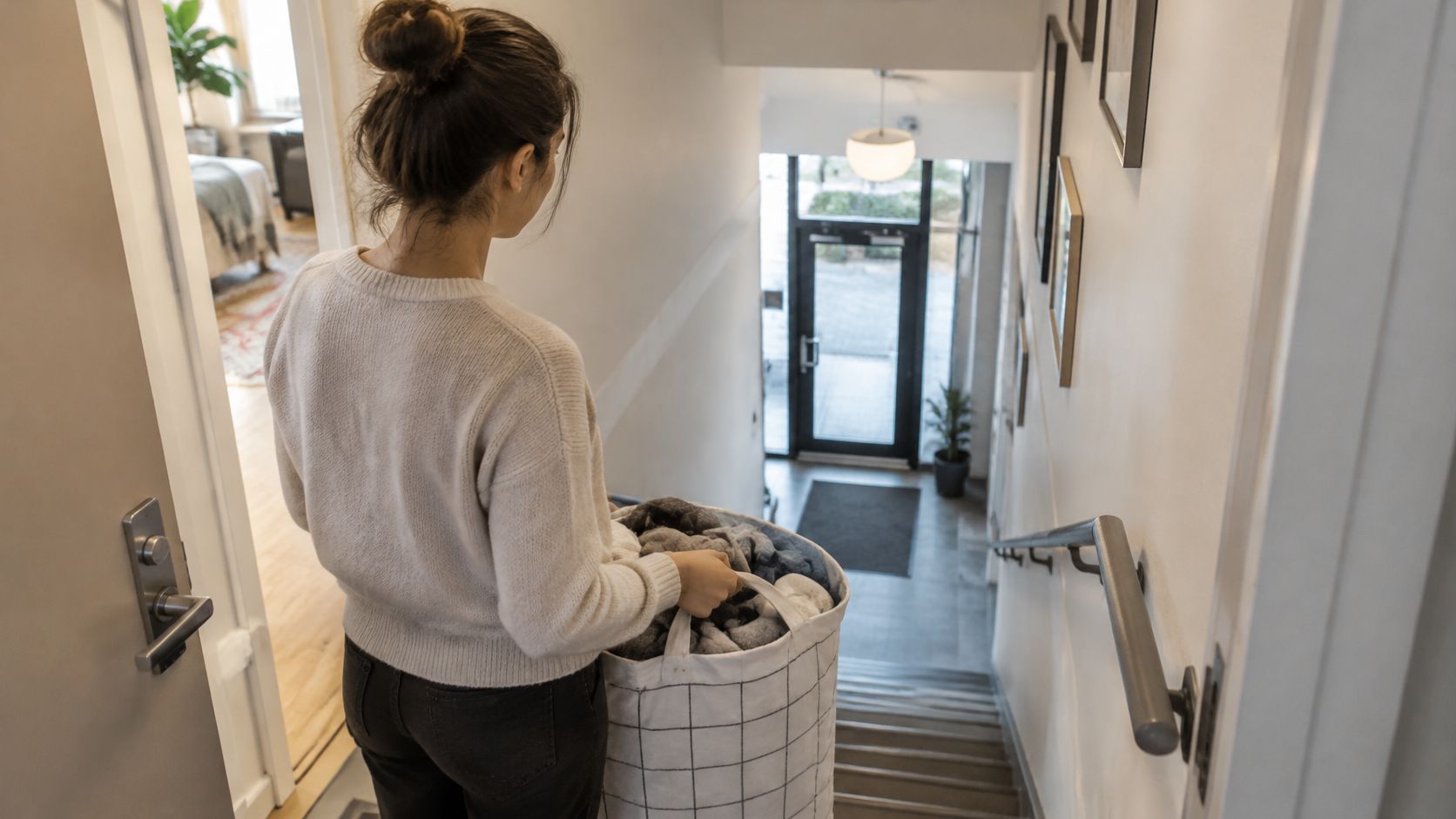
For someone who cannot carry a laundry bag down stairs or across a lobby, the lowest posted rate may not be the most useful comparison. A senior living alone, a parent recovering from surgery, or a caregiver managing another household may value doorstep collection as much as the cleaning itself. Ontario's Ministry for Seniors and Accessibility AODA annual report describes programs intended to help people with mobility restrictions remain safely at home. Laundry is one everyday task that can affect whether staying home is manageable.
How the Doorstep Handoff Works
Schedule a pickup, then leave your laundry bag at the doorstep before 8 am. CleanOnline's team can collect it safely without you needing to be home. Cleaned clothes are delivered back to your doorstep on the return timeline confirmed when you book, so you know when to expect them.
A condo may need one extra check. Ask whether the concierge will accept and release bags, where they will wait between handoffs, and whether collection reaches your unit or stops at the building entrance. If a caregiver is arranging service from another city, confirming those details first helps avoid an inaccessible handoff.
Keeping a Recurring Order Predictable
A recurring order is easier to budget when you separate laundry by how it is priced:
- Wash-and-fold: Everyday clothes and towels are priced by weight. CleanOnline's rate is $3.00 per pound.
- Bedding and household pieces: These are priced by item, so name them when requesting an estimate.
- Dry-clean garments, alterations and restoration: These are separate services, not part of the wash-and-fold pound rate.
For a household or small business, agreeing on a typical weight range or item list makes weekly bills easier to anticipate. CleanOnline offers free pickup and delivery anywhere in Toronto, and regular order updates help customers track their laundry and plan around its return.
Before booking, ask what the recurring order will cost, including any specialty pieces and building handoff arrangements.
The useful comparison is the full service, from collection at the door to clean clothes returned there. A clear estimate and a confirmed return timeline make it easier to decide whether that convenience fits the household's routine and budget.
Check a Live Toronto Rate Before You Book
A saved price can go stale, and a low per-pound rate is only part of the bill. Check the current Toronto price, then compare it with the full cost of laundry at home, including machine fees, supplies, travel and time.
- Weigh a typical week. Use a bathroom scale to estimate the pounds you usually send.
- Count item-priced pieces separately. Shirts, dresses and dry-clean garments are priced by item, so keep them out of the weight estimate.
- Confirm coverage and minimums. CleanOnline offers free pickup and delivery of laundry and dry cleaning anywhere in Toronto. Ask whether an order minimum applies to your booking.
- Ask about the return window. Confirm the timing for your address and whether same-day pickup changes the price.
- Get a written estimate. CleanOnline's mobile app schedules pickup in three minutes, with progress tracking available. Confirm the delivery timing when you book.
For a mixed bag, call for a price estimate. CleanOnline's laundry pricing depends on the types of items being cleaned. Businesses comparing pickup with in-house laundry can request pricing for facility supplies, then compare those costs with a pickup estimate.
CleanOnline's wash-and-fold service costs $3.00 per pound, with free pickup and delivery anywhere in Toronto. Visit CleanOnline, North York's Premium Dry Cleaners to schedule a pickup. Compare the final bill with your building's machine fees, supplies, travel and time.