Is Wash and Fold Worth It? a 2026 Cost Breakdown
Is wash and fold worth it? Weigh your time, home laundry costs and pickup options to see if outsourcing pays off for your Toronto household.


Wash and fold is worth it when its all-in weekly cost is lower than the value of the hours it removes: at $17.60 per hour, saving three hours gives you a $52.80 weekly time-value threshold, before avoided laundry costs.
Why compare a laundry invoice only with detergent and electricity when the service also replaces your labour? The useful question isn't whether outsourcing sounds convenient. It's whether the extra cash you spend buys back enough usable time, at a rate you're willing and able to pay.
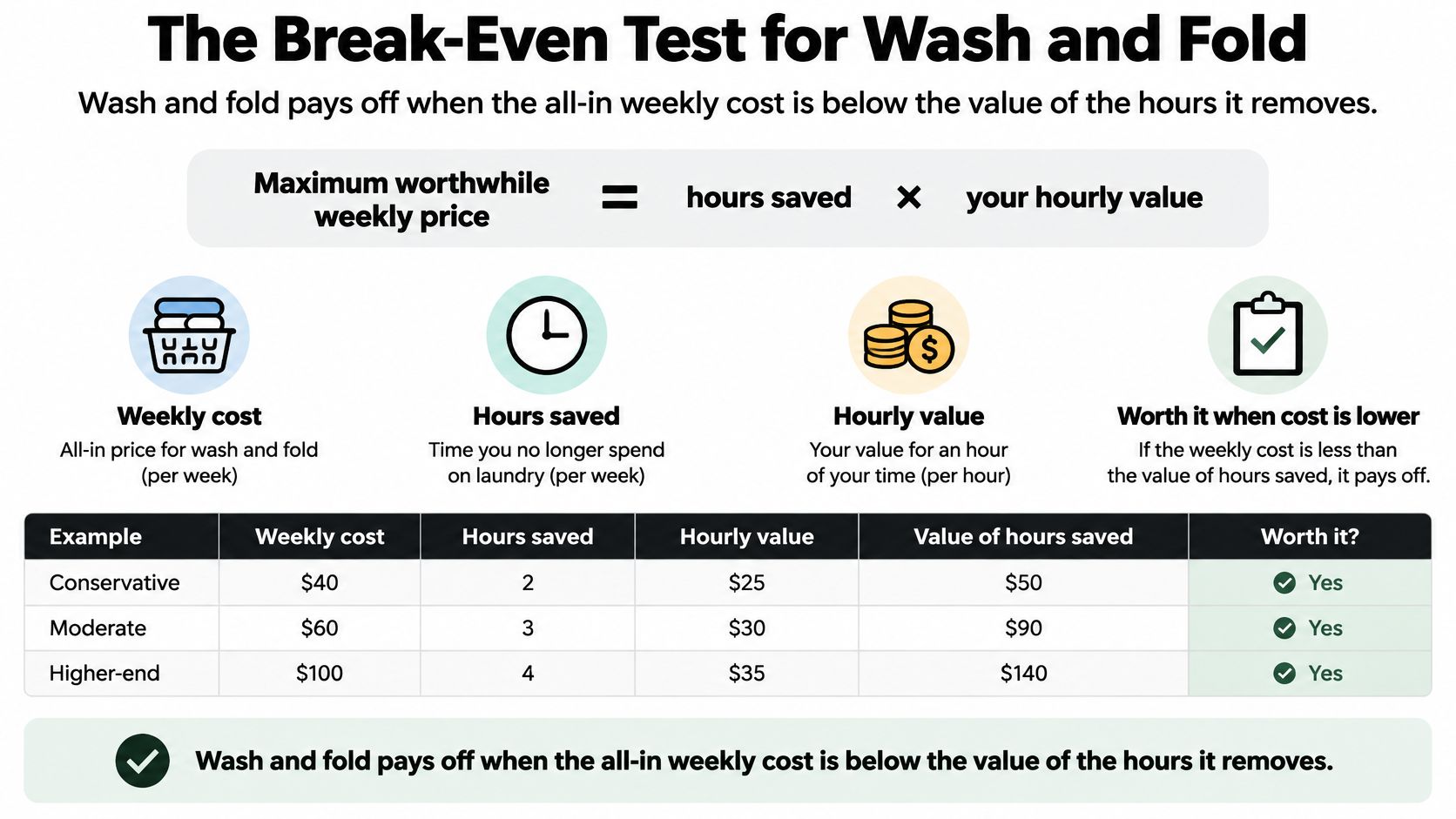
The Break-Even Test for Wash and Fold
Maximum worthwhile weekly price = hours eliminated × your hourly value + laundry costs you avoid.
That's the decision rule. If the complete service bill falls below that amount, outsourcing passes your economic test. If it exceeds it, you're paying a convenience premium that needs a separate justification.
Ontario's general minimum wage was $17.60 per hour from October 1, 2025, through September 30, 2026, according to the Ontario minimum wage guide. Use that dated benchmark for comparison, not as a claim that everyone's free time has the same value.
For a hypothetical household eliminating three hours of laundry work weekly, multiplying that benchmark by the saved hours produces the opening threshold. A higher bill could still make sense after avoided operating costs, but it doesn't pass on time savings alone.
Choose an honest hourly value
Use your after-tax incremental earnings if the recovered time lets you accept paid work. Don't use your professional billing rate if you wouldn't earn it during those hours.
For leisure, sleep or caregiving, use the amount you'd willingly pay to protect that time. That's a personal spending decision, not additional household income.
Weekly value of time saved at three hourly rates
The benchmark column uses the Ontario rate cited above. The other columns are hypothetical personal valuations, and every cell is calculated as hours multiplied by the column's rate.
| Hours saved per week | $17.60/hr minimum wage benchmark | $25.00/hr example | $35.00/hr example |
|---|---|---|---|
| 1 hour | $17.60 | $25.00 | $35.00 |
| 2 hours | $35.20 | $50.00 | $70.00 |
| 3 hours | $52.80 | $75.00 | $105.00 |
| 4 hours | $70.40 | $100.00 | $140.00 |
Convert the quote into a weekly bill
For a bag-priced service, multiply the bags you'd send each week by the quoted bag price. For weight-based pricing, multiply your weekly pounds by the quoted rate, then add applicable pickup, delivery, special-handling charges and tax.
Write the conversion as weekly quantity × unit price + applicable charges. Compare that complete figure with your threshold, not a headline unit price.
Remote work doesn't automatically create spare capacity: Statistics Canada found that people working from home spent about 16 additional minutes on unpaid housework on workdays, or 21% more than non-teleworkers. That finding supports measuring the burden, but it doesn't mean all additional housework is laundry or that outsourcing guarantees more paid work.
Budget check: A service can pass the time-value test and still be unaffordable. Recovered leisure doesn't pay the invoice.
How Many Hours Laundry Takes Each Week
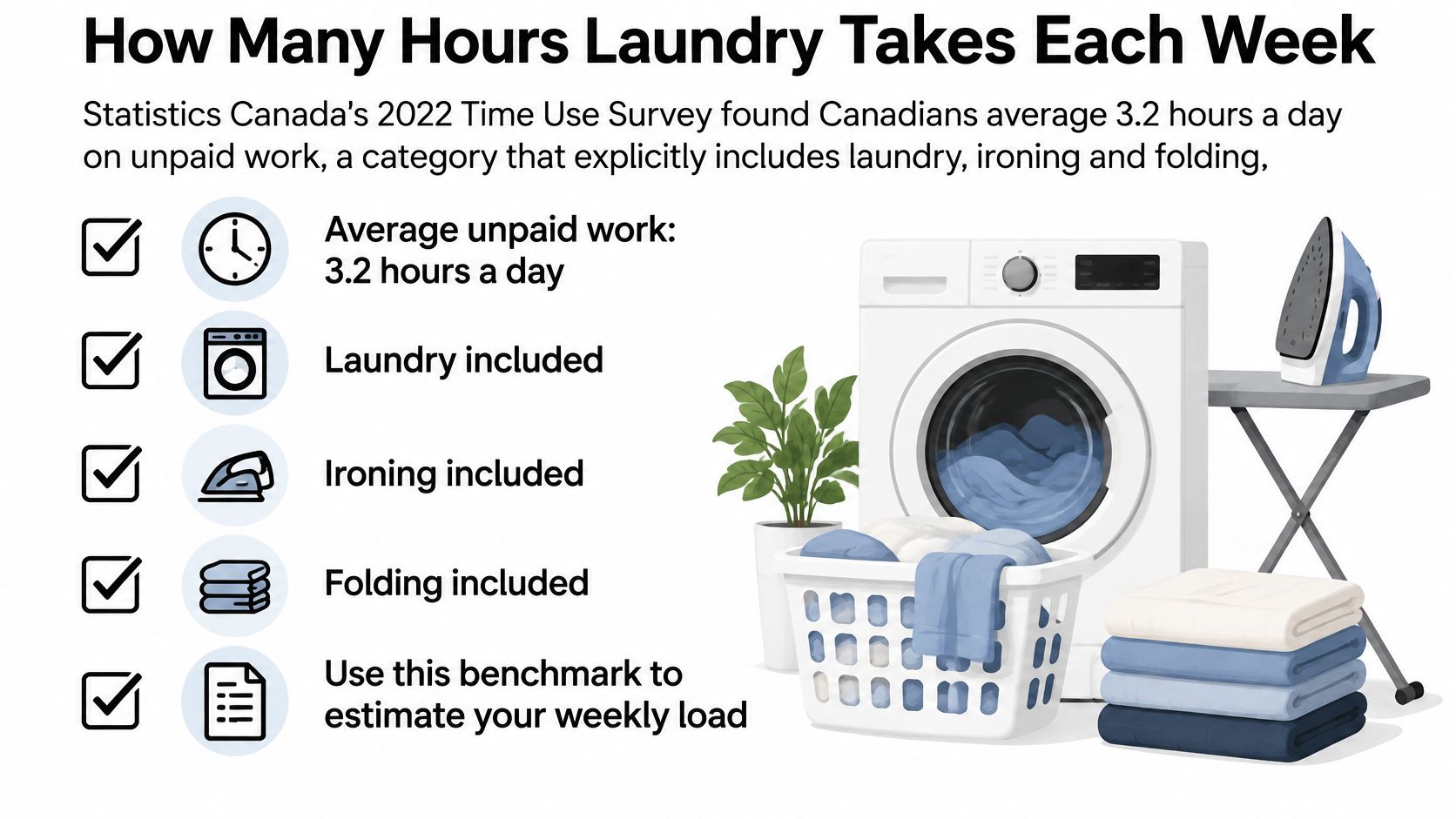
Canadians averaged 3.2 hours a day on unpaid work in Statistics Canada's 2022 Time Use Survey, a category that includes laundry, ironing and folding. That's a national unpaid-work benchmark, not a Toronto laundry-time estimate.
Don't allocate that average to your household. Measure your own routine, particularly if laundry interrupts remote work or requires leaving your building.
Keep a practical time log
Use your phone's stopwatch and a note with separate columns for hands-on work, travel and unavoidable waiting. Try logging a fortnight so an unusually light laundry day doesn't determine your decision.
- Sorting and loading: Record emptying pockets, separating fabrics, treating stains and loading machines.
- Transfers and checks: Include moving wet clothes, checking dryness and hanging items.
- Folding and storage: Time both tasks separately. Returned bundles may remove folding without removing putting away.
- Travel and waiting: Record laundromat journeys, shared-machine queues and cleaner drop-offs.
- Weekly total: Average your recorded weeks, then divide by your loads if you want a per-load measure.
The important distinction is elapsed time versus time you can recover. A washer running while you cook dinner isn't equivalent to standing in a laundry room unable to leave.
Likewise, don't count an entire evening because you had to remember a dryer transfer. Record the interruption, then decide whether it prevented another activity.
Subtract the work that remains
Bagging clothes, documenting special instructions, arranging access and storing returned laundry still take time. Your savings are the difference between the current routine and the outsourced routine, not your entire original total.
For specialist garments, how long dry cleaning takes is a separate scheduling question. A longer turnaround doesn't necessarily consume more hands-on time, but it can mean you need another work shirt available.
If your log shows a hypothetical two-hour weekly routine, carry only the portion the service would eliminate into your calculation. That prevents an attractive-looking quote from passing on overstated savings.
What Home Laundry Really Costs You
Home laundry has a cash cost even when you already own the machines. Count water, energy, detergent and usage-related wear, but distinguish avoidable expenses from bills you'll keep paying.
For 2026, Toronto's Block 1 water rate is $4.8629 per cubic metre for consumption up to 5,000 cubic metres, according to the City of Toronto water rates schedule. Apply that rate to your washer's measured consumption, not an assumed typical load.
The City of Toronto's household estimate puts 2026 water and wastewater costs at $1,118 annually for a household using 230 cubic metres, an increase of $40 from 2025. That whole-home bill isn't a laundry expense you can eliminate.
Build a cost sheet from your machines
Home laundry cost inputs and what they mean
| Cost item | Reported figure or input | How it affects the decision |
|---|---|---|
| Water at Toronto Block 1 rate | Rate stated above | Multiply measured cubic metres per load by the rate |
| Average Toronto household water and wastewater | Whole-home estimate stated above | Context only, not a single-load allowance |
| Laundry detergent prices, Canada | Historical change noted below | Use your actual detergent spending |
| ENERGY STAR washer energy use | Efficiency advantage over standard models | Efficient home equipment leaves less utility spending to avoid |
| Energy per load for your own machines | Measured kilowatt-hours for washing and drying | Use appliance documentation or a suitable meter |
| Laundromat or drop-off trips | Actual fares, parking or incremental driving costs | Separate cash expenses from travel time |
For water, convert the machine's litres to cubic metres before multiplying by the tariff. For electricity, multiply measured kilowatt-hours by your applicable marginal electricity rate; include dryer use rather than measuring the washer alone.
Canadian laundry detergent and soap prices increased 0.6% year over year in July 2024, according to Statistics Canada's detergent price analysis. That historical movement doesn't establish your current cost per load, so calculate detergent from your own purchase price and dosing.
Don't claim savings you can't realise
Your washer's original purchase price is already spent. Reduced use may defer wear, but outsourcing won't refund the machine or remove an appliance financing payment.
For a broader explanation of ownership expenses, asset costing with Facility Management Insights helps distinguish purchase costs from operating costs. Apply that distinction carefully to household equipment.
Compare the completed utility lines with your labour valuation. Where home operating costs are modest, a large outsourcing premium needs substantial time savings, not an inflated share of the household water bill.
Pickup Options Compared by Time and Cost
Laundry routes compared on time, cost and trade-off
| Route | Your time each week | Cost basis | Trade-off |
|---|---|---|---|
| Home washer and dryer | Sorting, loading, transferring and folding | Water, energy and detergent | Full control, but all hands-on time stays with you |
| Self-service laundromat | Travel, waiting and folding | Per cycle plus travel | Can accommodate bulky loads when home equipment isn't suitable |
| Drop-off wash and fold | Bagging, travel to the outlet and collection | Per pound or per bag, per provider quote | Removes washing and folding but keeps the trip |
| Doorstep pickup and delivery | Bagging, scheduling and receiving bundles | Quoted volume or item charges, plus any applicable fees | Removes trips and most handling, but leaves access arrangements |
The difference between drop-off and doorstep service isn't just convenience. It's whether you still have to transport the clothes and whether that journey is an extra trip.
A nearby outlet on an existing walking route creates a different calculation from an outlet requiring a dedicated drive. Count only the additional travel caused by laundry, not a journey you'd make anyway.
Price the route you'll actually use
For self-service laundry, include the full routine: getting machines, moving loads, folding and returning home. If you can productively use waiting time, don't automatically value all of it as lost.
Drop-off service removes the machine work, but collection still needs a place in your calendar. A cheaper quote may lose its advantage if it requires inconvenient journeys.
Doorstep service matters most when the trip is the obstacle, such as a car-free household carrying bulky bags or a commuter with limited opening-hour overlap. At our North York operation, sorting by colour and material is handled after collection, so the customer doesn't perform that processing stage.
A route only saves a trip if you no longer make it. Don't credit drop-off laundry with doorstep-level time savings.
Match access requirements to your schedule
Scheduling also has a cost when it requires you to stay home. Establish whether your building permits unattended collection, where bags can safely wait and how the return will reach you.
Our guide to finding laundry near you can help frame the location decision, but proximity alone isn't the right comparison. A close outlet can still require more involvement than a doorstep route.
For each option, write down the tasks left with you rather than accepting a broad time-saving promise. The best-value route is the one that removes your expensive or difficult tasks at an acceptable incremental price.
That can mean retaining home laundry for easy loads and outsourcing only the loads that force a separate trip. You don't need to move every garment to the same route.
Which Households Gain the Most Value
A household gains most when bought-back time has a clear use and the service removes a task that would otherwise fragment the day. At $3.00 per pound for wash and fold, estimate the service cost from bag weight, subtract the home water, electricity, detergent and travel expenses avoided, then divide the remaining premium by the hours freed.
Use your Toronto utility bill for the home-cost side and compare the hourly result with a relevant Ontario wage benchmark. For unpaid caregiving or rest, use the amount you would pay to protect that hour instead of assuming every recovered hour equals earnings.
Natural Resources Canada reports that ENERGY STAR-certified washers use about 25% less energy and 33% less water than standard models. Efficient equipment therefore weakens the cash-saving case, although it may still leave a strong labour-saving case.
Verdict on wash and fold by household situation
| Household situation | Likely verdict | Main reason |
|---|---|---|
| Remote worker, full-time job, no in-unit machine | Usually worth testing | Shared-machine interruptions can split paid work into unusable blocks |
| Efficient washer and dryer, full loads each week | Often not worth it on cash savings alone | The service mainly purchases relief from labour |
| Two or more shared laundry trips each week | Usually worth testing | Collection can remove repeated transport, machine waits and return visits |
| Occasional laundry, under one load weekly | Usually not worth it if minimum charges apply | A fixed charge can outweigh the small amount of time released |
| Parent or caregiver of young children | Often worth testing | Protected caregiving, sleep or rest may carry value above the wage rate |
| Household where carrying loads is hard | Often worth testing | Doorstep handling can change the comparison from convenience to access |
Interpret the verdict, not just the label
A full-time remote worker does not necessarily gain another billable hour. The more realistic benefit may be an uninterrupted work period, which needs a personal valuation based on what that focus is worth.
Caregivers face the same distinction. Paying to protect rest or care time can be rational without producing financial profit, provided the recovered hour is usable.

Recognise the strongest reasons to keep washing at home
Full loads, easy folding and no travel burden leave outsourcing with little usable time to recover. A well-delivered service can still be poor value when the premium buys convenience you do not need.
Low-volume households should pay particular attention to any minimum charge. Physical-access needs work differently because the alternative may involve pain, assistance or a difficult journey, giving the recovered time a higher practical value.
Specialised loads also need separate treatment. Our guide to washing hockey gear distinguishes equipment care from ordinary clothing, so include only the laundry tasks the service is meant to handle.
Treat each verdict as conditional on your actual quote, workload and hourly valuation. Household type shows where the break-even case deserves investigation, not what you must buy.
What You Trade Off in Folding and Garment Care
Outsourcing doesn't automatically reproduce your preferred finish. Washing, drying and folding aren't the same as laundering with pressing, especially for shirts you expect to wear straight to work.
Our wash-and-fold process doesn't include pressing. For laundered shirts, we return them folded or hung according to the customer's preference, but that's a different finish requirement from routine folded laundry.
Split the load by care requirements
- Send routine washable items: Everyday cotton clothing and towels are sensible candidates when their care labels permit the wash-and-dry process.
- Separate delicate garments: Keep dry-clean-only items out of the routine laundry bag and route them to specialist care.
- Identify finish-sensitive pieces: Decide whether work shirts need pressing rather than merely a tidy fold.
- Flag stains and sensitivities: Describe the stain and specify detergent requirements before treatment, rather than expecting ordinary washing to address every issue.
We sort by fabric, colour and soil level and select custom detergents during garment processing. For sensitive items, make the requirement explicit rather than assuming every piece can tolerate the same detergent or drying conditions.
Outsource the routine loads and reserve specialist handling for items where fabric or finish matters most.
Keep bulky and specialist care separate
A blanket's fabric and stain history matter more than whether it fits in the laundry bag. That Blanket Co.’s guidance on blanket care for stains and spills is useful when deciding how to handle household textiles before sending them out.
Outerwear deserves the same separation. Our guide to dry cleaning a winter jacket addresses a different care decision from washing everyday clothes.
The economic consequence is straightforward: price the finish you need. A low routine-laundry quote isn't the right comparison if you'll still spend time ironing the returned garments.
Decide Whether Wash and Fold Is Worth It for You
The answer to “Is wash and fold worth it?” comes from a measured routine and a complete quote, not a general promise about reclaiming your weekend. Keep the decision narrow: evaluate the ordinary laundry you'd send.
Make the decision from your own inputs
- Enter recoverable weekly hours. Use your time log, minus the bagging, scheduling and storage work you'll retain.
- Choose a realistic hourly value. Separate potential earnings from what you're willing to pay for rest or convenience.
- Calculate the complete weekly invoice. Apply the provider's charging method to your normal volume and include applicable extras.
- Compare equivalent costs. Set the invoice against your time valuation plus avoidable operating expenses.
- Test the result in practice. Check whether you recover usable time and whether the returned finish meets your needs.

A short trial with normal laundry is more informative than sending an accumulated backlog. Record the work that remains and whether you need additional pressing or special treatment.
For garments outside ordinary washable loads, distinguish wet cleaning from dry cleaning before including them in the estimate. Otherwise, you risk comparing unlike services.
Obtain a quote for an ordinary week
Our mobile app schedules pickup in 3 minutes, provides progress tracking and returns freshly washed and folded laundry within 24 hours. We offer free pickup and delivery anywhere in Toronto; our pricing is volume-based and depends on item type, and you can call for an estimate tied to your usual laundry.
Choose outsourcing if the tested result fits both your valuation and your cash budget. Keep washing at home if it doesn't, or delegate only the loads that create the greatest burden.
CleanOnline offers routine wash-and-fold care alongside specialist garment services, with free Toronto pickup and delivery to remove the laundry trip from your calculation. Visit CleanOnline, North York's Premium Dry Cleaners and request an estimate for one typical week of laundry, then compare it with the hours you'd recover.