Dress Alterations Cost in Toronto: What to Expect
Dress alterations cost about CAD $20–$80 for simple work and $150–$600+ for wedding gowns. Learn what drives each quote and how to compare them.

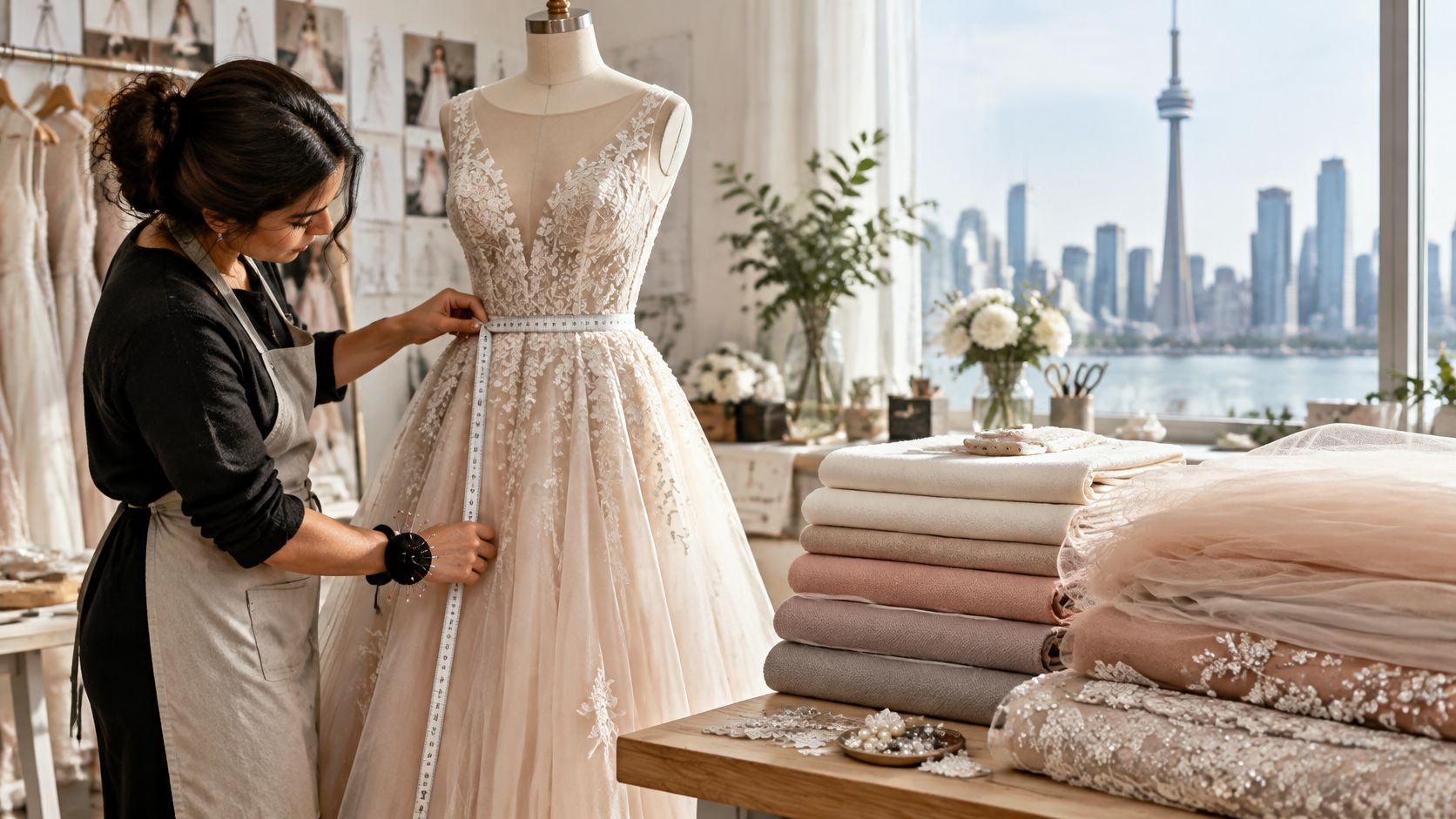
Simple dress alterations typically cost CAD $20–$80 in Toronto, and wedding gowns run about $150–$600 or more, with lining, fabric layers and embellishment moving a quote towards the higher end. The important difference is how much of the dress a specialist must open, adjust and finish again.
You might be standing in front of the mirror with a dress that almost fits. The skirt is too long, the waist gaps, or the bodice shifts when you move. Before deciding whether to alter it, you need to know what the price includes and whether the finished garment will be worth the expense.
Typical Dress Alteration Prices at a Glance
Use these tiers as a budgeting guide, not a fixed menu. The ordinary-dress and wedding-dress estimates reflect the scope described in Best in Hood's Toronto tailoring guide; the broader tailoring tier covers additional or more detailed work.
Dress alteration price ranges in Toronto
| Garment or job | Typical price (CAD) | What it covers |
|---|---|---|
| Ordinary dress, simple hem or fit change | $20–$80 | Single hem, take-in or fit correction |
| Simple or detailed tailoring work | $30–$100 or more | Several changes on one garment |
| Wedding dress, multi-step alteration | $150–$600 or more | Layers, lace, beading, bustle and bust adjustment |
| CleanOnline alterations and repairs | From $6.00 | Starting price; final charge depends on the work |
The rows describe types of work, not packages that automatically include everything listed. A wedding gown might need only a modest adjustment, while an ordinary evening dress could require extensive reconstruction. Don't add the rows together or assume that every task has its own identical charge.
Our alterations-and-repairs starting price applies to the service category. It isn't a dress-hem quote or a promise that a complete fit adjustment will cost that amount.
How to choose the right row
- Match the garment and the job. Start with the correction you need, such as shortening a skirt or reducing the waist. A dress requiring several adjustments belongs in a different budgeting category from a straightforward hem.
- Check the hidden work. Look inside for lining, stiff support, multiple skirt layers and seams covered by lace. These details can turn a small visible change into a more involved job.
- Treat the range as a budget. The final charge should follow an assessment of the garment, preferably while you're wearing it, rather than a description such as “just a little shorter”.
A photo can help communicate the silhouette and visible details, but it won't show every internal seam or support. Keep room in your budget until the dress has been inspected.
Budgeting rule: Compare the work included in a quote before comparing the total.
Check whether consultation, fittings, pressing or steaming, and taxes are included. A lower headline amount isn't necessarily better value if you must pay separately for the appointments and finishing needed to make the dress wearable.
Why Garment Construction Changes the Price
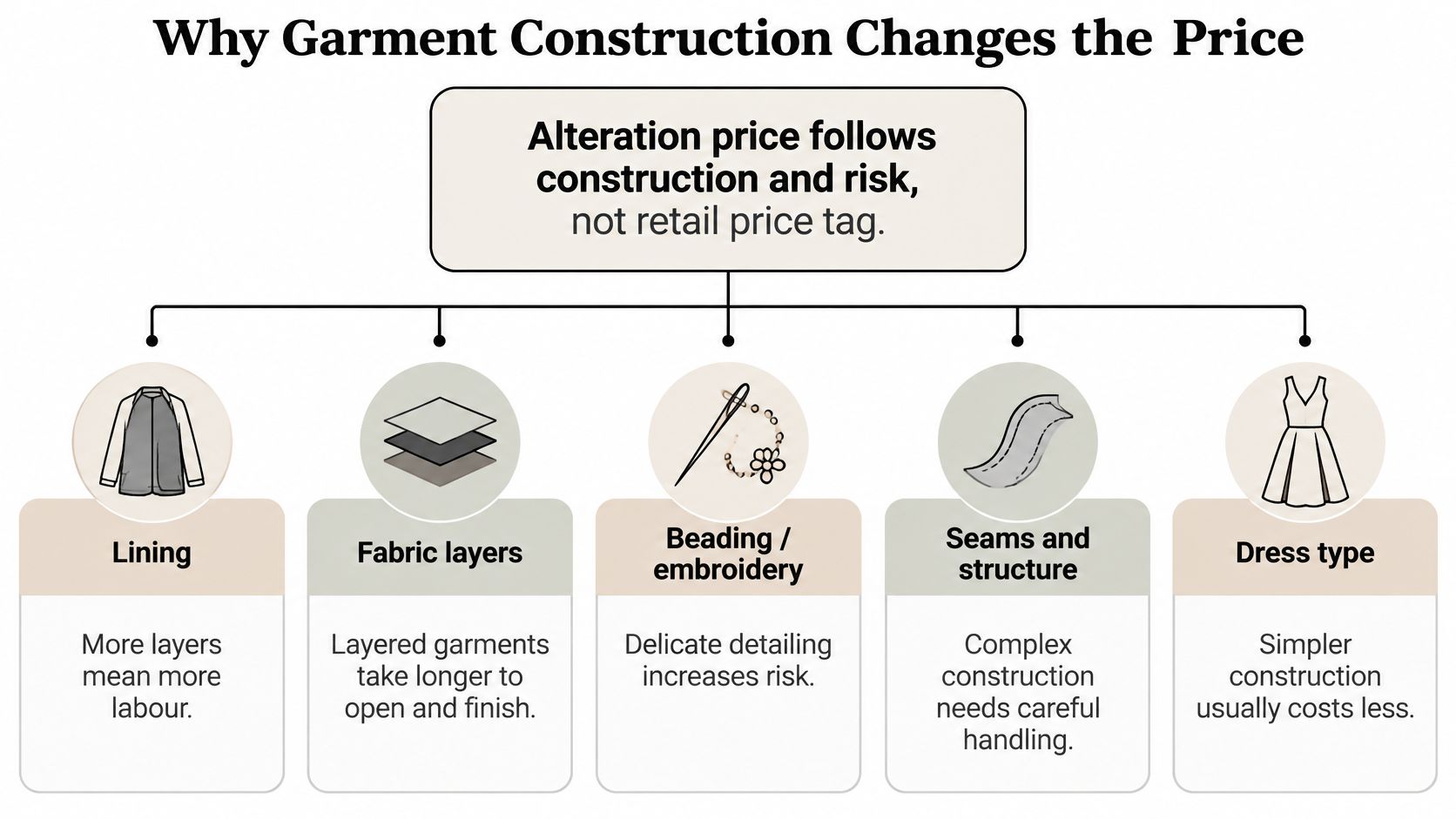
A dress's retail price doesn't tell a specialist how difficult it will be to alter. Statistics Canada's household-expenditure classification treats tailoring and alterations as clothing services, separate from buying the clothing itself. You're paying for work on the garment, not a percentage of its purchase price.
Construction factors that change the alteration price
| Cost driver | Lower-cost case | Higher-cost case |
|---|---|---|
| Lining | Unlined cotton dress | Fully lined silk with boning |
| Fabric layers | Single-layer jersey | Tulle or chiffon over a lining |
| Embellishment | Plain bodice | Beads, sequins or lace motifs to remove and reattach |
| Hem work | Straight hem, no lining | Hem through lining, tiered or pleated skirt |
| Fittings | One fitting | Two or more fittings for structural changes |
A plain cotton shift needing a hem is relatively contained work: mark the finished length, check the allowance, cut, finish and press. On a fully lined silk gown with boning, a broader fit change may require opening the lining, checking the support and rebalancing seams before establishing the hem.
Lining must hang freely without pulling the outer fabric. Separate skirt layers need their own length checks, while lace motifs may need to be lifted and repositioned rather than cut straight through. Structural changes also need movement checks so the garment looks right when you sit or walk.
Inspect before you budget
Count the construction factors present, then identify which ones the proposed alteration touches. Several interacting factors are a warning to allow more than a simple-hem budget, not a formula for calculating a surcharge. Ask which operations the quote includes before approving any cutting.
For a useful introduction to measuring, marking and finishing an uncomplicated hem, B-Sew Inn offers a beginner's guide to hemming pants. Our pants-hemming guide also explains the basic process, although neither should be treated as instructions for reconstructing formalwear.
Each extra operation adds handling time and another opportunity for a visible mark, uneven edge or distorted seam. A careful quote allows for that handling rather than counting machine-sewing time alone. That's why dresses with similar price tags can receive very different alteration quotes.
Sample Quotes for Three Common Dresses
An itemized quote should explain what happens to the garment. These are illustrative scopes, not priced offers: assigning dollar amounts to individual operations without inspecting the dress would create false precision.
A plain lined dress
Say your dress needs shortening and a waist take-in. It may fit the ordinary-dress tier if the seams are accessible and the lining needs little intervention, but it isn't automatically a basic job just because the outside looks plain.
| Sample line item | Scope to specify |
|---|---|
| Hem | Finished length and edge finish |
| Waist take-in | Seams being adjusted and amount approved at fitting |
| Lining | Shorten or reshape only where necessary |
| Fitting and pressing | Fit check and final finish |
For this sample scope, consultation, the fitting and pressing are included. Steaming, taxes and any correction or remake allowance remain unconfirmed until the written quote addresses them. If the lining must also be reshaped, it should appear explicitly rather than being discovered after work begins.
A multi-layer formal gown
A tulle or chiffon gown needing a bustle and bust adjustment requires a different breakdown. The quote should name the skirt layers being shortened, bustle attachment work, bodice adjustment, follow-up fitting and pressing. This belongs closer to detailed tailoring or wedding-gown work than a single fit correction.
In this hypothetical scope, consultation, the planned fittings and pressing are included; steaming is a separate decision. Taxes and responsibility for post-alteration corrections must be confirmed, not assumed.
A beaded or lace gown
Here, the quote needs to distinguish decorative handwork from ordinary hemming. Removing motifs, protecting loose beads, reattaching decoration and restoring the lining should be separate descriptions, even if the business bundles them into a total.
For this example, consultation and additional fit checks are included in the proposed scope. Steaming, taxes and the treatment of corrective work are still items to settle in writing. Clarify what happens if the original trim can't be reused as expected before authorizing removal.
A quote that says only “alter dress” doesn't give you enough information to compare it fairly with an itemized offer.
Cleaning also needs its own decision. If the dress is soiled, our explanation of wet cleaning versus dry cleaning can help you understand the care discussion before fitting and finishing are arranged.
Wedding and Formal Dress Alteration Costs
A bride planning garment care often combines cleaning, fit changes and preservation into a single mental budget. They are different services, and the quote should keep them separate.
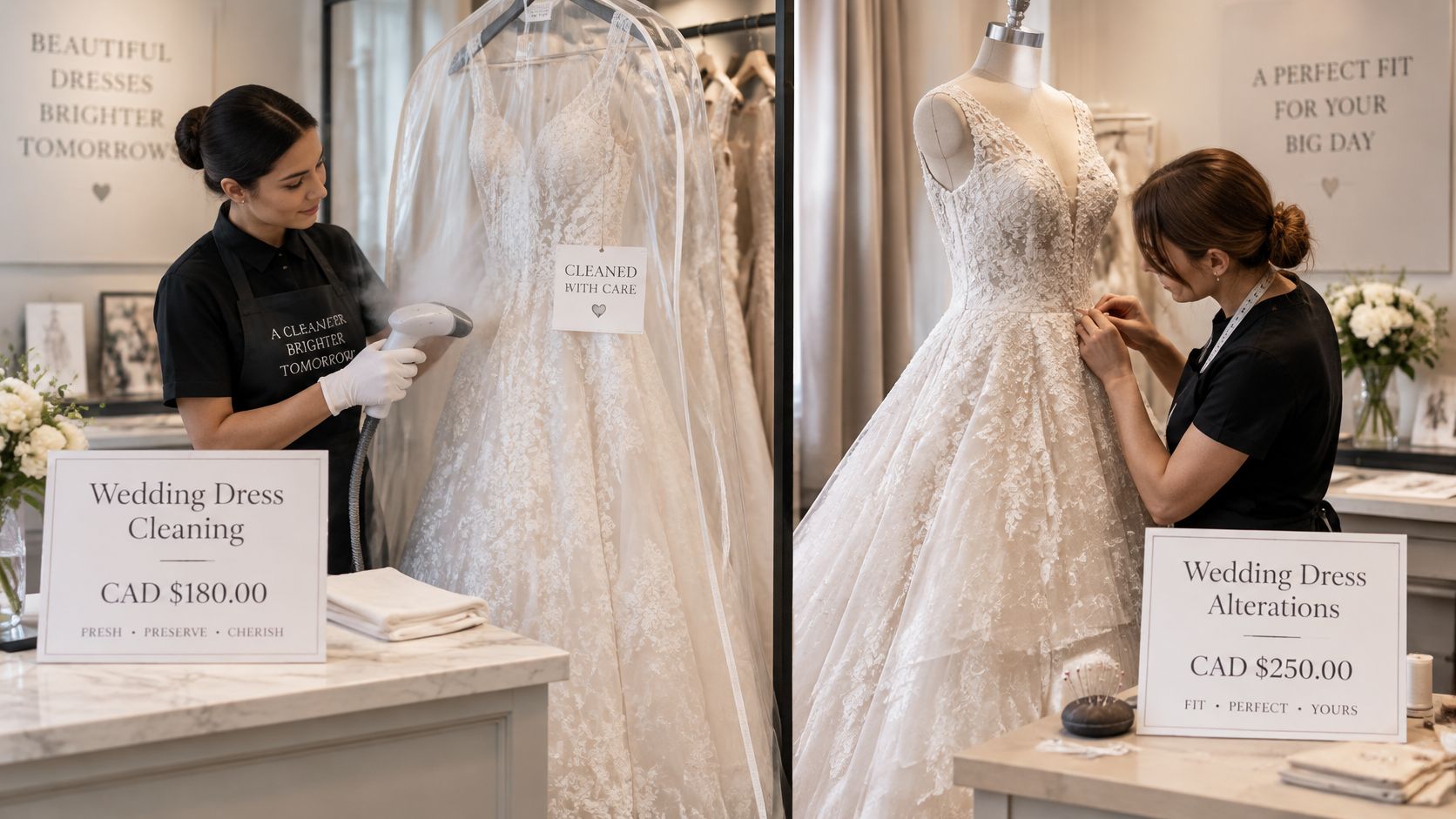
Our wedding dress dry cleaning costs $180.00, while cleaning a multi-layered or embroidered wedding dress costs $250.00. These are cleaning prices, not alteration packages. Our wedding dress cleaning and preservation services include stain removal, dry cleaning with green earth solvents, and storage in an acid-free airtight box with a display window.
From fitting to collection
Start with a physical fitting in your intended shoes and undergarments. The specialist can assess the hem, bust, waist and train together, rather than shortening the skirt before discovering that a bodice adjustment changes how it hangs.
We offer wedding dress alterations, fittings, steaming and pressing for fabrics including silk, satin, chiffon, lace and tulle. Tell us which changes matter most, including whether you want a bustle for moving comfortably after the ceremony. Keep the cleaning request distinct from those fit requirements.
Next, obtain an itemized alteration quote that identifies the planned fittings and whether post-alteration corrections are included. For context, Ontario Job Bank's seamstress wage report lists a median wage of $20.00 per hour and a high wage of $28.00 per hour. Those are employee wages, not customer-facing rates or a method for calculating your gown's price.
Finally, arrange the work several weeks before the event so there's room for fitting corrections without relying on rush availability. At the final check, walk, sit and turn, and practise fastening the bustle if you've requested one.
- Before the event: Establish fit, finished length and the required finish.
- After the event: Assess stains and preservation needs separately.
- On the invoice: Keep cleaning and alteration as distinct charges.
Our wedding dress cleaning guide explains the care side of that decision. Preservation should protect the garment you intend to keep, not obscure what you've paid to change its fit.
Cost Per Wear for Your Dress
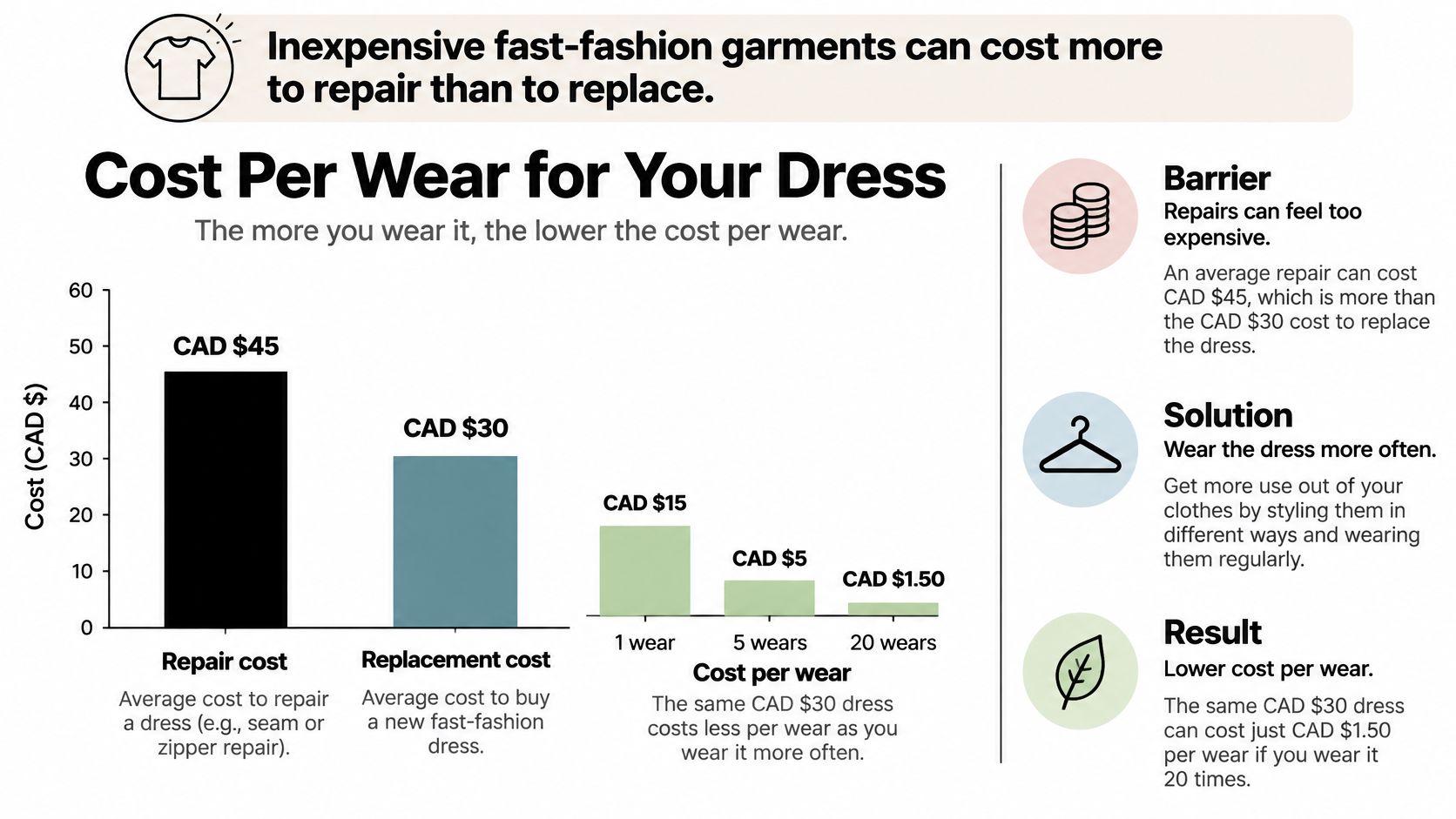
A more expensive alteration can be the better purchase if you'll wear the dress. Conversely, repairing an inexpensive garment isn't automatically sensible: Global Measure's discussion of clothing repair identifies replacement cost as a barrier and illustrates how a $75 alteration worn ten times costs $7.50 per wear, compared with $35 per wear for a $35 replacement worn once.
The table extends that hypothetical calculation. Here, the alteration total means the service cost, not the dress's original purchase price.
Cost per wear for alteration versus replacement
| Option | Total cost (CAD) | Times worn | Cost per wear (CAD) |
|---|---|---|---|
| Alter an existing dress, worn 10 times | $75 | 10 | $7.50 |
| Alter an existing dress, worn 3 times | $75 | 3 | $25.00 |
| Replace with a $35 dress, worn once | $35 | 1 | $35.00 |
These are spending scenarios, not predictions about how long either garment will last. Cost per wear equals the relevant cost divided by the expected wears. If you're comparing future choices, include any necessary cleaning or further repair on both sides, and use realistic wear expectations.
Choose according to the garment's condition
- Alter only: The fabric is sound, you like the design and fit is the obstacle. Check stress points around the zipper, underarms and seat before investing.
- Alter plus cleaning: The garment is worth keeping but needs both fit work and stain treatment. Agree on the care sequence so soil or shrinkage concerns aren't left until after fitting.
- Don't alter: The fabric is thinning, tearing or deteriorating, or the requested transformation would require rebuilding a garment you don't especially want. Structural work can be worthwhile, but not every dress justifies it.
Sentimental value can reasonably outweigh the arithmetic. An event deadline, hard-to-replace fabric or a particularly comfortable fit may also affect your choice. However, keeping an unworn dress after paying for alterations doesn't lower its practical cost per wear.
Choose the dress you're likely to wear, not the repair that merely looks cheapest today.
Consider disposal and ongoing care without assuming every repair is automatically sustainable. Our eco-friendly dry cleaning guide offers context for the care decision. Before committing, establish any assessment charge, minimum price and cancellation terms so you can decline work that no longer makes financial sense.
Reading a Quote and Booking the Alteration
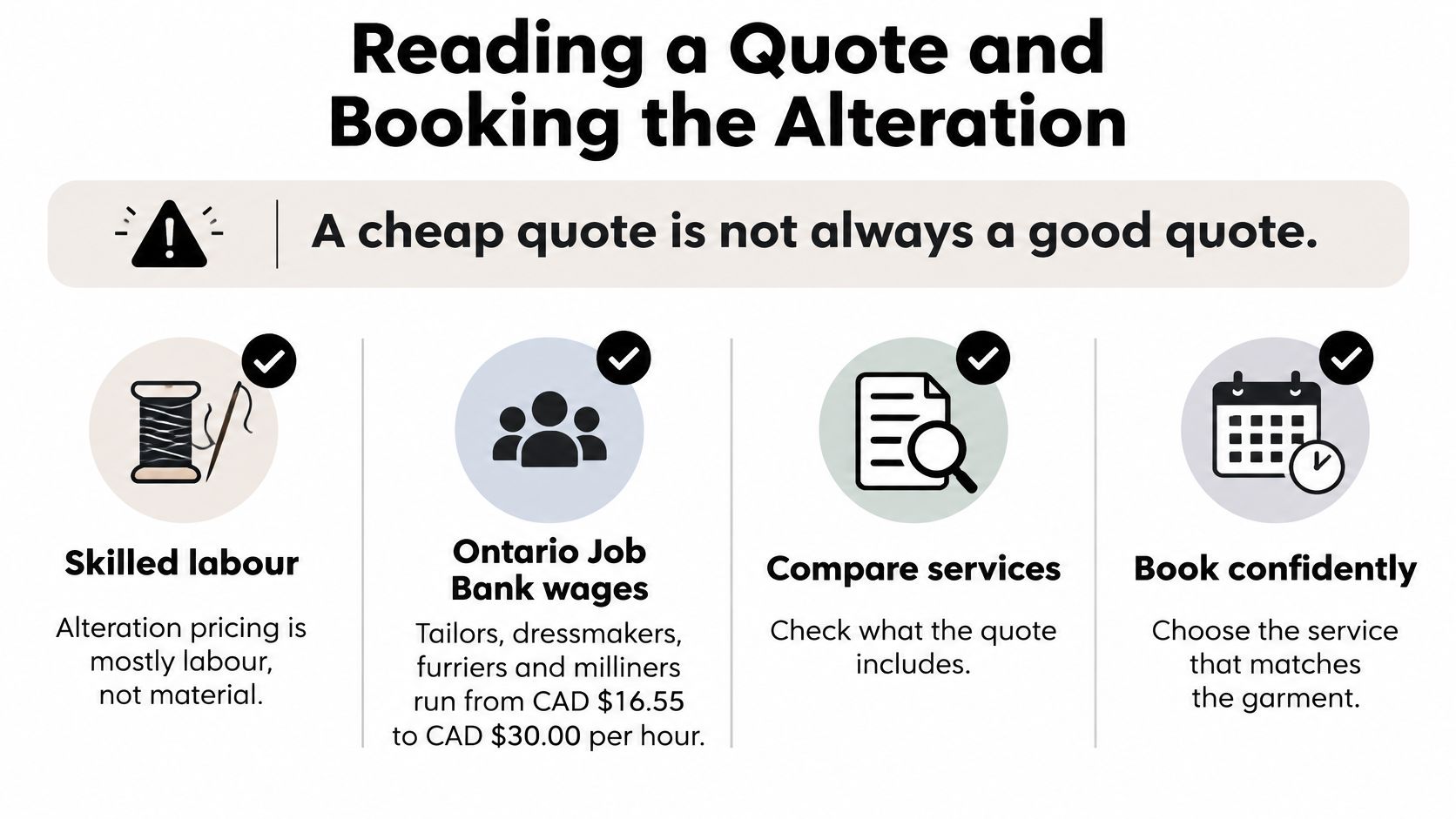
A quote for shortening a lined dress may cover two separate jobs: reshaping the outer fabric and adjusting the lining to match. Ask what work the price includes. The total depends on the agreed scope, the garment's construction and the time needed for fitting, sewing and finishing.
Book with a clear scope
- Bring the dress and intended shoes. A fitting lets the specialist assess how the dress hangs on you, rather than relying on measurements alone.
- Identify the fabric and internal details. Bring the care label and mention lining, embellishments, previous repairs or fragile areas.
- Agree on the finished length. Stand naturally while the hem is marked, in the posture you expect to use when wearing the dress.
- Request an itemized quote. Confirm whether it includes lining work, removing and reattaching decorations, pressing or steaming, fittings, taxes and any correction work.
- Share the event date. Ask whether the proposed schedule allows time for fittings and completion before you need the dress.
- Confirm the completion date and price. CleanOnline's branch crew provides the expected order completion time when you drop off alteration items. If the work changes, agree on the revised scope and price before proceeding.
A fit reference can make the conversation easier. The Dressed Man's simple fit advice for wardrobe beginners explains ideas such as balance and ease, though its examples concern menswear.
Know what can change
CleanOnline's prices may change without notice. For items selected through online orders, management or front desk staff may adjust the price to account for style, fabric or other factors, with your approval.
Pickup and delivery are available. The CleanOnline pickup and delivery service explains the collection option; a physical fitting may still be needed to assess the alteration.
Before booking, compare the itemized scope with the quoted price, then confirm the event date, completion time and approved total. CleanOnline offers alterations for dresses and wedding gowns, along with garment cleaning. Contact CleanOnline, North York's Premium Dry Cleaners to discuss the changes you need and request a quote.