Eco Friendly Dry Cleaning: Solvents and Questions
Compare eco friendly dry cleaning solvents, garment risks and the questions a Toronto cleaner should answer.

The popular advice to choose a perc-free cleaner is only a starting point. It tells you what a shop doesn't use, but not what replaces it, how the equipment contains it, or whether the treatment will leave your garment wearable. A leaf on the window can't answer those questions.
Eco friendly dry cleaning means choosing a suitable process, controlling pollution and protecting garment life. For a Toronto household, that might mean professional wet cleaning for one item, a named solvent for another, and no full cleaning cycle for a jacket that only needs airing. The useful conversation starts with the garment, not the slogan.
Six Cleaning Methods Compared Side by Side
Cleaning methods customers should be able to name
| Method | Medium | Environmental note | Garment caution |
|---|---|---|---|
| Conventional perc | Perchloroethylene, a chlorinated solvent | Associated with toxic-air concerns; not a preferred environmental benchmark | Effective on many oily soils, but stain removal doesn't resolve exposure concerns |
| Professional wet cleaning | Water plus controlled detergent | Avoids cleaning-solvent off-gassing; can reduce resource use | Wrong temperature or mechanical action can shrink or felt wool |
| Liquid carbon dioxide | Liquid carbon dioxide in a pressurized vessel | Closed-system alternative to perc | Not every stain responds; pretreatment still matters |
| Hydrocarbon | Petroleum solvent | Flammable and a volatile organic compound; don't assume perc-free means impact-free | Residual odour warrants a drying and recovery check |
| Siloxane or liquid silicone | Siloxane solvent, such as a cyclic siloxane | Ask about persistence and aquatic toxicity rather than accepting a natural-sounding name | Delicate fabric still needs checks for dyes, trims and adhesives |
| n-Propyl bromide | nPB solvent | Persistence and aquatic-toxicity concerns make it a poor green upgrade | Don't accept the solvent change alone as evidence of better garment care |
The practical definition isn't water-free cleaning. Dry cleaning uses a liquid other than water as its main cleaning medium, while professional wet cleaning deliberately uses water under controlled conditions. Both require inspection, stain treatment, drying and finishing suited to the item.
The environmental notes in this table are screening questions, not a league table. A solvent name helps identify relevant concerns, but it doesn't establish how much escapes, how waste is managed or how much treatment a garment needs.
What the names tell you
Professional wet cleaning isn't a household wash cycle with a more expensive detergent. The cleaner controls detergent chemistry, temperature, movement and drying, then restores shape through finishing. That distinction matters for a lined wool jacket, whose outer fabric and lining may respond differently to water.
Liquid carbon dioxide cleaning uses pressure to maintain the cleaning medium inside its vessel. Hydrocarbon and siloxane systems use different solvent chemistry, so neither should be described as chemical-free. Even a water-based process involves cleaning agents.
Our explanation of wet cleaning versus dry cleaning helps distinguish these processes before you choose a service.
Practical rule: Match the method to the whole garment, including its lining, trim and construction, not just the fibre printed on the label.
What the names leave out
A silk blouse with unstable dye needs a different assessment from a plain, colourfast silk scarf. Glued decoration, shoulder padding and contrasting panels can change the decision even when the main fabric looks familiar.
Start with the care label, then have the cleaner explain any proposed alternative. Treat each row as a process to investigate, not permission to experiment at home. The right answer should identify both the cleaning medium and the garment risk it's intended to avoid.
What California and Toronto Records Measure
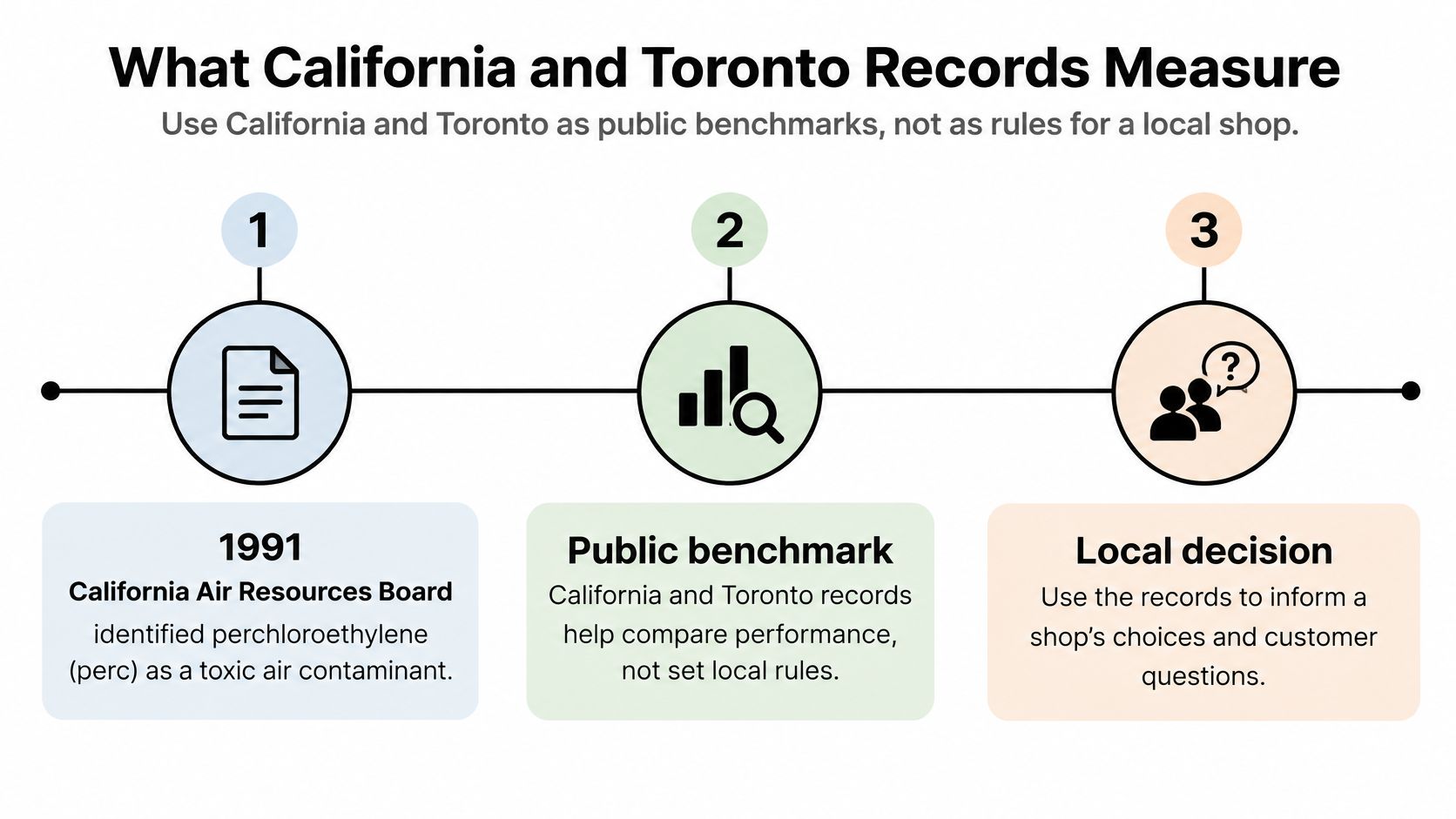
California's records show a sustained move away from perc, not proof that every replacement process has the same environmental performance. The California Air Resources Board's phase-out record says it identified perc as a toxic air contaminant in 1991 and ultimately required perc dry-cleaning machines and related equipment to be phased out by 1 January 2023.
That history provides a benchmark for evaluating a cleaner's direction. It isn't an Ontario rule, and it doesn't tell a Toronto customer which machine operates behind a particular counter.
A transition is different from a shop score
A phase-out concerns the cleaning system itself. It asks businesses to move beyond reducing releases from an established solvent and adopt another process.
That distinction helps explain why better containment and solvent substitution aren't interchangeable. A well-maintained machine may control a problematic substance more effectively than an older machine, but it doesn't change the substance's underlying properties. Conversely, switching fluids doesn't remove the need for maintenance and recovery.
Customers shouldn't interpret a permitted process as an environmental recommendation. Legal compliance establishes obligations within a jurisdiction; choosing lower-impact garment care requires a more specific discussion about the technology and its operation.
California's transition therefore gives Toronto customers a useful comparison point: continued reliance on perc is out of step with that regulatory direction. It doesn't follow that every perc-free option is equally desirable.
What Toronto's reporting captures
The City of Toronto's dry-cleaning pollution-prevention technical guide records that, in 2013, 69 dry-cleaning and laundry facilities reported 13,208 kg of perchloroethylene released to air, while 32 facilities reported 37,164 kg of total volatile organic compound emissions.
Those are historical totals from different reporting groups. They aren't current readings, an average for every Toronto cleaner, or evidence about the facility handling your clothes today. Nor should the totals be added together as though they described separate, non-overlapping pollution categories.
What they establish is the importance of looking beyond the finished garment. A customer sees a pressed suit; an environmental assessment also examines what happened to the cleaning medium during storage, washing, recovery, drying and waste removal.
| Public record | What it helps establish | What it doesn't establish |
|---|---|---|
| California's phase-out | A regulatory direction away from conventional perc cleaning | The law governing a Toronto establishment |
| Toronto's historical emissions reporting | The relevance of solvent releases at a regional scale | A current score for an individual shop |
| A facility's operating records | How that facility maintains equipment and manages material | Whether every garment should receive the same process |
Follow the cleaning medium through the operation
Volatility describes a substance's tendency to enter the air. Containment determines how well the equipment keeps it inside the process. Vapour recovery helps return cleaning medium for reuse rather than letting it escape.
Leaks can occur outside the main cleaning chamber, including around connections, seals and material-handling points. Residue handling matters too: capturing contamination inside a machine only helps if staff manage the resulting waste properly.
For a fuller picture of what happens between inspection and finishing, see our explanation of the dry-cleaning process. It gives context for asking about the less visible parts of garment care.
A meaningful facility assessment follows these practical distinctions:
- Purchased material: What enters the operation, and which process uses it?
- Recovered material: What does the equipment capture and return to use?
- Removed waste: How are contaminated residues contained and transferred?
- Unintended releases: How does the operator identify and address leaks or faulty recovery?
These aren't interchangeable measures. A purchase record alone can't show where all material went, and a solvent's favourable description can't demonstrate that staff handled it correctly.
Public benchmarks help you ask better questions. They don't certify the shop holding your clothes.
The most useful comparison is therefore between a stated process and evidence of its operation. Ask whether the cleaner can explain its equipment, maintenance and waste arrangements without substituting a broad environmental promise for a technical answer.
Which Process Fits the Garment in Your Hand
A lined coat isn't just wool. It may also contain interfacing, padding, adhesives, a different lining fibre and buttons that react differently to cleaning. The cleaner needs to assess that assembly before choosing a method.
The City of Toronto's pollution-prevention review describes professional water-based cleaning as economically viable and environmentally preferred because it can use less water, gas and electricity, avoid solvent off-gassing and treat garments gently enough to support longer use. That's a reason to consider it, not a guarantee that every item belongs in water.
Process fit by garment
| Garment | Ask for first | Avoid |
|---|---|---|
| Wool coat or suit | Professional wet-cleaning assessment, or a named alternative solvent consistent with the care label | Hot water, tumble heat or an ordinary home wash cycle |
| Silk blouse or dress | Gentle solvent cleaning or careful wet cleaning matched to dye stability | Agitation, high heat or an unnamed solvent |
| Rayon | Low-agitation wet cleaning or a carefully selected solvent cycle | Assuming it behaves like cotton |
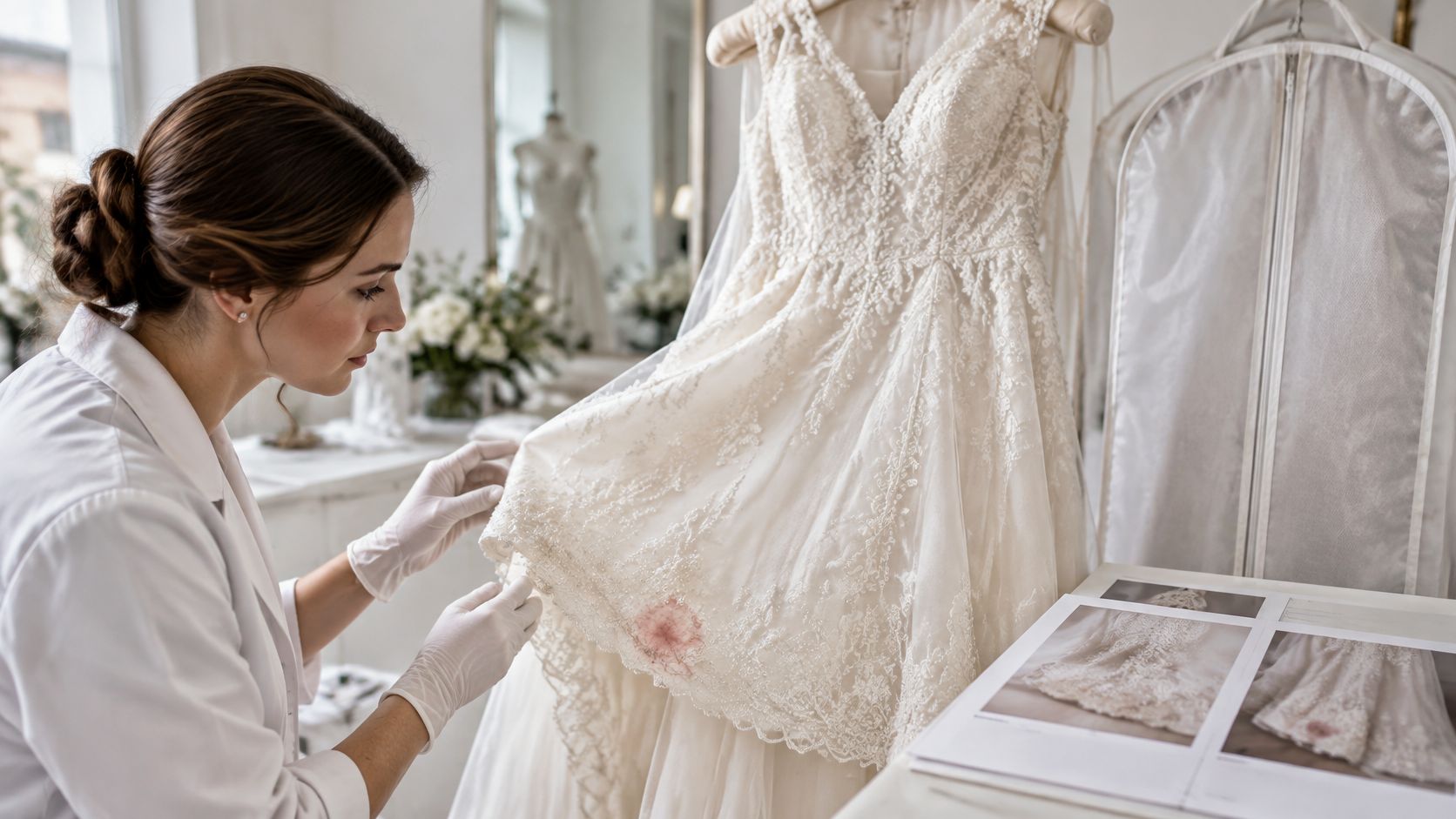
| Wedding gown | A named alternative-solvent assessment, stain treatment and suitable preservation storage | Home washing without specialist assessment or long-term storage in a garment bag |
| Leather or suede | Specialist leather or suede care | Ordinary water-based washing |
| Comforter, blanket, drapery or table linen | Laundering or wet cleaning when fibre, dye and trim allow | Choosing a full solvent cycle by default |
| Lightly worn jacket | Airing, suitable steaming or targeted spot treatment | Automatically cleaning after every wear |
Inspect before choosing
Read the label and point out alterations, loose seams, previous stain treatments and any area that has already changed colour. Tell the cleaner what caused a stain if you know. Cooking oil, wine and paint need different treatment decisions.
For wool, moisture, heat and agitation must be controlled to protect size and surface texture. For silk, dye movement may be as important as fibre strength. Rayon can distort when wet, so handling and drying deserve particular attention.
Our guide to dry-cleaning a winter jacket addresses the practical decisions around outerwear. Don't assume a washable outer shell means the insulation, trim and construction can tolerate the same treatment.
Keep the item usable
A wedding gown requires inspection of beadwork, lace, adhesives and discoloured areas before anyone selects a cleaning medium. Preservation is a separate decision from stain removal; the storage materials and the garment's condition both matter.
Upholstery needs its own assessment because backing, filling and attached construction introduce risks a removable garment may not have. For that related household task, you can explore eco friendly upholstery cleaning methods through J.G. Carpet Cleaning LLC rather than transferring clothing advice directly to a sofa.
Garment life is the tie-breaker when methods offer different risks. A lower-impact cycle isn't a useful choice if it leaves a suit misshapen and unworn. Repairing a loose seam before treatment, or deciding that an unsoiled item needs only refreshing, can be part of responsible care too.
Questions Worth Asking Before You Drop Off
Environmental performance depends on what staff do between cleaning cycles as well as during them. The Ontario dry-cleaning equipment regulation encompasses maintenance, servicing, solvent-residue removal and residue management, requires a trained full-time person at a commercial establishment, and directs operators to minimize contaminant discharge.
That makes a counter conversation useful. You don't need to inspect the plant yourself, but you should receive answers that describe actual practices rather than repeat an advertising phrase.
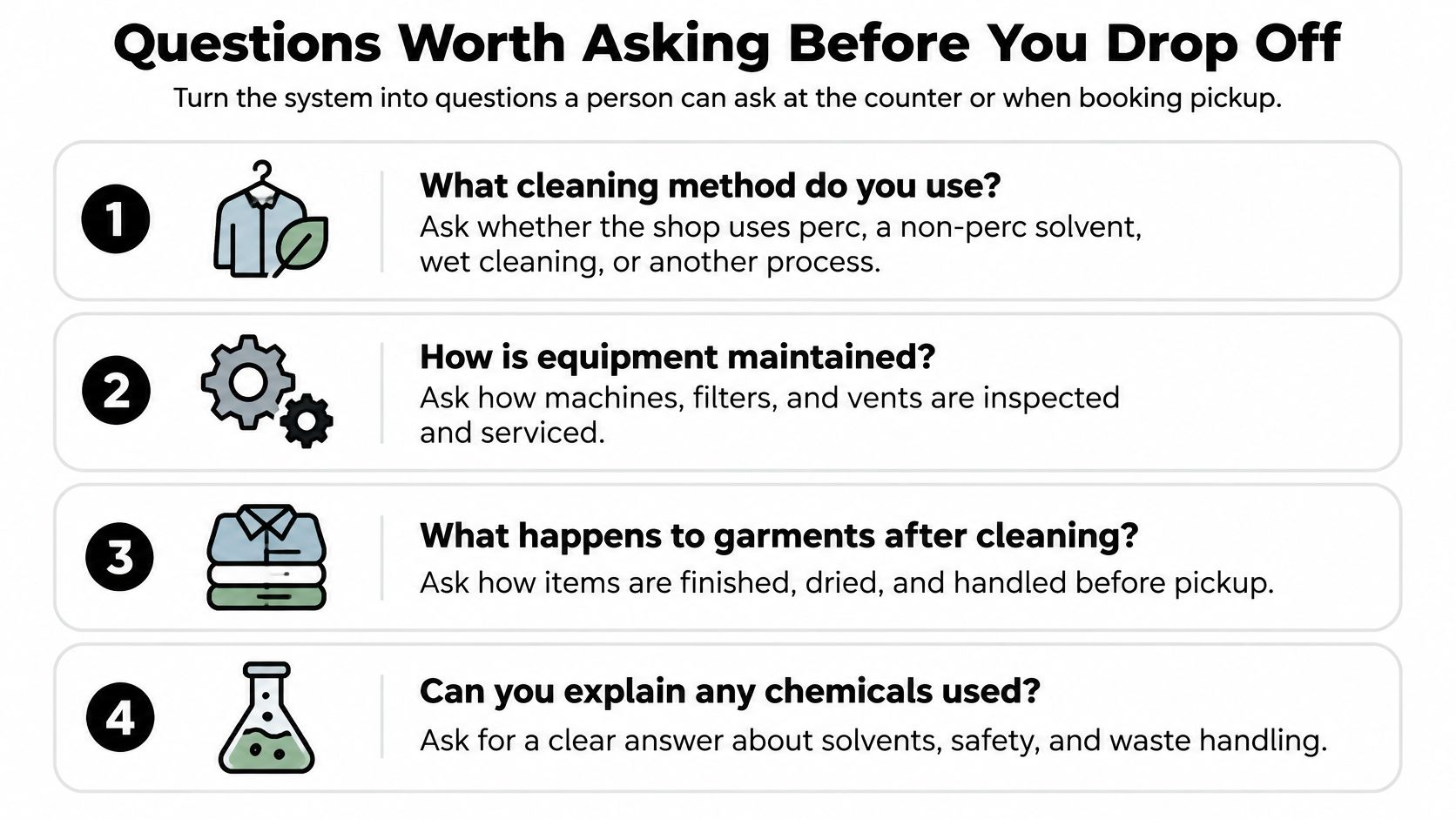
Ask about the item and the operation
Which solvent or water-based process will you use on this item?
The answer should name the medium. Non-toxic, natural and premium don't identify a cleaning process.Is the machine closed-loop or otherwise high-recovery?
Ask whether solvent-wet garments move between separate machines. That transfer creates a handling point worth understanding.What happens to spent solvent, filters and still bottoms?
Still bottoms are residues left after solvent distillation. The cleaner should explain how contaminated materials are contained and sent for appropriate treatment or disposal.How do you inspect for leaks, and who responds to a fault?
Listen for a maintenance routine and a responsible trained person, not reassurance that a machine is new.What risks do you expect for this fibre, dye, lining and trim?
A useful answer might identify possible colour movement, dimensional change or damage to decoration. A blanket promise that nothing can go wrong isn't a substitute for assessment.Does this stain need a full cycle?
Ask whether localized treatment is appropriate and whether it could leave a ring or uneven finish. Spotting requires judgement too.
Listen for a process, not a promise
A booking employee may need to check with the person assessing the garment. That's reasonable when they explain who will decide and how you'll receive the answer. Guessing confidently is less reassuring than obtaining the correct information.
For a high-value item, describe the construction and damage before authorizing treatment. Our guide to cleaning a wedding dress can help you prepare for that conversation without assuming every gown requires the same approach.
A useful answer names an action: inspect the dye, recover the solvent, contain the residue or consult the garment specialist.
You're not asking for an environmental audit at the counter. You're checking whether the business can connect its claims to identifiable work. If nobody can name the process that will be used, the shop hasn't given you enough information to hand over the bag.
Green Claims That Still Miss the Mark
Perc-free doesn't name the replacement. A cleaner can remove one concerning substance from its operation and introduce another with a different environmental problem. Ask what changed, not just what disappeared.
The same caution applies to descriptions such as gentle, plant-friendly or natural. They don't tell you how a substance behaves in air or water, or what happens when the operator disposes of contaminated material.
Better equipment isn't an optional detail
In its 2007 explanation, the California Air Resources Board said closed-loop machines used about 70% less perc than transfer machines and projected that secondary controls on newer closed-loop systems could capture roughly 95% of emissions that could otherwise escape when machine doors opened.
These are historical comparisons and projections for particular equipment and controls. They aren't a performance guarantee for a cleaner advertising closed-loop technology today.
The correction is practical: a claim about the fluid leaves out the machinery that handles it. Equipment design, its condition and staff operation belong in the same environmental conversation.
For help evaluating broad sustainability language beyond garment care, Fillaree's guide to spotting greenwashing offers a useful companion resource. Apply that scrutiny to a cleaner's claims by looking for specific descriptions rather than reassuring imagery.
More treatment doesn't mean better care
A greener cycle can still be unnecessary. A clean jacket worn briefly may need ventilation, while a stained work garment needs prompt attention before soil becomes harder to remove.
Home washing isn't automatically the better alternative either. If the chosen treatment causes avoidable shrinkage or colour loss, the item's reduced usefulness belongs in the decision.
Eco friendly dry cleaning is pollution prevention plus a garment that stays wearable.
Be cautious about absolute promises. No-impact cleaning, universally safe solvents and guaranteed fabric longevity compress complicated decisions into claims that a careful cleaner should qualify. A credible explanation includes limitations, including stains that may remain and treatments that would place the fabric at risk.
Decide Before You Hand Over the Bag
Choose the outcome you need before choosing the service. Does the item need soil removed, an odour assessed, its shape restored or a damaged seam repaired? Those aren't necessarily the same job.
Lay the garment flat in good light, read the label and check the cuffs, collar, underarms and lining. Note stains without rubbing them or adding household cleaners. Keep any detached trim with the item and tell the cleaner about previous attempts at treatment.
Make the booking specific
Use a short decision checklist rather than booking everything as dry cleaning:
- Identify the item: Give the fibre, lining and construction details you can confirm.
- Describe the problem: Separate a visible stain from general wear, odour or damage.
- State your priority: Explain whether preserving colour, shape, decoration or a sentimental feature matters most.
- Request clarification: Get the proposed process and any material risks before authorizing an uncertain treatment.
For households in North York, Toronto and the wider GTA, comparing local laundry and garment-care options should involve more than distance and collection convenience. An online booking deserves the same technical clarity as an in-person visit.
Judge the answer you receive
A strong answer connects the item to a named treatment and explains what the operator will do if inspection reveals a problem. It also distinguishes what the cleaner can confirm from what requires further assessment.
At CleanOnline, we use eco-friendly solvents such as liquid silicone. That identifies a cleaning medium, but it shouldn't end your decision: the particular garment still needs an appropriate treatment plan.
Keep your stain description with the order, especially when arranging pickup. Don't assume the person collecting the bag will know which mark concerns you or which trim is fragile.
Choose the cleaner whose explanation is specific enough to evaluate. Convenience is valuable, but a clear treatment decision gives you a better basis for trusting the work than a green logo alone.
CleanOnline offers dry cleaning, laundry, alterations and specialized garment care, with doorstep pickup and delivery for North York, Toronto and the GTA. Visit CleanOnline, North York's Premium Dry Cleaners to discuss your garment, clarify the cleaning process and arrange the care it needs before packing your bag.