Dry Cleaning Toronto: Garments, Solvents and How to Choose
Dry Cleaning Toronto explained: which garments need it, how solvents differ, what to check in a cleaner and how to book a doorstep pickup.

The most common advice about dry cleaning is to send anything delicate to a professional and choose the closest shop. That skips the decisions that matter: whether the garment needs cleaning at all, whether damage should be repaired first, and whether the proposed process suits its construction.
Good dry cleaning in Toronto starts before you book. Separate routine laundry from structured clothing, identify pieces that need specialist assessment, and ask what will happen to each item. The right treatment matters more than the convenience of the transaction.
Which Garments Need Dry Cleaning in Toronto
The care label is the starting point, but fabric and construction decide how cautiously to proceed. A washable outer fabric doesn't make a jacket washable if its lining, shoulder padding or bonded layers can't tolerate the same treatment.
When a garment needs dry cleaning in Toronto
| Garment | Usually needs professional dry cleaning | Often fine at home |
|---|---|---|
| Wool suits and tailored jackets | Yes | Rarely |
| Silk blouses and dresses | Yes, unless the label allows hand washing | Sometimes, with gentle hand washing |
| Leather and suede | Yes, through a leather specialist | No |
| Velvet and other special fabrics | Yes, through an appropriate specialist | No |
| Cotton and cotton-blend shirts | Optional, for heavy soiling; professional laundering may be preferable | Yes, with machine washing |
| Wedding dresses | Yes, with construction and trim assessment | No |
| Comforters and duvets | When the fill or label requires it | Often yes, if the label allows and the machine has sufficient capacity |
| Heavy coats and outerwear | Yes for structured wool; assess down blends by label | Washable shells and down items when the label permits |
| Polyester and performance fabrics | Rarely, unless construction requires it | Yes, on a cold cycle when permitted |
Read the whole label before choosing a method
Check the written instructions and symbols, including drying and ironing restrictions. Dry clean only means no home washer, even on its gentlest setting. A hand-wash instruction isn't permission to use a machine's delicate cycle.
Next, inspect the garment rather than judging by fibre alone. Beading, glued decorations, contrasting dyes and a fragile lining can change the safest method. A cotton shirt may tolerate washing easily, while its oily collar needs targeted pretreatment rather than a stronger wash.
Professional care doesn't always mean solvent cleaning. A washable duvet may need commercial laundering because your drum can't accommodate it without compression. A heavily soiled washable shirt may benefit from professional stain treatment and pressing.
Practical rule: Choose the least aggressive process that can remove the soil without compromising the garment.
Cleaning frequency should follow actual wear, perspiration and staining, not an automatic calendar. Our guide to how often to dry clean a suit helps distinguish a garment that needs cleaning from one that needs airing and careful brushing.
Before booking, ask:
- What does the label permit? Include the drying instructions, not just the washing symbol.
- What needs removing? Identify visible stains, odour or general soil.
- What could change shape or colour? Check padding, lining, trims and contrasting panels.
A Garment Triage
Cleaning isn't always the most sustainable choice. Toronto households throw away an average of 17 kilograms of clothing and other textiles annually, according to the City of Toronto's waste-reduction guidance. Keeping a useful garment in service requires more than removing a stain.
Start with its remaining wearable life. A coat with sound fabric and a loose hem is a different proposition from a jacket with thinning elbows, a shredded lining and permanent discolouration.
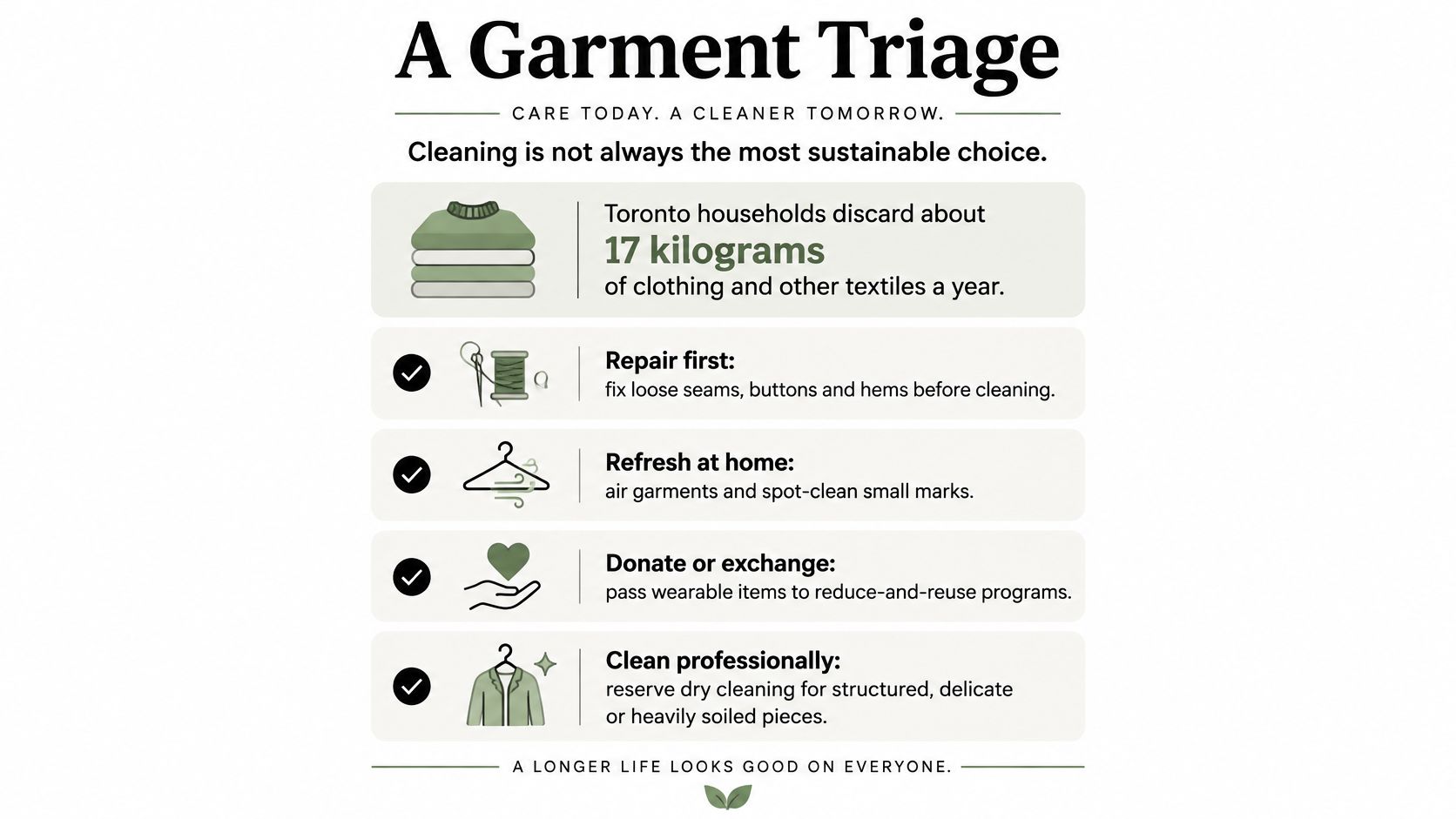
Triage outcomes and the signs that point to each
| Outcome | Signs that point to it |
|---|---|
| Clean and wear again | Sound fibres, good colourfastness, soiling without structural damage |
| Repair before cleaning | Loose hem, missing button or open seam that cleaning could worsen |
| Restore after damage | Water, smoke or mould damage on a garment of real value, with an assessment before work |
| Donate | Wearable with no visible damage, but no longer suits the owner |
| Recycle | Fibres worn beyond reuse, so reuse is no longer practical |
Inspect condition before spending money
Turn the garment inside out. Check underarms, cuffs, pocket openings and the lining around seams. Hold worn areas against the light to identify thinning, but don't stretch weakened fabric to test its strength.
Tell the cleaner how old a stain is and what you've already applied. Colourfastness needs professional assessment, especially on contrasting panels; rubbing a wet cloth across a valuable garment can create a new problem. A cleaner should distinguish likely improvement from a guaranteed removal.
Consider a low-cost dress with a torn lining and a persistent stain. Cleaning alone won't make it wearable, and extensive work may not make economic sense. A simple repair could still be worthwhile if you'll wear it regularly, but donation isn't an appropriate escape route for unusable clothing.
For sound pieces that no longer fit, donation or exchange can preserve their usefulness. Send them on clean and in wearable condition, and check the recipient's acceptance rules.
A garment's original price doesn't determine whether it deserves repair. Its condition, usefulness and personal value do.
Mould-contaminated textiles belong in a separate assessment pathway, not a donation bag. Keep suspect items apart from clean clothing and disclose the damage before arranging handling. Work through the condition decision before purchasing the cleaning service.
How Professional Dry Cleaning Works, Step by Step
Dry cleaning uses a cleaning liquid other than water as its main medium. The garment still gets wet during processing, so the operator must control the solvent, mechanical action, temperature and drying conditions.
A good result depends on the work around the machine cycle as much as the cycle itself. Stain identification, load preparation and finishing can determine whether an item returns wearable or merely looks pressed.
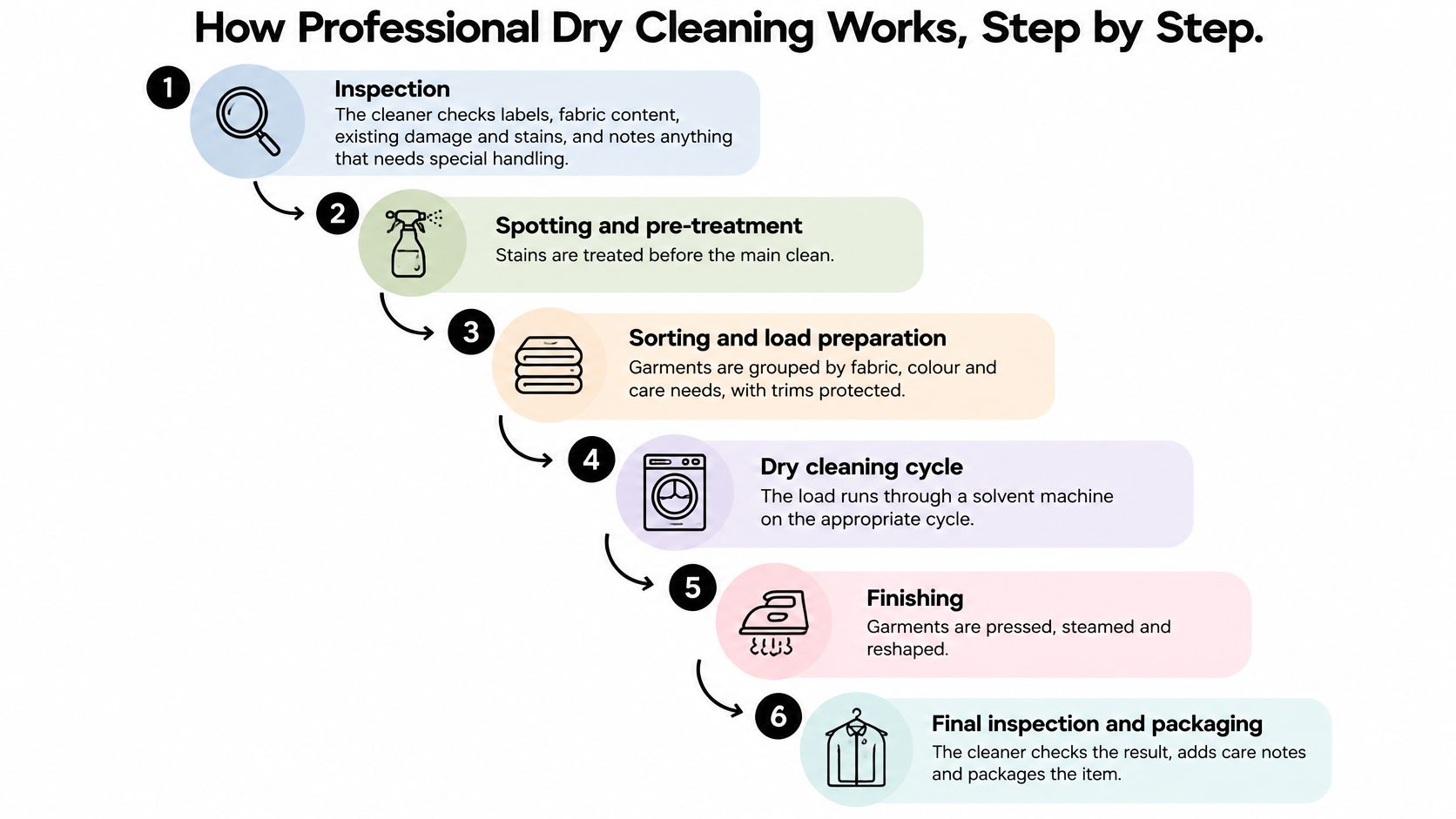
From intake to finishing
Inspection establishes the treatment plan. The cleaner checks the label, fibre content, stains, trims and existing damage, then records concerns before processing. Empty pockets yourself and identify anything concealed, such as a detachable belt or a weakened zip.
Spotting targets what the main cycle won't remove reliably. Protein stains such as blood, oily marks and tannin stains such as tea require different approaches, so the cleaner selects spotting agents rather than treating every mark alike. Controlled pretreatment reduces the temptation to repeat an unsuitable cycle or apply excessive heat to unresolved staining.
Sorting and solvent cleaning protect the garment during treatment. The operator groups compatible colours and fabric weights, protects vulnerable trims and selects the appropriate machine programme. Agitation loosens soil while filtration helps keep removed material from redepositing on the load.
Drying removes solvent under controlled conditions. The machine extracts and recovers solvent before the garment proceeds to finishing. Persistent chemical odour warrants investigation, not masking with fragrance or immediate storage in a wardrobe.
Finishing restores shape rather than flattening fabric. The finisher uses steam, pressure and suitable supports to shape lapels, sleeves and seams, then checks buttons, hems and presentation. Excess pressure can produce shine on wool or leave seam impressions that a customer shouldn't have to accept.
Inspect the result before storing it
Look at the garment outside its packaging. Lapels should sit naturally, sleeves shouldn't twist, and trousers should have the requested crease rather than competing press lines.
Check the original stain location in good light. A remaining mark doesn't automatically mean careless work: further treatment may threaten the dye or fibre. What matters is whether the cleaner explains the limit instead of promising that another aggressive attempt will solve it.
If there's a concern, leave the item unworn and contact the cleaner promptly. Photographs of the affected area and the order record make a discussion more useful than attempting another treatment at home.
Solvent Options and What Each One Means
The solvent is a major difference between cleaning plants, but it isn't a complete measure of quality. Fabric compatibility, stain treatment, recovery equipment and operator judgement all affect the result.
Toronto has a substantial history with PERC. A Toronto Board of Health report estimated that approximately 360 facilities used PERC in 2007 and identified its federal toxic designation. That historical baseline explains the importance of solvent management, not which process a particular shop uses today.
Common dry cleaning solvents compared
| Solvent | Where it is typically used | What to ask the cleaner |
|---|---|---|
| Tetrachloroethylene (PERC) | Conventional and older plants | Is the garment run in a closed machine? Benchmark questions follow in the regulation section |
| Hydrocarbon | Delicate fabrics and general garments | How are flammability controls and solvent recovery managed? |
| Liquid silicone | Delicate and structured garments | Which product is used, and how is it recovered? |
| Wet cleaning | Labelled items that tolerate water | Is the garment label marked as suitable for wet cleaning? |
| Eco-marketed alternatives | Garments for which a lower-impact process is proposed | Can the cleaner provide the product name and safety data sheet? |
Match the method to the problem
Say a silk blouse has a water-soluble beverage stain. Professional wet cleaning may suit it if testing, the label and its construction support that choice. A structured wool jacket with oily soil may be better suited to a solvent process that protects its shape.
Wet cleaning is a controlled professional process, not putting delicate garments through ordinary laundry. It requires suitable detergents, mechanical action, drying and finishing.
Hydrocarbon requires flammability controls. Silicone still needs appropriate recovery and waste handling. Neither a gentle-sounding product name nor an environmental marketing term proves that the entire operation has a lower impact.
Our dry-cleaning solvent guide explains the distinctions behind these names. Ask for the actual process rather than accepting green or natural as a technical answer.
No solvent is correct for every garment, and no cleaning method is impact-free.
For washable synthetic clothing, avoid unnecessary cycles and follow the care instructions. Choosing solvent cleaning solely to avoid washing-machine discharge would ignore the other environmental costs of garment care.
Stains, Leather, Wedding Dresses and Water Damage
A routine cleaning order assumes the garment is stable enough for an established process. These situations need a more specific decision before work starts.
Small stains and specialist materials
A coffee splash on a blouse. Blot excess liquid with a clean white cloth without scrubbing. Tell the cleaner whether the drink contained milk or sugar and disclose any detergent, stain pen or home remedy you used. Fresh stains are generally more responsive than aged ones, but fibre and dye stability still limit treatment.
A suede jacket with a dark cuff. Don't wash it or attack it with household degreaser. A leather specialist needs to assess the finish, colour and accumulated wear; cleaning may reveal differences previously hidden by soil. Ask whether colour correction or refinishing is part of the proposed work.
Occasion wear and contaminated textiles
A wedding dress put away after the reception. Arrange assessment promptly rather than storing it with unnoticed drink spills or perspiration. Beading, adhesives, lace and layered hems need separate consideration, and the safest treatment may not be identical across every component.
Use our guidance on cleaning a wedding dress to prepare for the assessment. Confirm the proposed cleaning method and preservation materials, and keep the storage box away from damp areas and temperature extremes.
A coat affected by a basement leak or smoke. Disclose the source of the water, how long the garment remained damp and any visible mould. Don't shake contaminated textiles through the house or enclose damp items for prolonged storage. Restoration may address soil and odour, but it can't necessarily reverse dye movement, shrinkage or weakened fibres.
Before authorising work: Separate the assessment fee, proposed treatment and expected result. An assessment isn't a promise of full restoration.
For sentimental or valuable pieces, request a written description of the risks. The decision should account for what could be lost through treatment, not just what might be recovered.
Choosing a Toronto Cleaner Using Regulatory Benchmarks
For a cleaner using PERC, equipment and waste handling aren't optional extras. The federal tetrachloroethylene regulations overview specifies closed handling controls and, for machines installed after July 31, 2003, a design consumption limit of 6.2 litres, or 10 kilograms, per 1,000 kilograms of clothing cleaned.
You don't need to inspect machinery yourself. Use the requirements to judge whether the business can explain how the processing facility operates, particularly if your local counter sends garments elsewhere.
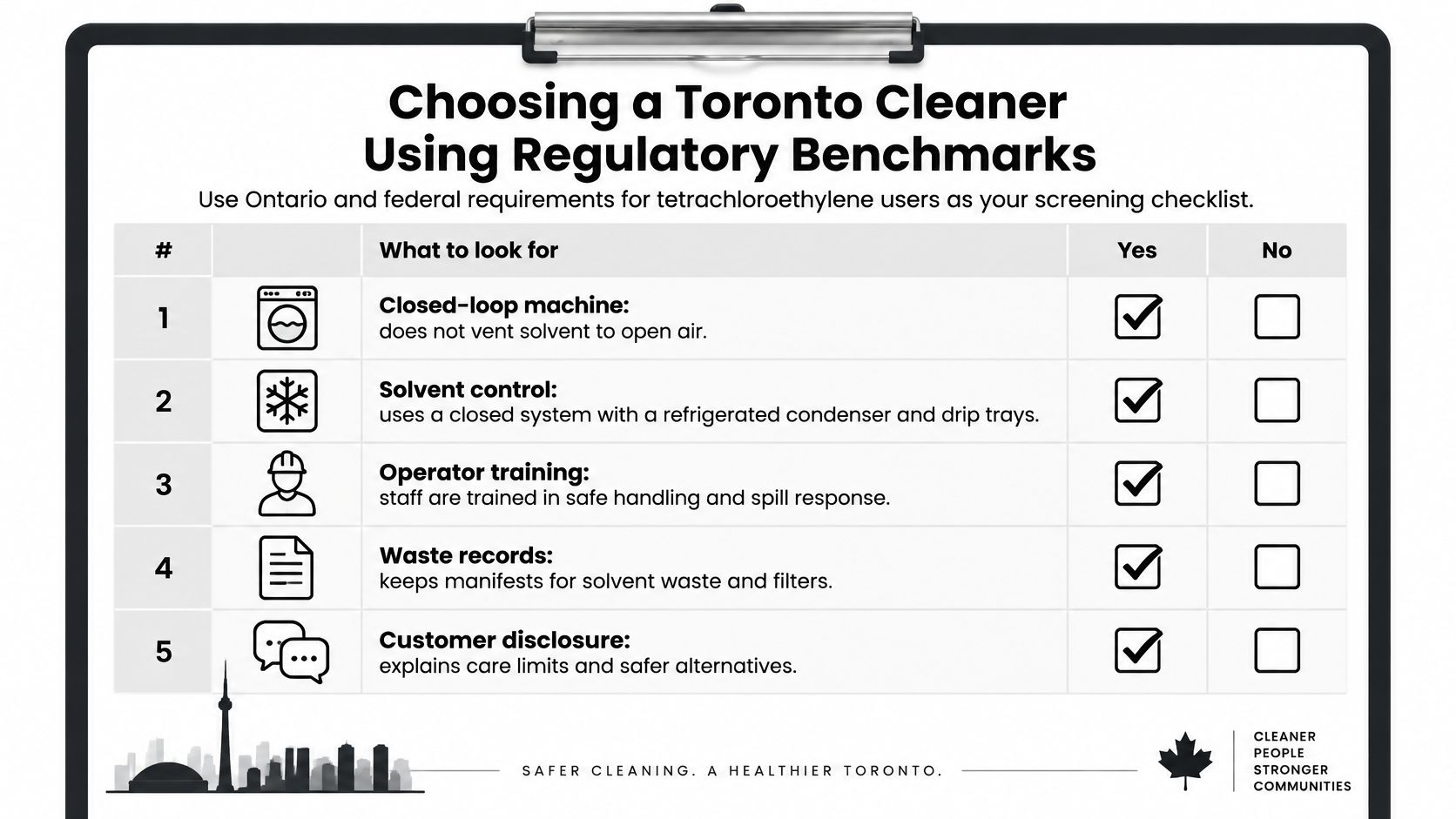
Ask operational questions, not marketing questions
- Does the machine vent PERC directly outdoors during processing? Federal controls prohibit direct venting during washing, extraction, drying and aeration. Ask about the built-in refrigerated condenser and PERC–water separator.
- How is solvent delivered and contained? Look for a clear explanation of closed direct-coupled delivery, closed storage containers and secondary containment sized for the relevant tanks and containers.
- What happens to contaminated wastewater and residue? The answer should describe authorized waste handling, removal records and scheduled collection, not disposal into a drain.
- Who is responsible for safe operation? Ontario's trained full-time employee requirement makes operator competence a practical screening issue. Ask who handles operating questions at the processing site.
A counter employee may need to obtain answers from the plant. That's reasonable. A vague assurance that everything is environmentally friendly isn't an answer.
Check the customer agreement too
Ask for an itemised receipt, documentation of existing damage and the written liability terms before handing over a valuable garment. Our liability is limited to the lesser of 10 times the cleaning or service cost or the item's depreciated value, determined using International Fabricare Institute or Ontario Fabricare Association guidelines.
That makes it important to discuss unusually valuable items before authorising treatment. A sentimental value and a contractual compensation value aren't the same thing.
Use the same scrutiny for environmental claims. Our guide to eco-friendly dry cleaning helps you evaluate the process behind the label. Regulatory compliance is a baseline, while careful intake, realistic advice and transparent terms help distinguish customer service.
Book Your First Toronto Dry Cleaning Pickup
Choose doorstep pickup for routine garments with straightforward care needs. Choose an assessment first for leather, wedding dresses or water-damaged items. Convenience should follow the treatment decision, not replace it.
We offer free pickup and delivery of laundry and dry cleaning anywhere in Toronto. If you prefer an in-person handover, our North York locations are 4664 Yonge Street and 4841 Yonge Street, both in Ontario, Canada.
Prepare a clear order
- Sort by care needs. Keep routine washable clothing separate from garments requiring specialist handling.
- Flag assessment items. List the damage, stain history and any missing accessories without attaching adhesive notes directly to delicate fabric.
- Request an itemised quote. Confirm the proposed treatment and expected turnaround for each garment before work begins.
- Resolve the handling questions. Establish where the garments will be processed and review the relevant operating and liability terms.
- Schedule collection. Keep a record of the items and identify any matching pieces that should be handled together.
Same-day dry cleaning is available on special request for urgent needs. Don't assume an urgent request can include complex stain removal or restoration; agree on what's feasible before committing to an event deadline. Our guide to how long dry cleaning takes can help you plan the handover.
Results depend on the garment's condition, previous treatments and stability. Valuable pieces need an assessment before work begins, even when the visible problem looks small.
CleanOnline, North York's Premium Dry Cleaners offers garment care with free pickup and delivery anywhere in Toronto, alongside in-store drop-off in North York. Visit to arrange collection for your routine cleaning or request an assessment for a delicate, damaged or sentimental item before authorising treatment.