Laundry Service North York: Prices, Pickup and Options
Find a laundry service North York residents can use: doorstep pickup, wash-and-fold prices, dry cleaning options and commercial laundry for businesses.

Toronto households throw out roughly 16 kilograms of textiles a year, and most of that material is still wearable. City of Toronto waste audits covering 2012 to 2018 put textiles at an average of 2.1% of residential waste by weight, and the 2018 single-family audits estimated that nearly 70% of discarded textiles were reusable, according to the City of Toronto waste audit background file. Read those figures together and the local question stops being whether to book a laundry service. It becomes which one, at what price, and how a bag of clothes gets from a 14th-floor unit to a folding table and back without disappearing.
This guide answers in that order. Prices first, in a table of every published starting rate, so you can price a shirt or a tuxedo before reading a paragraph of sales copy. Then the pickup routine, the building-access protocol you can forward to a property manager, and the cleaning-versus-repair maths that decides whether a garment gets a second life. Where a recommendation is blunt, it's because it holds up against how North York buildings and household budgets work.
Laundry Service Prices in North York at a Glance
Match the item in your hand to a starting price before anything else. This is the whole published list for a laundry service North York residents can price in a minute.
Starting prices for laundry and dry cleaning in North York
| Item | Starting price | Basis |
|---|---|---|
| Wash and fold laundry | $3.00 | Per pound |
| Shirts | from $3.49 | Per item |
| Dresses | from $14.99 | Per item |
| Press-only suit | $16.99 | Per item |
| Vest-only suit | $8.99 | Per item |
| 2-piece women's suit | $21.99 | Per item |
| 2-piece men's suit | $21.99 | Per item |
| Special care suit | $24.99 | Per item |
| 2-piece tuxedo | $25.99 | Per item |
| 3-piece men's suit | $26.99 | Per item |
| Suit with leather trim | $27.99 | Per item |
| Track suit | $18.99 | Per item |
Every figure above is a starting price, and the final charge depends on the service and the item you select. A dress with a fresh spill and a dress that needs pressing only don't travel the same route, and a suit with leather trim can't be processed like plain wool. Treat the table as the floor of the range, not the invoice.
The two models do different jobs. Wash and fold is priced by weight, so a week of everyday clothes is easiest to estimate in pounds, and the cost tracks how much you send rather than how many items are in the bag. Dry cleaning is priced per garment, so suits, dresses and coats get counted by the piece. Mixing the two units is where most estimates go wrong.
Pricing rule: split the bag into everyday clothes and garments, weigh the first pile, count the second, and ask for a quote on anything the list doesn't cover.
The split isn't a quirk of one shop. In 1949, Canadian power laundries, dry-cleaning establishments and dyeing plants took 36% of receipts from laundry and 54% from cleaning and dyeing, according to Statistics Canada's report on the industry. The two units survived because they measure two different kinds of work.
Household items, blankets, drapery and alterations all have their own published rates on our laundry and dry cleaning price list, which is the same document the counter quotes from.
Matching Each Garment to the Right Cleaning Service
Scan the left column first. The middle column tells you what to book, and the right column explains why that's the answer rather than the nearest alternative.
Which service fits which item or need
| Item or need | Service | Why it fits |
|---|---|---|
| Everyday shirts and casual clothes | Wash and fold | Washed, dried and folded in sets of five |
| Silk, rayon, velvet or leather | Special fabric dry cleaning | These fabrics need specialized handling |
| Suits, tuxedos and dresses | Dry cleaning and pressing | Priced per garment in the price table |
| Wedding dress | Wedding dress cleaning | Dedicated service for a single high-value garment |
| Outerwear | Outerwear cleaning | Dedicated service for coats and jackets |
| Hems, loose stitching or fit changes | Alterations | Keeps the garment usable |
| Shoes | Shoe repair and cleaning | Repair and cleaning in one visit |
| Blankets, duvets, curtains, rugs | Household items cleaning | Bulky household textiles handled separately |
| Fire or water damaged textiles, electronics or art | Restoration | Assessment and treatment of damage |
The expensive mistake is sending a structured garment down the everyday route. A suit jacket is built with canvas, shoulder padding and fused layers that only hold their shape when pressed on proper equipment. A wash-and-fold cycle returns it soft and shapeless, and no amount of pressing restores the shoulder line afterwards.
Declare the problem, not just the garment
One decision above the table changes results more than the table itself: say what the stain is and what the fabric is before the garment gets bagged. A coffee spill, a blood stain and a grease mark each take a different pre-treatment, and blood responds to cold water because heat sets the protein into the fibre. Rayon and velvet get tested on an inside seam before anything aggressive touches the surface.
Name the fabric and the spill in the order notes, or say it at the counter. That single sentence decides whether a garment is pre-treated or washed.
A garment that arrives unidentified gets the general process. A garment that arrives described gets the right one.
Splitting one order across two services
You don't need separate bookings. One order can carry a bag of everyday clothes priced by weight, a suit and two dresses priced per piece, and a duvet routed to household cleaning. There's no reason to hold a stained shirt back until the pile justifies a pickup.
If alterations are in play, settle the fit first. A hem taken up after cleaning usually needs re-pressing, and a waist taken in after a fresh press wastes the press.
Fabric-specific handling for leather, silk, rayon and velvet is set out on our dry cleaning services page, alongside the rest of the garment services.
How Doorstep Pickup and Delivery Works
The sequence below is the entire process, with the reason each step matters so nothing gets skipped.
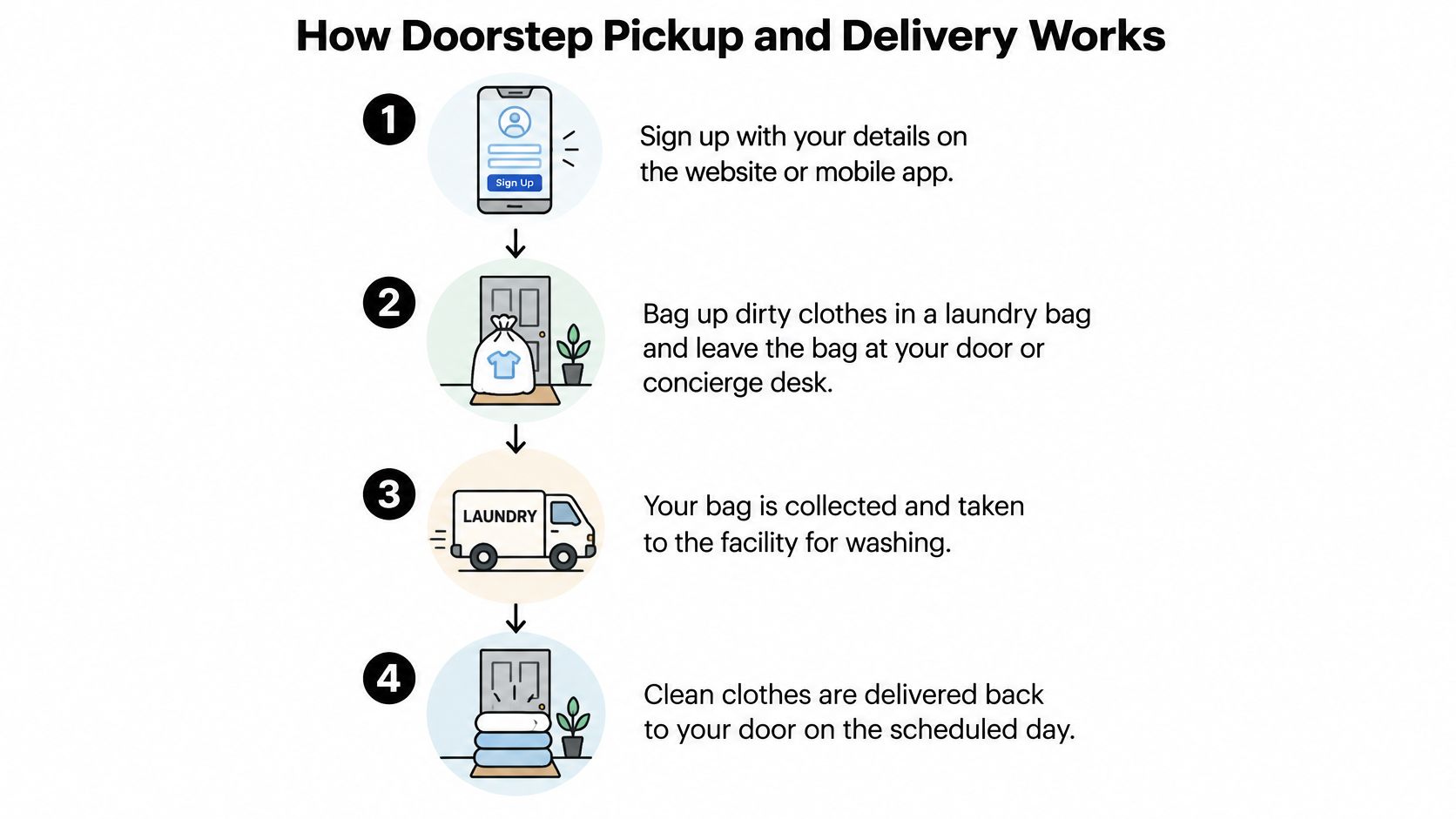
- Sign up with your details on the website or the mobile app. That account is what ties a bag to an address and a phone number, and without it a returned bag has nowhere to go.
- Bag the dirty clothes and leave the bag at your doorstep. Write the unit number on it.
- Schedule the earliest pickup that fits your week, because an early slot leaves room for the return in the same cycle.
- The team collects the bag and takes it to the nearest outlet. You don't need to be home for this.
- Sorting comes first, by colour and material, then washing, drying, pressing where needed and folding in sets of five.
- An email and a text go out when the laundry is ready, so save that number on your phone rather than letting a filtered message sit unread.
- Delivery lands back at your door in a 100% reusable, eco-friendly laundry bag.
Pickup and delivery are free anywhere in Toronto, so the only real cost line on your first order is the laundry itself. That's exactly why the per-pound versus per-item distinction matters: the bag you send sets the bill.
If you'd rather watch the handoff than read it, this short walkthrough shows the same four moves.
Two timings to get in writing
Before you book, get two dates confirmed in writing: the pickup window the driver will arrive in, and the date the clean laundry comes back. "Morning" isn't a window, and a return date that lives only in someone's memory is the most common reason a first order disappoints.
A good first order is boring: an account, a labelled bag, a confirmed window and a return date you could put in a calendar.
What to do when an order goes wrong
Sometimes a bag comes back late, short or damaged. Photograph the bag contents at handoff so there's a record of what went in. Report the problem through the same channel that sent the delivery notification, not a different inbox, and keep the order record until the issue is closed.
The full process, including scheduling options, sits on our pickup and delivery service page.
Building Access and Doorstep Pickup for Apartment Residents
Most local guides skip the questions that decide whether pickup works in a high-rise. Start here: doorstep service is not automatically accessible.
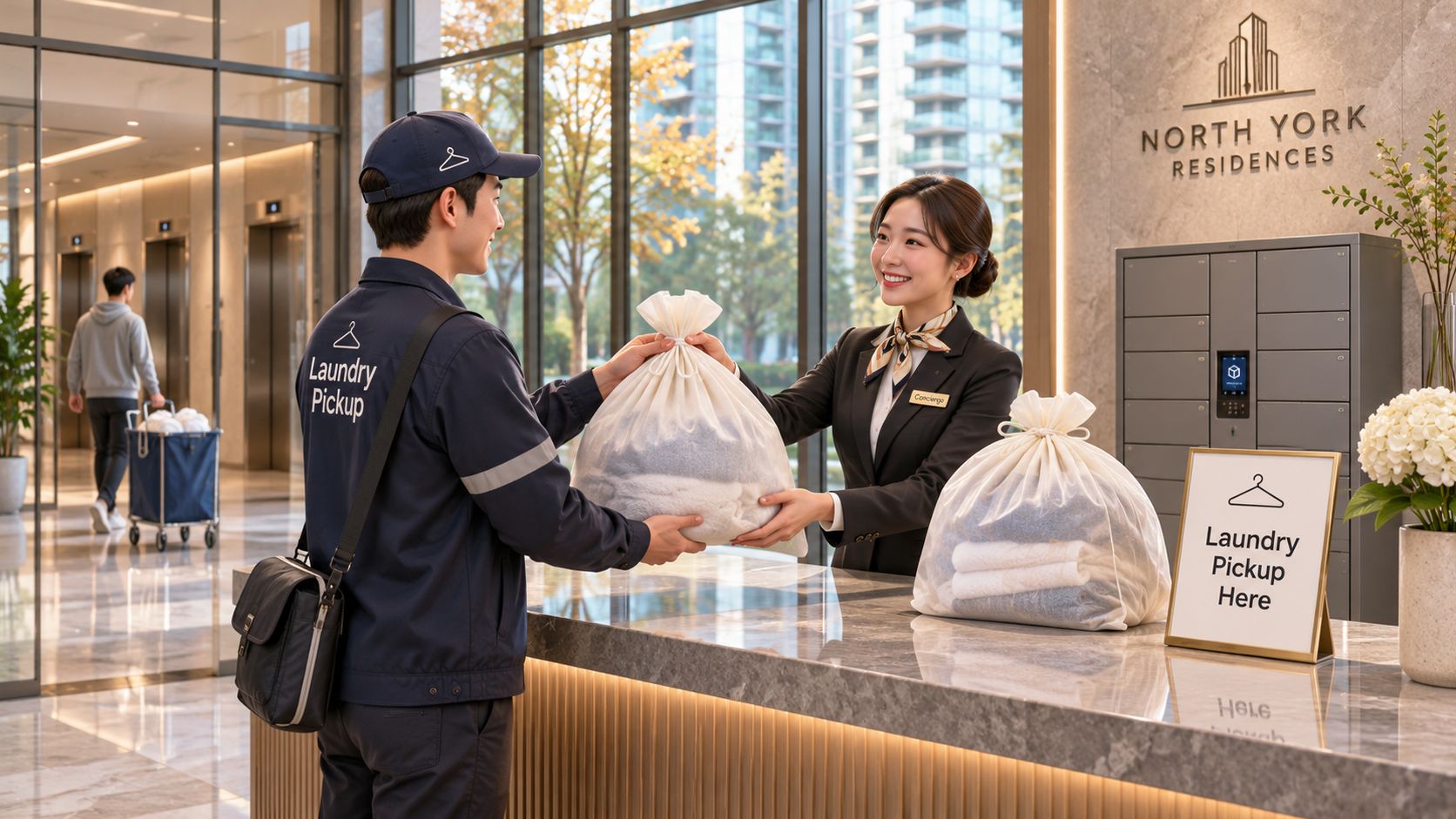
Can a bag be collected from a concierge desk, a lobby, a parcel locker or a sheltered outdoor spot? What happens in a building where the elevator is booked or locked for moves? Leaving laundry outside before an early pickup creates four risks at once: theft, weather, privacy and lifting. A bag with a name and unit number on it, sitting in a public corridor, tells strangers exactly which door is unattended.
Safe access to shared laundry is a live issue for the residents who depend on it most. Toronto Seniors Housing's 2025/26 tenant experience survey found that 76% of residents felt safe in common spaces, down from 78% in 2024, according to the Toronto Seniors Housing survey findings. If a laundry room in the basement doesn't feel safe to walk to, a handoff at the door isn't a luxury. It's the only option.
Where a laundry bag can be handed over in a North York building
| Handoff point | Works when | What to confirm |
|---|---|---|
| Concierge desk | Building has a staffed concierge or security desk | Management accepts third-party pickup and the desk will hold and log a labelled bag |
| Lobby or mailroom | Secured entry with someone present during the pickup window | The provider may pass the entry door and the bag carries the unit number |
| Parcel locker or package room | Building already accepts deliveries there | The locker fits a laundry bag and the provider can open it without a resident present |
| Outdoor or porch spot | House, townhouse or low-rise with a sheltered spot | Weather cover exists and the pickup window is short enough to leave a bag out |
| In-suite door | Walk-up or building with no elevator restriction | Entry instructions and a phone number answered during the pickup window |
A protocol to hand to your property manager
Send this list before the first pickup, not after a bag goes missing.
- Agree the handoff point with building management in writing, naming the exact desk, room or door.
- Label every bag with the unit number and a phone number, and add the building address if the entrance has more than one.
- Pick a weather-protected spot for outdoor handoffs, and check the pickup window is short.
- Confirm the notification reaches a phone you answer, since a text to a dead number delays the return.
- Flag anyone who needs extra support, including seniors, disabled residents and households with no in-unit machine.
Buildings that run on parcel lockers can start with our locker handoff details before the first booking.
Commercial Laundry for Hotels, Restaurants and Care Facilities
Commercial laundry is a capacity question dressed up as a cleaning question. The sectors that ask us most often are salons and spas, restaurants and caterers, religious organizations, daycare centres, assisted living and nursing homes, hotels and motels, nail salons, and athletic facilities and gyms.
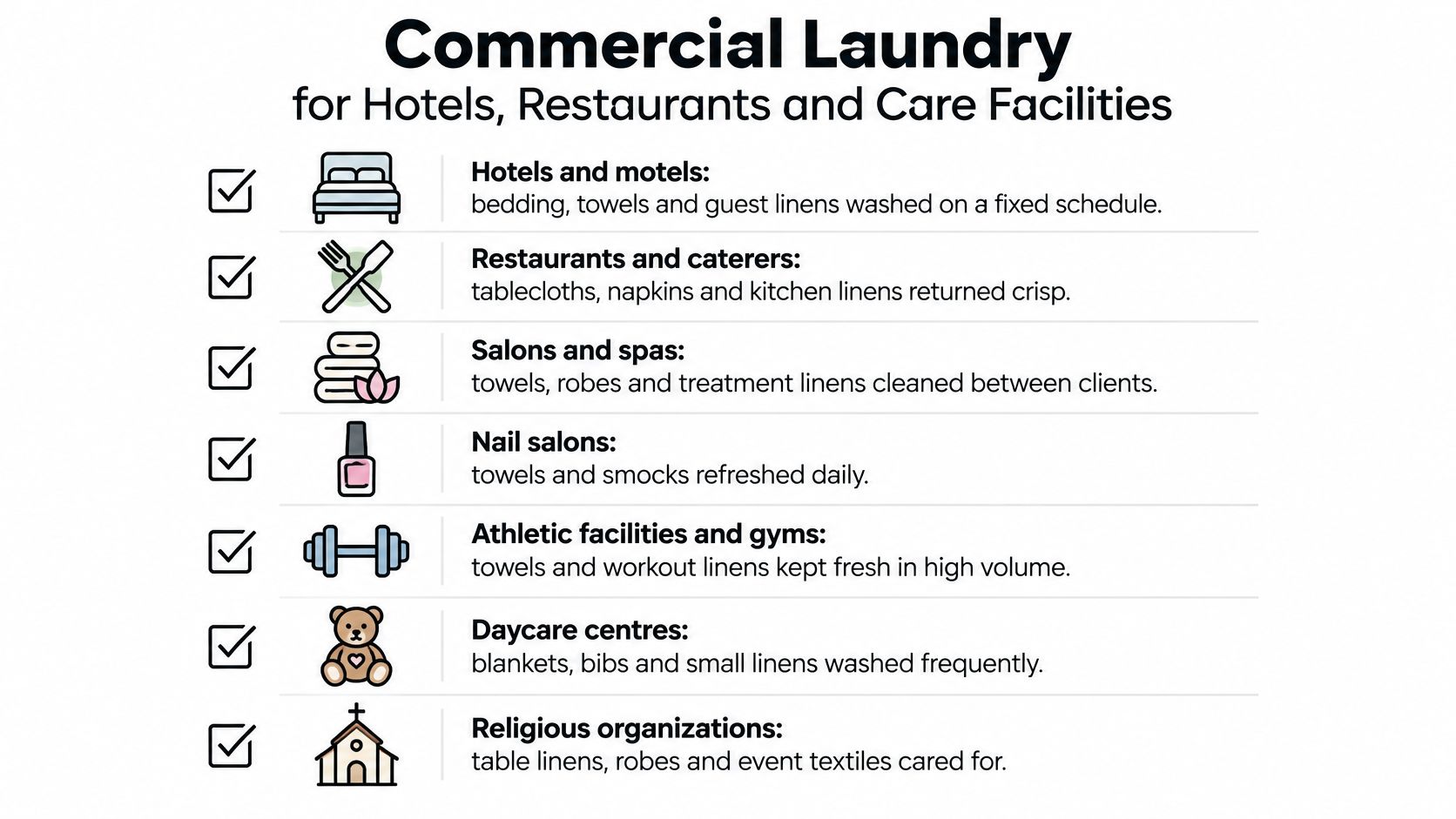
The work itself is straightforward: washing in current-generation washers and dryers, ironing, folding and stacking into bundles. The decision is about what stops happening in your building, namely staff hours spent loading machines, equipment capacity and maintenance, linen turnaround, and the storage space holding both soiled and clean stock.
Outsourcing turns those into a per-pound or per-item rate, which is why the wash-and-fold per-pound figure in the price table is the right benchmark for comparing quotes. Below a certain weekly volume, buying capacity you use three days a week is worse maths than paying for processing.
Process discipline is part of what a commercial rate buys. Toronto-specific modelling estimates household washing releases roughly 90,700 to 138,000 microfibers per load, with the city's households sending an estimated 23 to 36 trillion microfibers into wastewater a year even before treatment captures most of them, according to the Toronto microfiber study. At commercial scale the same three levers apply: separate heavy-shedding synthetics, run fuller loads, and cut unnecessary rewash cycles.
What to bring to a quote request
- Weekly volume in pounds, estimated over a normal week rather than a peak one.
- Linen types, split into bedding, table linen, towels, uniforms and personal items.
- Required turnaround, including which items must come back same day.
- Pickup schedule, matched to your opening hours and delivery access.
- Invoicing preferences, so you aren't reconciling paper slips at month end.
When Cleaning, Repair or Replacement Makes Sense
Run the same three questions on every item: is the fabric and construction still sound, is the fault a stain, a fit problem or a worn part, and does the service cost clearly less than replacing the thing?
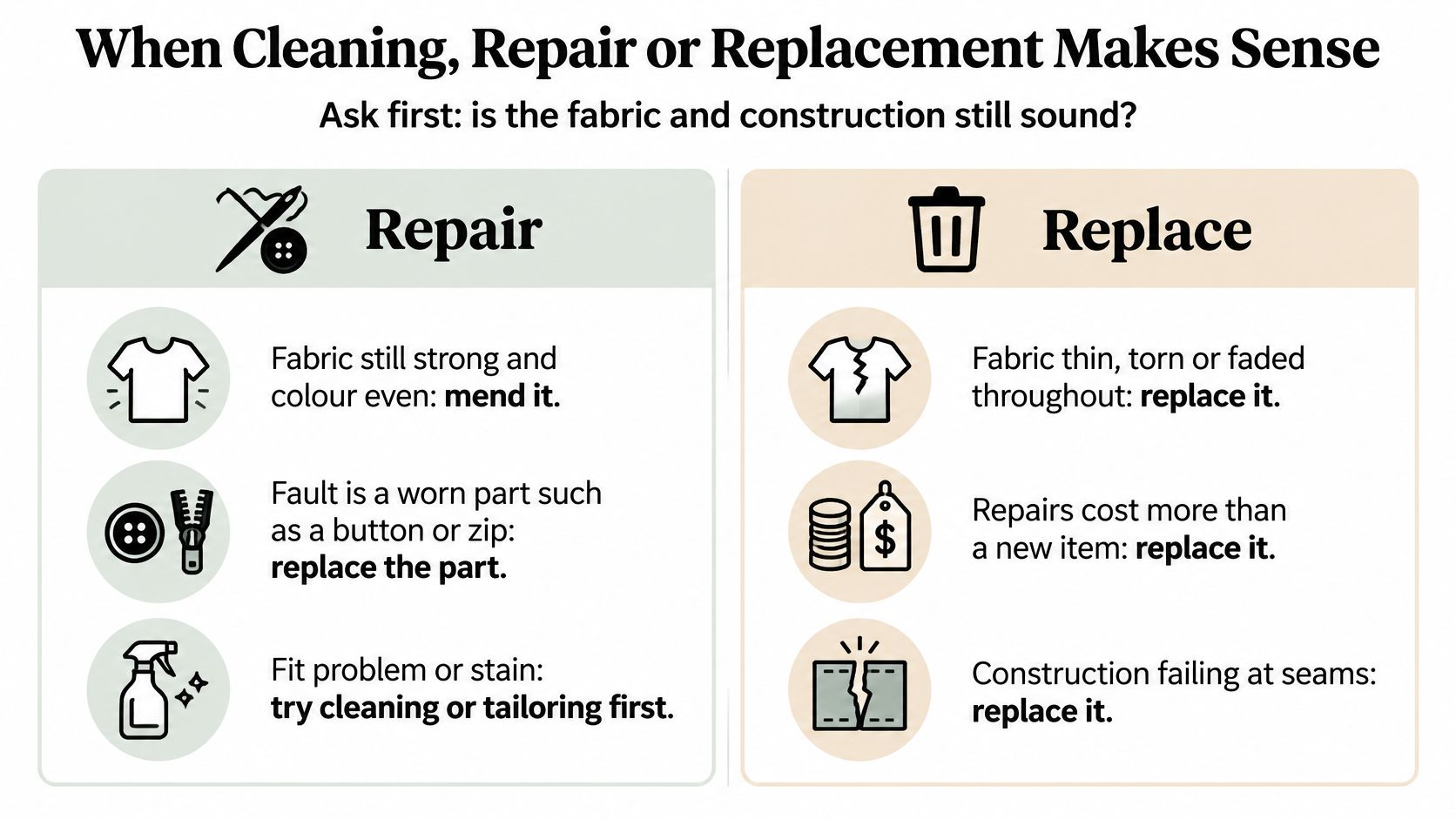
- A recent stain on a sound shirt: launder it, and do it early. Age is what makes a stain permanent, and a laundered shirt starts at $3.49.
- A suit jacket whose only fault is sleeve length: tailor it. A full dry clean on a two-piece suit runs $21.99, and the jacket has years left once the sleeve fits you.
- A resoleable pair of leather shoes: repair the sole. Good uppers outlast two or three soles.
- A torn duvet cover or a water-marked curtain: have it assessed first, and replace it if the damage is structural rather than surface.
- A garment that needs two services at once: run the numbers before booking both. Stacking a repair on top of a clean often costs more than the replacement.
The waste context backs the repair side. York Region's 2025 waste audits found clothing and textiles made up about 17% of garbage, while municipal reuse and repair programs kept more than 1,400 tonnes of textiles and household items in use, according to York Region's clothing and textile reuse page. Every repaired jacket and resoled pair trims that share and skips the cost of a new purchase.
One bundled pickup beats three separate trips, and a repair almost always costs less than replacement plus the packaging a new item arrives in. What you should question are green claims. Ask whether the process is wet cleaning, which Toronto's pollution-prevention guidance describes as replacing perchloroethylene and other volatile-organic-compound solvents with water and detergent, per the City of Toronto dry cleaning guidance. If it isn't, ask which solvent is used. Ask whether the reusable bag comes back on the next order.
Hems, seam repairs and fit changes have their own rates on our alteration services page.
Book Your First Pickup or Drop-Off in North York
You have two ways to hand over the bag. Doorstep pickup runs across Toronto, and if you'd rather hand it to a person, there are two counters on Yonge Street in North York: 4664 Yonge Street and 4841 Yonge Street, the second inside the Yonge Sheppard Center.
Whichever route you choose, work through this before the order starts.
- Pick the service per item from the matching table, so the everyday clothes, the garments and the duvet don't get booked as one blob.
- Confirm the price on the day you book. Starting prices change, and the final charge depends on the item and the service.
- Write down four things: bag contents, the pickup or drop-off time, the notification method and the return date.
- Save the notification channel on your phone so a filtered message doesn't delay the return.
After the first delivery, compare what arrived against that record: item count, folded sets, the price charged and the return date. If any of them differ from the quote, raise it through the same channel that sent the notification before booking again. Only then settle into a rhythm, with a weekly wash-and-fold bag, monthly suits and seasonal household items.
CleanOnline, North York's Premium Dry Cleaners, runs free doorstep pickup and delivery anywhere in Toronto, with two Yonge Street counters for anyone who prefers to drop off in person. Send the everyday clothes by the pound, the suits and dresses by the piece, and the duvet to household cleaning in the same order. Book the first pickup or find the nearest counter at CleanOnline, North York's Premium Dry Cleaners.