Dry Cleaning Solvent Explained: Types, Safety and Rules
Learn what a dry cleaning solvent is, how it cleans, which types are used, and the safety and environmental rules that apply in Canada.


If a dry cleaner tells you their solvent is green, what have you learned? Less than the word suggests, and that's not a knock on the cleaner. "Green" describes a marketing position. Performance and environmental footprint come from a system: the chemical itself, the machine it runs in, how the still residue and wastewater leave the building, and whether anyone can show you a record instead of a slogan.
That's why a garment-care specialist judges a dry cleaning solvent by the whole system rather than by a word on the window. What follows covers what a solvent does, how the main types differ, what Canadian law demands of a facility that uses perchloroethylene, and the five questions that turn a vague eco claim into checkable evidence.
What a Dry Cleaning Solvent Is and How It Cleans
A dry cleaning solvent is a liquid formulated to dissolve oils, grease and oil-based soils, meaning body oils, makeup, sebum and food grease, without soaking the fibres the way water does. Think of a degreaser on a frying pan. It lifts the cooked-on oil so a cloth can wipe it away, and nobody rinses the pan under the tap afterwards. A solvent does that work inside a machine, on wool and tailoring instead of cookware.
Water isn't the enemy. It's a different tool, and it behaves badly on some fibres: wool can felt and shrink, silk can water-mark and lose lustre, rayon can distort, and a structured jacket can lose the line of its shoulder padding. Laundering relies on water and detergent, which is why the two methods suit different garments rather than competing for the same job. The differences between dry cleaning and laundry come down to which liquid touches the fibre and what that liquid does to it.
There's a limit worth naming early. A solvent handles oil. It doesn't handle sugar, salt or tannin, so wine, juice, sweat and coffee need spotting with water-based agents before or after the machine cycle. A cleaner who promises a solvent will fix every stain is guessing.
Practical rule: oil-based soil belongs in the solvent; water-based stains get a water-based spotting agent first. Good results come from using both in the right order, not from picking a favourite.
The machine matters as much as the chemical. Detergent additives boost soil removal, filtration traps lint and particulate, and the recovery system captures vapour so the operator isn't breathing it and the neighbourhood isn't either. Judging a solvent on its own, without the equipment around it, is half a story.
Home workarounds are where this usually goes wrong. People reach for a DIY route on rugs, drapes and upholstery, and the risks of powdered rug cleaning kits show why: powder can lodge deep in a pile, hold moisture and leave a dull residue that a controlled solvent process never creates.
Read a "dry clean only" label as a statement of intent rather than a ban on water. It means the maker expects solvent cleaning for that fabric, usually followed by a specific finishing press.
Solvent Types Compared and PERC's Legacy
Four options cover most of the Canadian market, and they aren't interchangeable. Here's how they sit side by side.
| Solvent | Chemical family | Canadian regulatory status | Typical use today |
|---|---|---|---|
| Perchloroethylene (PERC, PCE) | Chlorinated hydrocarbon | Federal PERC rules apply to facilities that use it | Legacy standard still used in some plants |
| Petroleum hydrocarbon (e.g. DF-2000) | Petroleum distillate | Outside the PERC-specific federal rules | Common in many traditional and modern plants |
| Liquid silicone (D5 siloxane) | Siloxane | Outside PERC-specific rules, since the federal framework is built around PERC use | Growing use as a lower-hazard alternative |
| Wet cleaning | Water-based, not a solvent | Not covered by solvent rules | Delicate fabrics that tolerate water |
How to read the comparison
The chemical family tells you how the solvent behaves on fabric and soil. The regulatory column tells you whether the federal PERC rulebook applies. The use column tells you where you'll meet each option today.
Wet cleaning earns its own row because it isn't a solvent at all. It's a controlled water process with detergents, driers and tensioning equipment, and the case for wet cleaning versus dry cleaning rests on fabrics that tolerate water and soils that are water-soluble.
Why PERC still shapes Canadian shops
Health Canada's assessment report records that tetrachloroethylene, also called perchloroethylene, PERC or PCE, was the principal dry-cleaning solvent in Canada, with roughly 10 kilotonnes, about 10,000 tonnes, used for dry cleaning in 1990. That was around 71% of the 14.0 kilotonnes of reported domestic demand that year. Canada imported 6.5 kilotonnes and exported 11.5 kilotonnes in 1990, and the country's sole producer stopped manufacturing in May 1992, according to the Health Canada assessment report on tetrachloroethylene. The regulatory response followed: tetrachloroethylene went on the Canadian Environmental Protection Act, 1999 list of toxic substances on March 29, 2000, and the federal dry-cleaning regulations became law on February 27, 2003, as Health Canada's drinking-water technical document on tetrachloroethylene notes.
The solvent hasn't vanished. Canada's dry-cleaning industry currently uses about 600 tonnes of tetrachloroethylene per year, according to CAREX Canada's 2026 profile on tetrachloroethylene. Machines built around PERC are expensive and long-lived, so a shop that bought one years ago keeps running it, and that machine shapes what the shop can clean well.
Language travels faster than chemistry. A service promoting chemical-free garment care in Ireland speaks to the same instinct that makes a Toronto customer ask for the green option, even though water is a chemical too.
Match the solvent to the fabric and soil first. Then ask whether the provider can name the solvent and describe how it's handled. That second question is the one most customers never ask.
How Solvent Moves Through the Cleaning Cycle
The solvent does its work in a sequence, and every stage has its own failure mode. The flow below shows the loop, including the return path from distillation back to the wash drum.
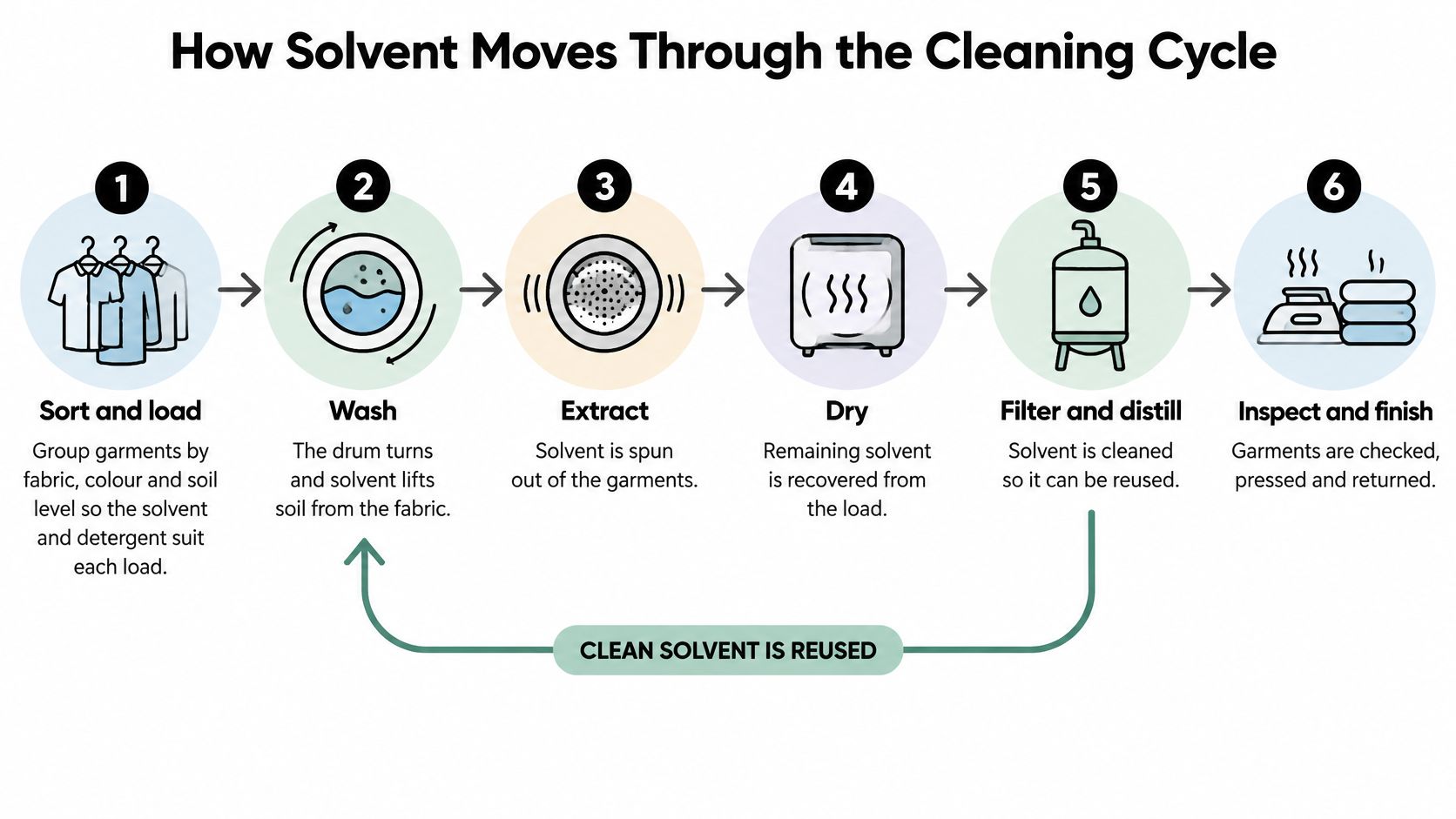
- Sort and load. Garments are grouped by fabric, colour and soil level so the solvent and detergent suit the load. The common mistake is mixing a bleeding red with pale wool, or packing the drum too full to save a cycle.
- Wash. The drum turns in solvent with a detergent additive that lifts oil-based soil off the fibres. Too little detergent, or solvent kept in service past its distillation schedule, leaves a greasy film that shows up weeks later as dullness.
- Extract. A spin throws most of the liquid out of the garments and back into the system. Overloading here is the quiet killer: a crammed drum extracts poorly and leaves more solvent in the fabric for the dryer to chase.
- Distil. The still boils clean solvent off the soiled liquid and leaves sludge behind for disposal. Skip adequate distillation and dissolved oils redeposit onto the next load.
- Dry. Warm air moves through the load and past a condenser, which captures the vaporised solvent instead of venting it. A clogged condenser means slower drying, higher solvent loss and more vapour in the workroom.
- Aerate. The garment is aired to clear remaining vapour before pressing. Pressing straight out of the drum traps that vapour in the cloth, and the customer smells it on the hanger.
Federal rules put a ceiling on how much solvent a modern machine may consume. A dry-cleaning machine must have a maximum design consumption of 10 kg, or 6.2 L, of PERC per 1,000 kg of clothing cleaned, unless it was installed or operating before August 1, 2003, as Environment and Climate Change Canada's regulation on machine consumption states. That threshold only makes sense once you've watched stages three to five, because consumption is mostly about how well extraction, distillation and recovery work together.
A well-run cycle leaves garments that smell neutral, show no damp patches and carry no visible residue at the seams or under the collar. If your last order came back with a sharp chemical smell, the problem is usually in aeration and recovery, not in the fabric. A fuller walkthrough of the dry cleaning process covers how sorting decisions feed into everything downstream.
Canadian Rules Every PERC Facility Must Meet
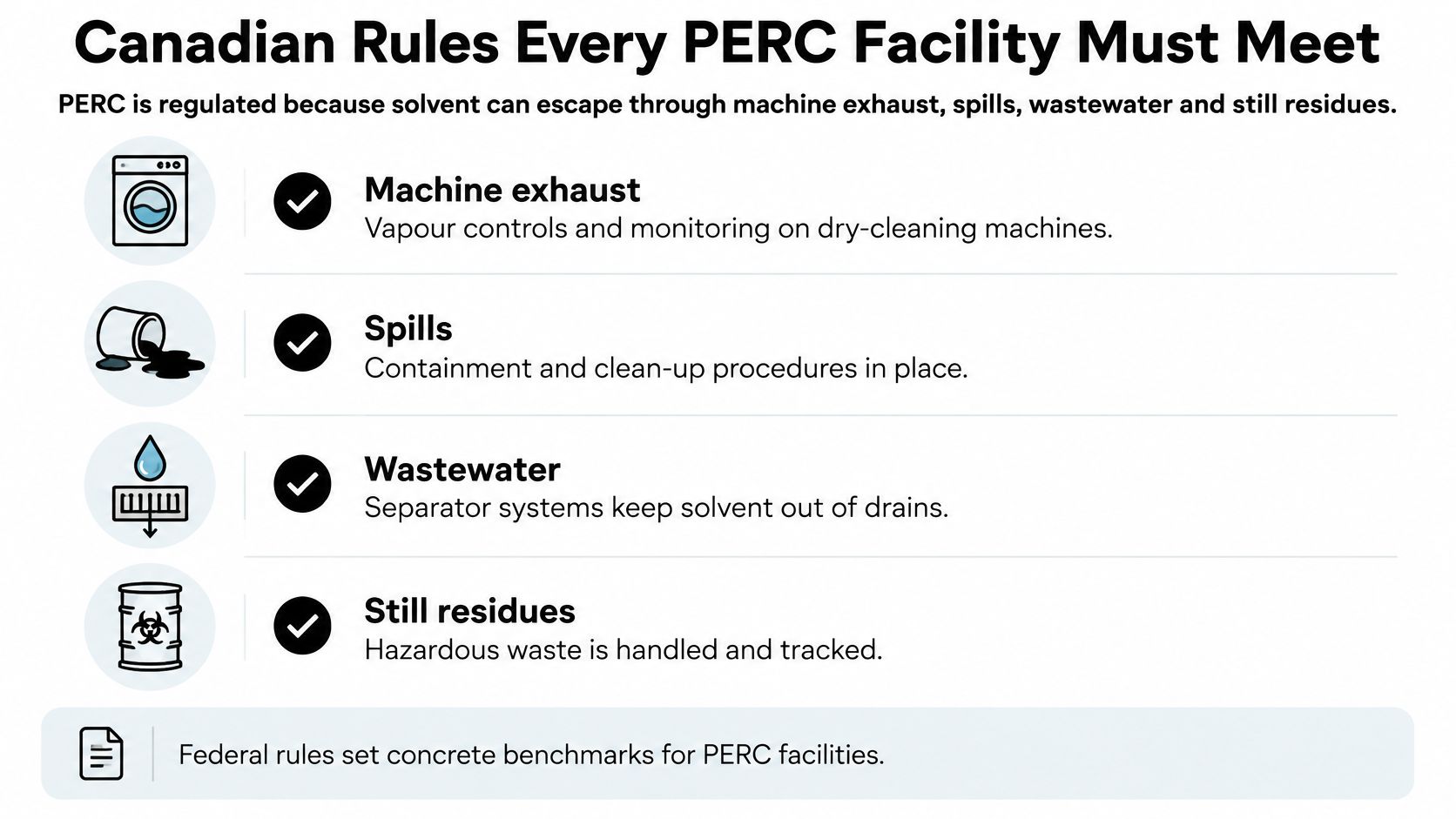
Federal rules regulate PERC because solvent escapes through four routes: machine exhaust, spills, wastewater and still residues. Where PERC is used, Environment and Climate Change Canada's waste-handling requirements for dry cleaners translate into concrete engineering benchmarks a facility can be audited against.
| Requirement | Federal benchmark | What to check |
|---|---|---|
| Secondary containment | Impermeable, covers each machine or tank, holds at least 110% of the largest container | Measure containment volume against the largest container |
| Wastewater and residue removal | Sent to a waste-management facility at least once every 12 months unless treated onsite | Review waste-transfer records |
| Machine venting | No venting to the atmosphere during washing, extraction, drying or aeration | Confirm the machine is a closed system |
| Spill protection | PERC-resistant drain plugs available | Inspect the spill kit and drain controls |
| Storage | Closed containers except when access is needed | Check container closures |
Closed containers and secondary containment. PERC, PERC-contaminated wastewater and residues stay sealed except when someone needs access for operation or maintenance. The containment area must be impermeable to PERC, cover the space beneath each machine, tank or relevant container, and hold at least 110% of the largest container's capacity. Picture a drum that splits overnight: the volume has somewhere to go that isn't the concrete slab.
Drain plugs and waste transfer. Floor drains usually run straight to the sewer, so PERC-resistant plugs have to be within reach before a spill happens, not ordered afterwards. Wastewater and still residues go to a waste-management facility at least once every 12 months unless an approved onsite system treats them. The still bottoms are the most concentrated waste in the building, which is why the paperwork trail matters as much as the drum.
No atmospheric venting. Machines must not vent during washing, extraction, drying or aeration, and PERC delivery must use a closed direct-coupled system. The vapour path is the largest release route in a neglected plant, so the rule targets the equipment rather than relying on operator habits.
Facilities that use only non-PERC solvents sit outside these specific regulations, a distinction Environment and Climate Change Canada's overview of the PERC regulations makes clear. That's exactly why accurate solvent identification and written operating procedures matter: the answer to "which solvent" decides which rulebook applies.
Common Misconceptions About Dry Cleaning Solvents
Myth one: waterless means harmless. A solvent is a chemical with its own hazard profile, and the risk depends on handling, ventilation and waste disposal rather than on the absence of water. Somebody who assumes a non-water process must be gentle has stopped asking questions at the most useful moment. The thing to ask is how the solvent is contained and where the residue goes.
Myth two: green means risk-free. A solvent sold as green may indeed be safer on some measures, and shop staff often deserve credit for switching. The catch is that its total impact depends on the full system: energy used to heat and distil, machine design, worker exposure and disposal. A modest product run in an efficient plant can outperform a "clean" product run badly.
Judge the process, not the adjective. Ask what the solvent is, what machine it runs in, and who takes the waste away.
Myth three: every dry cleaner uses PERC. Many shops now run petroleum hydrocarbon or liquid silicone, and wet cleaning handles a slice of the delicate work. Assuming PERC means you may be questioning a business that never used it. Assuming "eco" means you may miss a facility that does use it and complies carefully.
Myth four: the solvent always stays in the clothes. Extraction, drying and aeration remove the great majority of the liquid before a garment is bagged. If a jacket smells faintly chemical on the hanger, that's a signal to ask about drying and aeration time, not proof that the fabric is saturated.
There's a grain of truth in the suspicion behind these myths. PERC has caused soil and groundwater contamination where it was handled carelessly, and older generations of equipment lost far more vapour than modern closed machines do. The correction isn't to dismiss the concern. It's to aim it at the parts of the operation that decide the outcome. Ask which solvent, how it's contained, and where the still residue ends up.
Verify a Cleaner's Solvent Before You Hand Over Clothes
Federal rules regulate tetrachloroethylene specifically, with controls for efficient equipment, spill prevention, residue and wastewater management, and reporting by users, importers, recyclers and sellers, as Environment and Climate Change Canada's compliance guidance for owners and operators sets out. Those rules put real weight on how residues and waste are handled, which means the people running the machine matter as much as the fluid inside it. Ask whether staff who handle solvent and waste have been trained, and whether that training is recorded.
A green or eco-friendly label is a starting point, not proof. Environmental performance depends on the chemical hazard, the machine, worker exposure, energy use and disposal, all pulling in the same direction or against each other. The questions below test the whole system, because a compliant answer on one point can hide a weak answer on another.
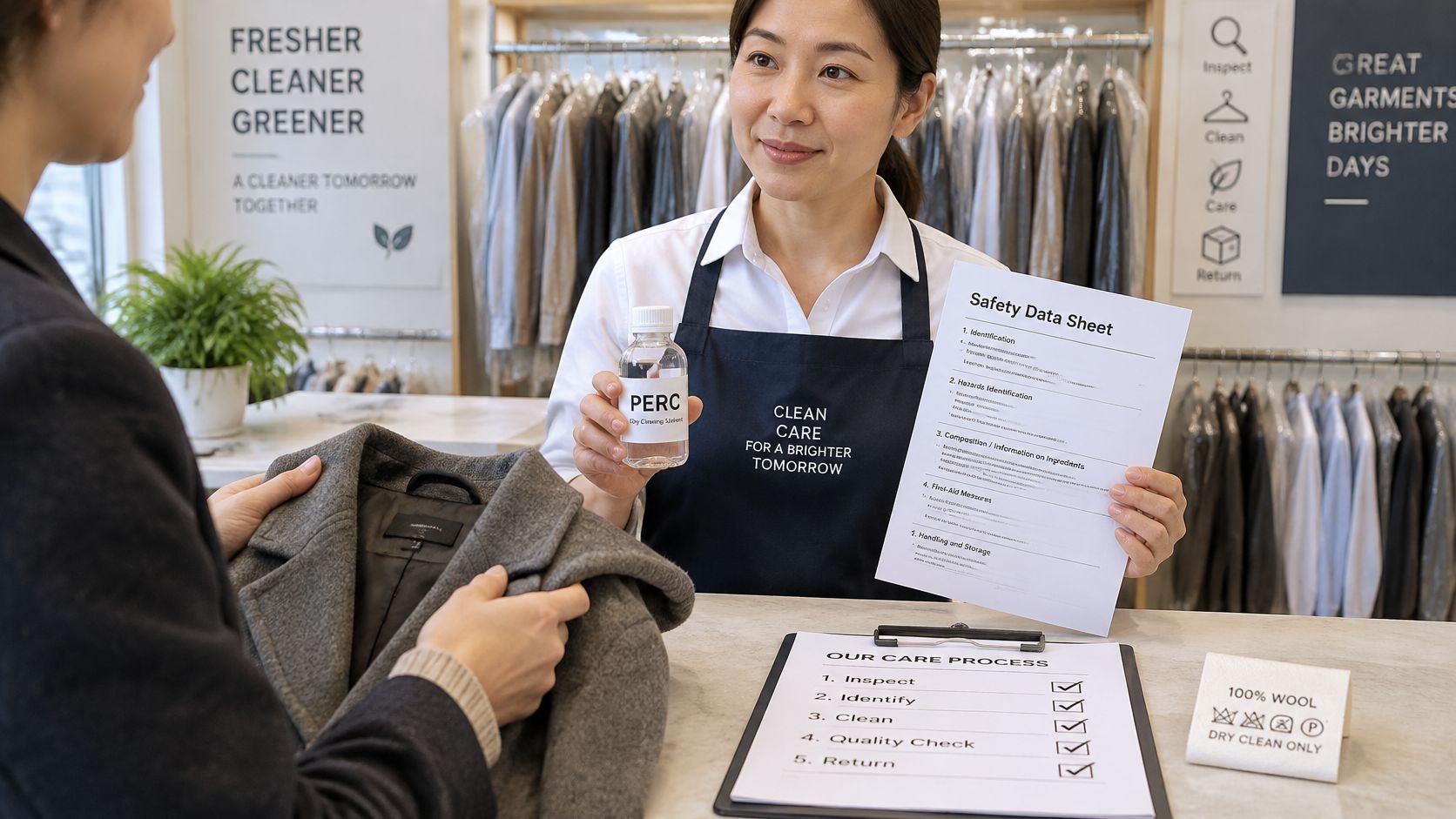
- Name the solvent. Ask for the exact name: perchloroethylene, a petroleum hydrocarbon such as DF-2000, liquid silicone (D5 siloxane), or wet cleaning. A category like "organic" tells you nothing you can check.
- Ask how wastewater and still residues are stored. The answer you want is closed containers inside secondary containment, not drums parked by a back door.
- Ask where the waste goes. Which authorised waste-management facility, how often, and can they show transfer records on request.
- Ask what happens after a spill. If PERC is in use, drain plugs and a spill kit should already be in the room, not on order.
- Ask how staff are trained. Look for recorded training, not just "learned on the job".
A cleaner who answers all five in writing has given you evidence, which is worth more than any logo on the window. We clean with eco-friendly solvents such as liquid silicone, and our approach to eco-friendly dry cleaning starts with a nameable solvent and a documented process, because that's the part a customer can verify. Bring the garment label and these questions to your first visit and you'll know within minutes whether the answers are rehearsed or real.
Ready to hand your clothes to a team that can name the solvent on the label and explain how the waste leaves the building? We run eco-friendly solvents, including liquid silicone, on everything from everyday shirts and wool coats to wedding dresses and household linens. Visit CleanOnline, North York's Premium Dry Cleaners to book, and bring these questions with you so we can walk you through the process before anything goes in the drum.