Dry Cleaners North York: A Practical Guide
A guide to dry cleaners north york covering garment routing, doorstep pickup, solvent rules, access needs, and booking in 2026.
You're getting ready for a North York morning, but the wool coat needs attention, dress shirts are piling up, and the comforter won't fit comfortably in the washing machine. Booking a pickup sounds simple until you have to decide what belongs in each bag, whether the driver can reach your suite, and who will receive everything when it comes back.
Choosing among dry cleaners in North York means looking beyond a price list. The useful questions are practical: which process suits the item, how does the cleaner control solvents and waste, and can your household manage the pickup safely?
What Dry Cleaning Means in North York
A wool coat, cotton shirt and bulky comforter don't necessarily belong in the same cleaning process. Although a cleaner may accept all of them at the counter, staff should route each item according to its care label, construction, trim and condition.
Dry cleaning uses a cleaning solvent rather than an ordinary water wash, usually alongside stain treatment and finishing. It suits garments whose fibres, shape or decorative details need specialised handling. Laundry uses water and detergent, followed by appropriate drying, pressing or folding.
Start by separating the job you need done:
- Recurring laundry: Everyday washable clothing for wash-and-fold, or suitable shirts for laundering and pressing.
- Specialist garment care: Structured clothing, delicate fabrics and items with sensitive linings or trim.
- Repair or restoration: Loose seams, damaged footwear and belongings affected by fire or water, which need more than a cleaning cycle.
Our explanation of the dry-cleaning process describes how inspection, stain work, cleaning and finishing fit together. At CleanOnline, described as North York's Premium Dry Cleaners, the household decision should still begin with the item, not the service name.
Why solvent handling matters locally
Toronto has a substantial dry-cleaning history: an April 2007 City of Toronto technical report estimated that approximately 360 facilities in Toronto used tetrachloroethylene, commonly called PERC, and that Toronto cleaners purchased approximately 205 tonnes in 2005. Those are historical figures, not a count of today's facilities or evidence that every current cleaner uses PERC.
For facilities using PERC, the City's dry-cleaning pollution-prevention guidance describes federal requirements for single-drum washing, extraction, drying and deodorizing, with no transfer machines, plus a refrigerated condenser and integrated PERC–water separator; it also describes Ontario's requirement for a trained full-time person at a commercial dry-cleaning establishment.
Those controls address pathways customers rarely see: solvent vapour, separator wastewater and still bottoms, the concentrated residue left after solvent recovery. Ask which solvent the facility uses, how it recovers that solvent, who handles waste, and whether applicable ChemTRAC reporting is maintained.
Practical rule: An environmental slogan isn't a substitute for a clear explanation of equipment, recovery procedures and waste disposal.
You don't need to inspect machinery yourself. You do need an answer that distinguishes the cleaning chemistry from the procedures used to contain it.
Which Garment Goes to Which Service
Which North York service fits the item
| Item | Best process | Why this process | Avoid |
|---|---|---|---|
| Dress shirts | Launder and press | Suitable cotton and blends take water, detergent and pressing | Solvent-only cleaning when a wet wash is enough |
| Silk, rayon, velvet | Special-fabric dry cleaning assessment | Water can spot, shrink or crush pile | A normal home wash cycle |
| Wool coats and sweaters | Outerwear dry cleaning assessment | Fibre, linings and shape need controlled cleaning and careful finishing | Packing a soiled coat for the season |
| Leather | Specialty leather cleaning | Finishes and skins aren't cloth | Household detergent |
| Comforters, duvets, blankets | Household linen cleaning | Bulk and fill need suitable machine capacity and drying | A home machine that cannot balance the load |
| Curtains and drapery | Household textile cleaning | Size, lining and hardware need measuring and controlled cleaning | Machine washing lined drapes without assessment |
| Wedding dresses | Preservation cleaning | Lace, beading and stains need dedicated attention before storage | Leaving food and perfume residues untreated |
| Hems and loose seams | Alterations and repairs | Washing doesn't fix fit or stitching | Wearing a garment that's already pulling apart |
| Shoes | Shoe repair and cleaning | Soles, heels and uppers need a separate repair bench | Tossing shoes into a garment bag |
| Fire- or water-damaged textiles | Restoration assessment | Soot and suspected mould need specialist evaluation | Home washing before an assessment |
Read construction as well as the label
The care label takes priority over habit. A cotton shirt with an unusual decorative panel may need different treatment from a plain work shirt, while a washable wool sweater shouldn't automatically be treated like a structured wool coat.
Fabric names alone don't settle the question. Silk may have unstable dyes, velvet may have a pressure-sensitive pile, and rayon can change shape when wet; the cleaner needs to consider the finished garment rather than assume every version behaves alike.
The distinction between dry cleaning and laundry is especially useful for shirts. Laundering and pressing can be the appropriate route for a suitable cotton business shirt, but a silk blouse shouldn't enter that workflow because both items have collars and buttons.
Beading, linings, adhesives and mixed materials are reasons to flag an item for inspection. A dress may contain washable fabric but delicate embellishments, and a comforter's outer shell may tolerate a process that its fill doesn't.
Separate cleaning from fixing
A clean garment can still be unwearable. Point out a dropped hem, strained seam or missing fastening before processing so staff can identify the repair and discuss the order of work.
Leather and shoes need their own assessment because colour, finish, glue and structural components affect treatment. Wedding dresses also deserve a dedicated conversation about trim, stains and storage, rather than a promise that a standard clean will resolve every issue.
Don't experiment on smoke-damaged or suspected mould-affected textiles to make them presentable before collection. Keep them apart from ordinary clothing and describe the damage when arranging an assessment.
Bag unlike items separately, with a short label identifying the requested service. That prevents a shirt bag from becoming an ambiguous mixture of silk, shoes and repairs.
How Doorstep Pickup and Return Works
A successful collection begins before the driver arrives. Clear instructions let the team identify your order without guessing which bag belongs to whom or whether a delicate item can join the everyday wash.
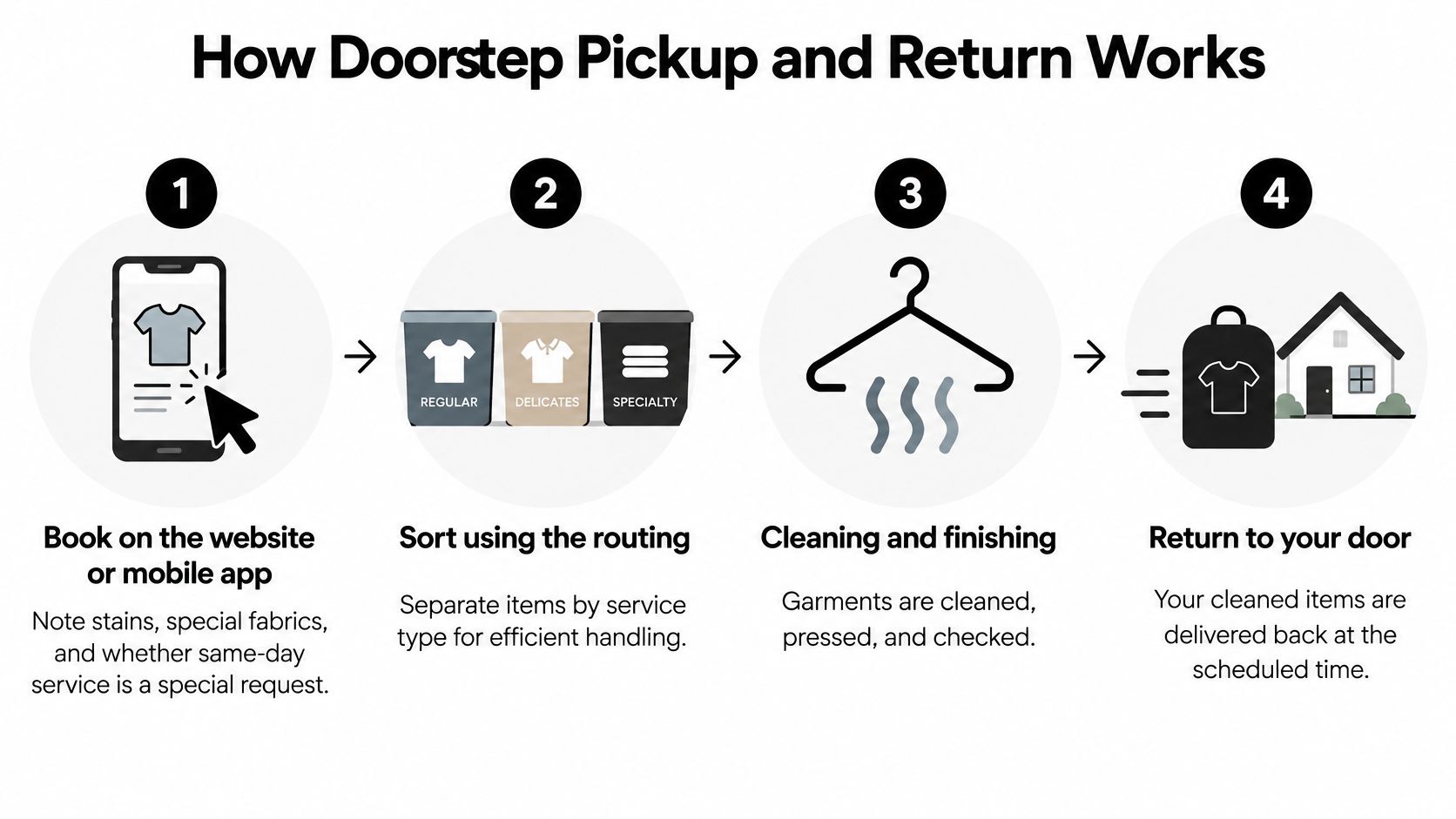
Book through the website or mobile app. Add stain notes, special-fabric details and any urgent deadline. Our same-day dry cleaning is available on special request, so don't treat it as the automatic turnaround for every order.
Sort by the service needed. Identify shoes separately, and tell the team about damaged belongings before including them in a collection. For recurring everyday laundry, our wash-and-fold guide explains what happens between collection and return.
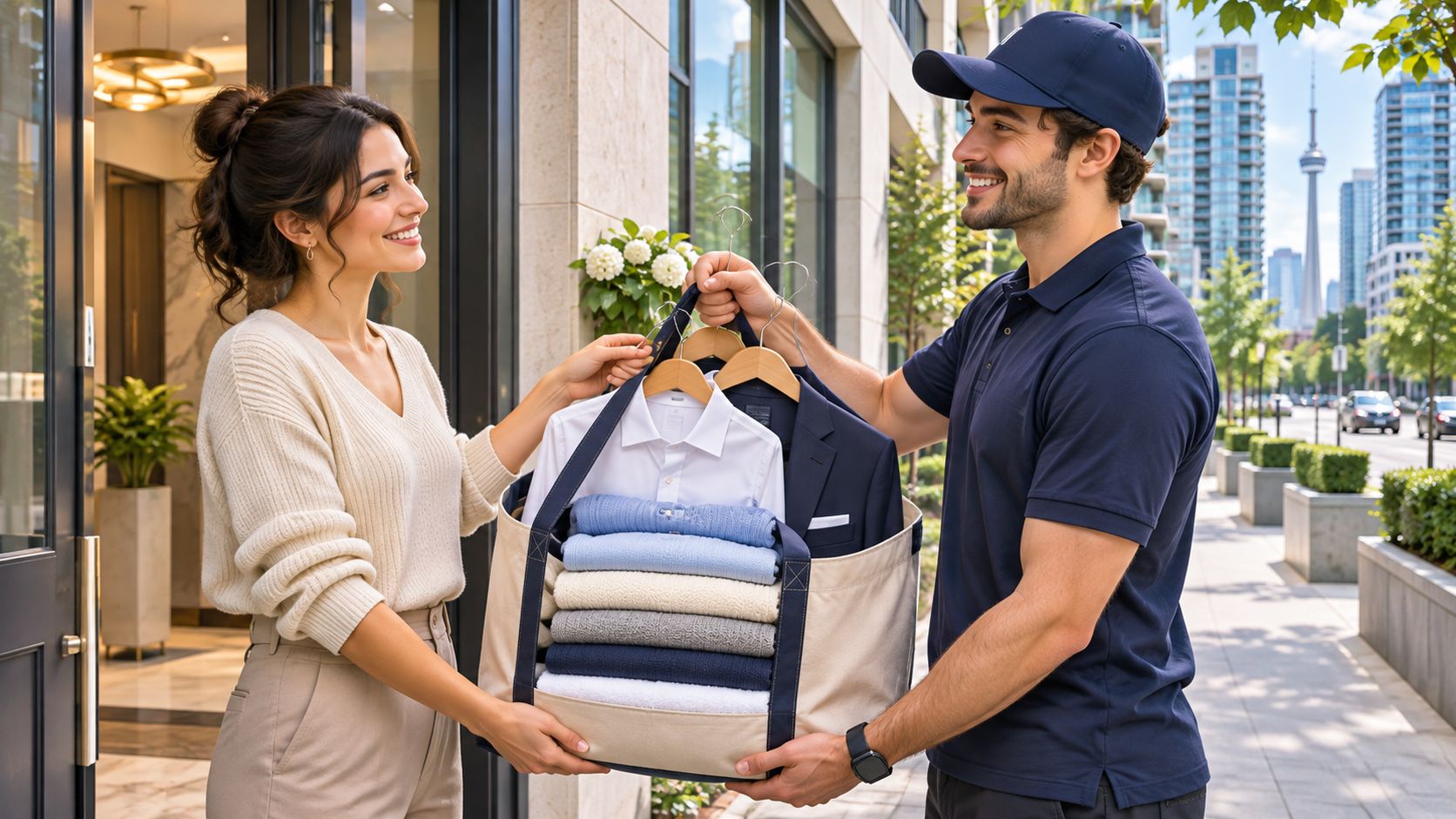
Prepare the agreed collection point. We offer free pickup and delivery of laundry and dry cleaning anywhere in Toronto. Our described no-contact option allows laundry to be left outside before 8 a.m. when nobody is home, provided that arrangement is safe and suitable for the property.
Our delivery team collects the clothes from your doorstep and takes the order to the nearest outlet for cleaning. Make the order identifiable, and keep any written item list available until the return is checked.
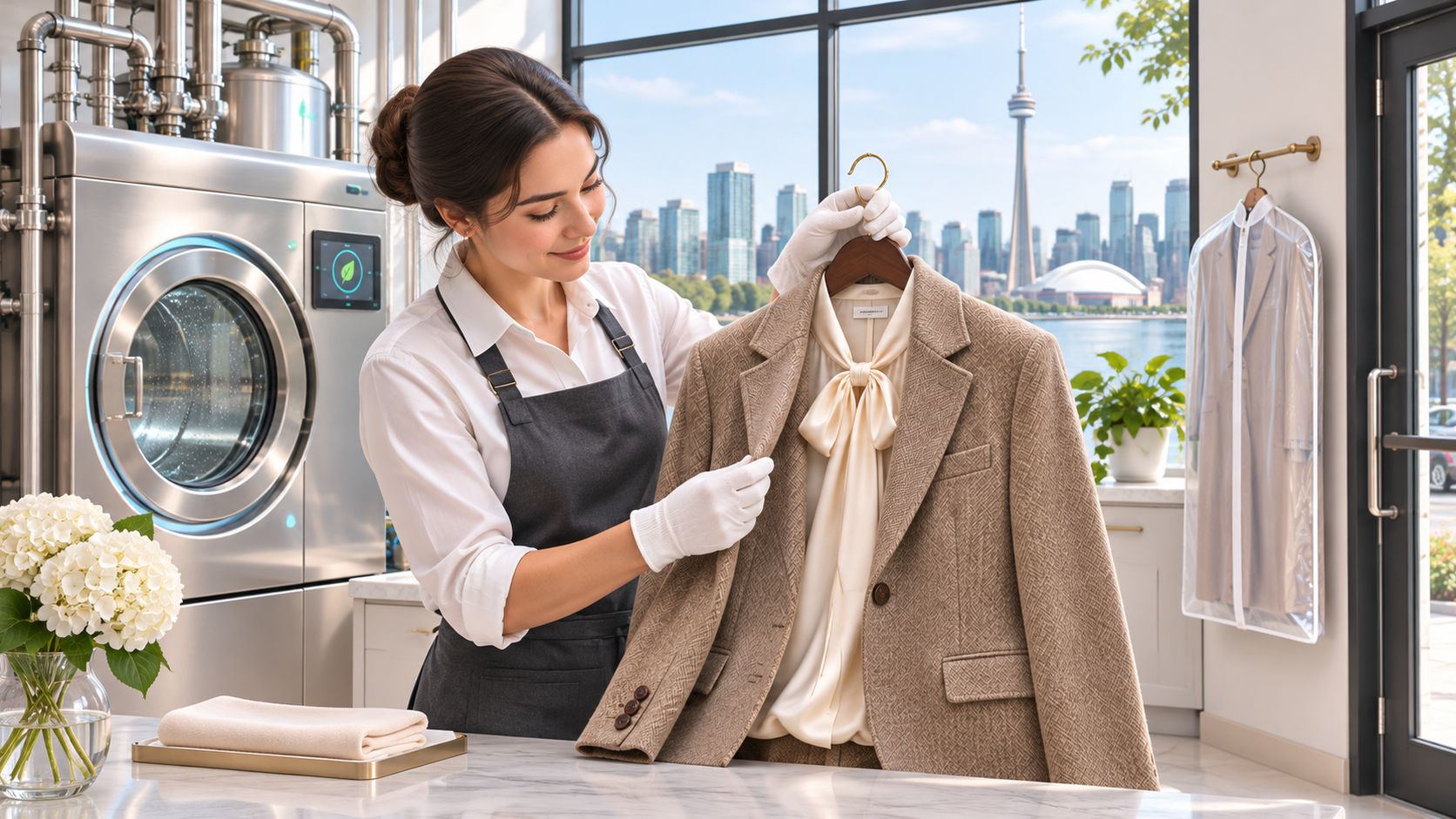
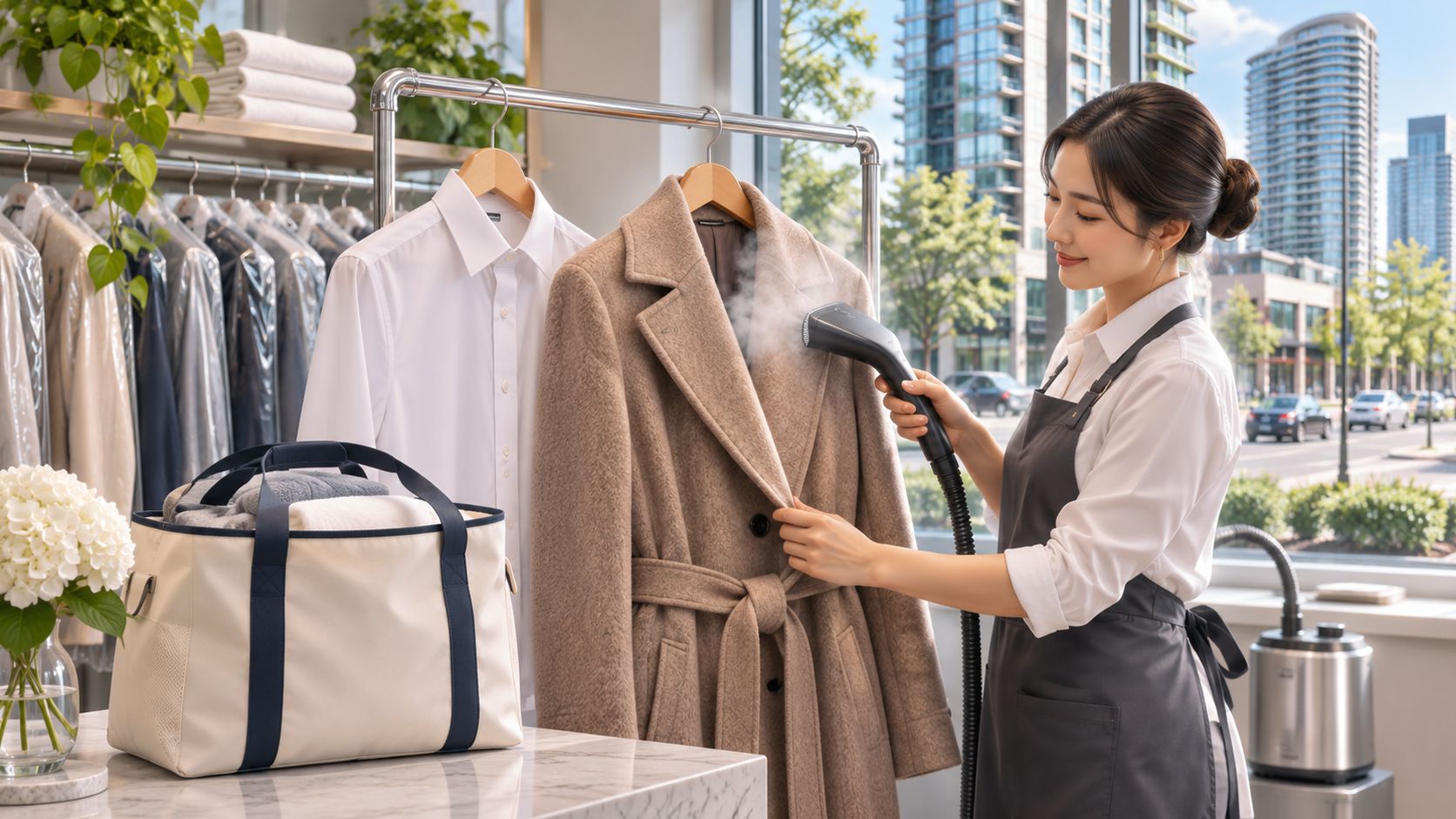
Cleaning and finishing follow the item's needs. Appropriate solvent or wet cleaning, stain treatment and pressing take place at the outlet. A deadline doesn't remove the need to assess sensitive trim or an uncertain stain.
Cleaned clothing returns in tidy bundles. We use reusable laundry bags rather than relying on a new disposable bag for each delivery, so keep the return bag available for the next collection.
Track the order and pay online. Use the available contact details if an item appears missing, a stain needs discussion or your delivery instructions change. Keep the order reference handy so staff can locate the right record.
Keep booking notes usable
For service operators organising recurring visits, Ansa's guide on how to connect booking software to your CRM provides context for keeping scheduling information connected to customer records. That's an operational resource, not a statement about which software CleanOnline uses.
Our pickup-and-drop arrangement is also available for shoe repair. Whatever the service, an unattended bag is only useful if the customer can put it out and retrieve it safely; lifting, stairs and building access need an explicit arrangement rather than an assumption.
Household Loads Worth Sending Out
The most useful professional-care order isn't always the largest. It's often a carefully selected group of items that need equipment, finishing or repair the household can't comfortably provide.
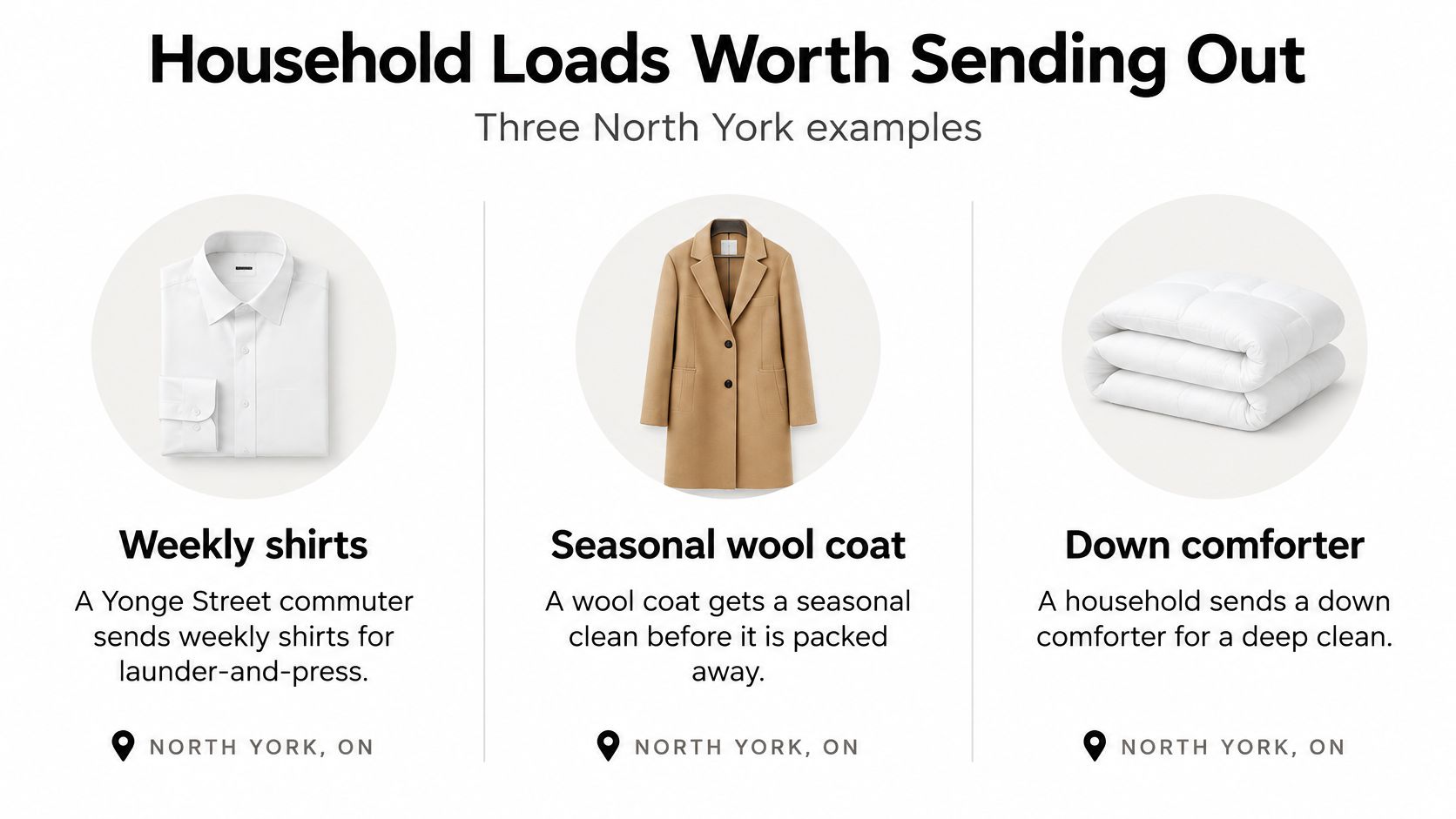
The commuter's seasonal changeover
Say a Yonge Street commuter has washable business shirts ready for laundering and a wool coat about to go into storage. The shirts need a routine finishing service; the coat needs inspection for collar soil, pocket contents and marks that might otherwise remain unnoticed.
The useful preparation is simple: empty every pocket and point out any stain whose origin you know. Don't spray the coat with a household stain remover before sending it, because an unidentified treatment adds another variable for the cleaner.
The household with oversized textiles
A down comforter may fit through a washing-machine door without having enough room to move properly. Lined drapes present a different problem: the face fabric and lining may respond differently to cleaning, and damaged seams can become apparent during handling.
For bedding, identify the fill and disclose tears or leaking seams. Our down-duvet cleaning guide helps explain the questions to resolve before choosing a process.
For drapery, note the original hanging position and discuss removal of hooks or other hardware. Photographs of how panels hang can also help you organise their return.
The family's keep-wearing order
Another household might bring a silk dress, trousers with a frayed hem and shoes with worn heels. These aren't interchangeable cleaning jobs: the dress needs fabric assessment, the trousers need stitching, and the shoes need a repair decision.
The purpose is to keep useful belongings wearable, not to promise that every damaged item can be saved. Ask for an assessment when the fabric is thinning, a seam has repeatedly failed or a shoe's upper is deteriorating.
Repair makes sense when the remaining garment or shoe is sound enough to benefit from it.
The wider waste context makes that assessment worthwhile: Environment and Climate Change Canada reports that approximately 290 kilotonnes of synthetic textile products were purchased in Canada in 2020, while approximately 280 kilotonnes were discarded as waste that year.
Those national totals don't measure the impact of an individual cleaning order. They do support a sensible household habit: assess cleaning and repair before replacing something that may still be usable.
Pickup Access in Towers and for Seniors
Doorstep convenience isn't automatically accessible. A collection policy can save a trip to the counter yet still fail someone who can't lift a bag, hear a doorbell, use stairs or reach an approved collection point.
The City of Toronto's Disability Inclusion Action Plan states that 25% of residents aged 15 and older reported a disability in 2022, including 43% of residents aged 65 and older. These are Toronto-wide figures, but the practical implications belong in every North York building's pickup arrangements.
Confirm the handoff before booking
A building address isn't a complete delivery instruction. Resolve these details with the service team and, where relevant, building staff:
- Door, concierge or lobby: Confirm the actual handoff location and whether the driver can reach it. Don't assume permission to enter a tower includes access to individual floors.
- Approved bag placement: Agree on a location building staff allow, away from exit routes and places where belongings could be mistaken for abandoned items.
- Lifting limitations: Explain if the resident cannot carry or raise the bag. Confirm an arrangement that doesn't leave them responsible for a task they can't safely perform.
- Communication preference: Specify phone, text or email, and explain if a buzzer or doorbell won't be effective.
- Caregiver authorisation: Establish who may release or receive the order and how staff should identify that person.
- Missed collection: Ask what happens if access fails, the caregiver is delayed or the driver cannot reach the agreed contact.
These are questions to confirm, not a claim that every accommodation is already available. A no-contact policy can exclude customers unless an workable alternative exists.
Make responsibility explicit
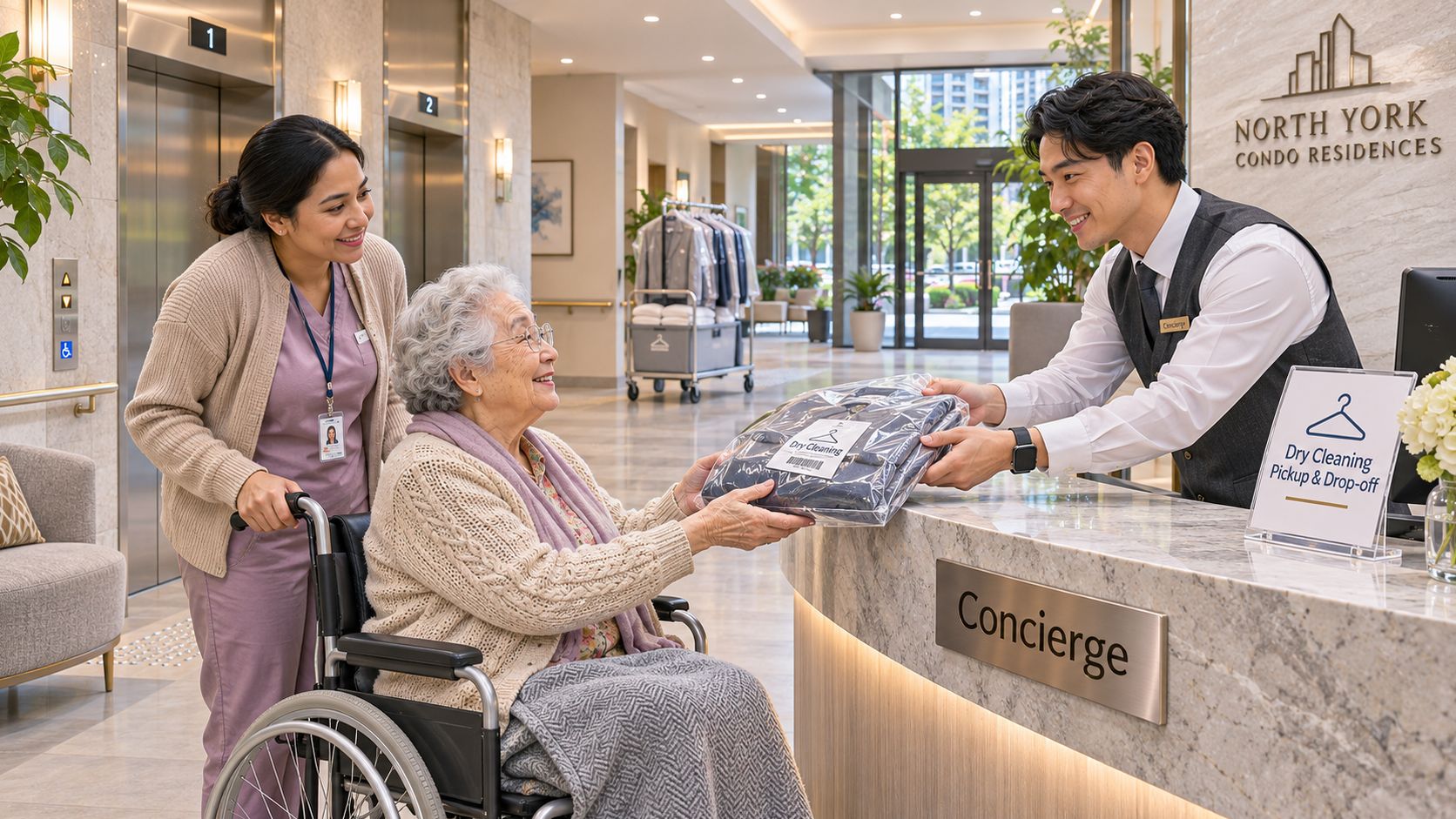
Consider a senior living in a Sheppard high-rise whose caregiver can meet the driver in the lobby. A confirmed caregiver handoff gives everyone a defined role, whereas leaving the bag in a corridor can create uncertainty about security and obstruction.
Concierge involvement also needs agreement. Building staff may accept some deliveries but not store outgoing laundry, and a customer shouldn't discover that distinction after preparing the order.
Choose unattended collection only when the resident, or an agreed helper, can place and retrieve the bag safely.
If that test fails, arrange a supported handoff before scheduling. The right service is the one the household can use, not merely the one advertised as contactless.
What Commercial Clients Should Confirm
Commercial accounts need to distinguish wet laundering from solvent cleaning. Water-based laundry produces wastewater containing detergents and soil, while solvent cleaning produces residues and separator water requiring controlled handling; Toronto's ChemTRAC tools for dry cleaning and industrial laundry also call for summaries of cleaning-chemical use and accompanying Safety Data Sheets for reporting.
A hotel, restaurant, salon, gym, daycare, faith organisation or care home should therefore assess more than finished appearance. The vendor needs to explain which workflow receives each textile and how the account remains traceable throughout collection, processing and return.
Commercial laundry checks before you outsource
| Question | Acceptable evidence | Risk if missing |
|---|---|---|
| Which chemistry is used for each textile? | Written match of detergent or solvent to linen type | Wrong processing damages uniforms or linens |
| Are Safety Data Sheets current? | SDS pack for solvents, detergents, spotters and softeners | Staff cannot judge hazards |
| Can use be totalled for ChemTRAC? | Annual-use summary for VOC cleaners and related chemicals | Reporting gap where reporting applies |
| How is solvent residue segregated? | Separate handling for solvent waste and separator water | Cross-contamination of wet-wash wastewater |
| Are orders traceable? | Batch or order records tied to pickup labels | Lost linens and no audit trail |
| Who escalates damage? | Written rule for stains, tears, fire or water damage | Damaged textiles treated as ordinary soil |
Test procedures against your actual textiles
Ask the vendor to walk through a representative order. For a restaurant, that might mean table linens with food grease and uniforms with different care labels; for a salon, towels may carry residues that need clearly described pretreatment.
Request written procedures for stain pretreatment, wastewater handling and damaged-item escalation. An employee who notices an unusual residue or torn seam should know whom to contact before the item enters an ordinary batch.
Pickup labels should connect the outgoing order to the returned textiles. Confirm how discrepancies are recorded, who receives a damage notification and what information the vendor retains when an item cannot be processed.
Evaluate evidence rather than adjectives
Hygienic consistency, textile durability and an auditable service record deserve more weight than the lowest per-piece quote. Don't assume ordinary cleaning meets a facility's specific infection-control requirements; state those requirements and obtain a clear response before contracting.
Our guide to eco-friendly dry cleaning provides useful context for environmental language, but a commercial decision still needs account-specific documentation. A general sustainability statement doesn't identify the chemistry used on your kitchen linen or the person responsible for an exception.
If a vendor cannot name the chemistry and show the relevant paperwork, don't entrust that vendor with kitchen or care-home linen. Resolve the gaps before opening the account, not after a disputed delivery.
Book Garment Care with CleanOnline
Book with CleanOnline when you want to organise routine clothing care and specialist work through the same provider, but specify the service and handoff before the first collection. We offer dry cleaning, laundered shirts, wash-and-fold, household-item cleaning, wedding-dress cleaning, outerwear care, alterations and shoe repair, alongside restoration services covering textiles, electronics, art, and fire or water damage.
Restoration is a separate assessment, not an extension of the weekly laundry bag. Explain what was affected and the nature of the damage before arranging how those belongings should be handled.
Choose collection or a counter visit
Our North York counters provide an in-person option when you'd rather discuss a garment directly. Confirm opening hours and the turnaround for your particular order before travelling.
CleanOnline North York service counters
| Counter | Address |
|---|---|
| Yonge Street | 4664 Yonge St, North York, ON M2N 5M1 |
| Yonge Sheppard Center | 4841 Yonge Street, Unit 237 C, North York, ON M2N 5X2 |
| Hours and turnaround | Confirm current hours and item-specific turnaround at booking |
Published starting prices are $3.00 for dry cleaning and $3.49 for shirt dry cleaning. These are starting prices, not a quote for every garment; the selected item and service determine the final charge.
Use our website or mobile app to arrange collection, review pricing information, track the order and pay online. If an event date matters, obtain confirmation that the requested work can be completed before relying on that deadline.
Prepare a clear order
Write stain notes in plain language: what spilled, where it landed and whether you've already treated it. If you don't know the cause, say so rather than guessing.
- Identify the service: Keep specialist fabrics, footwear and repair requests clearly distinguished from routine washable clothing.
- Describe access: Provide the agreed lobby, concierge or caregiver instructions, including any communication or lifting needs.
- Confirm exceptions: Raise urgent timing, uncertain care labels and damage assessments before collection.
- Define commercial requirements: For a business account, settle chemistry, documentation and order-identification procedures before the recurring service begins.
Keep a simple item list so you can check the return without relying on memory. Schedule the pickup only when the bag, the building handoff and the service type are all specified.
CleanOnline offers garment cleaning, laundry, repairs and restoration, with free pickup and delivery across Toronto. Visit CleanOnline, North York's Premium Dry Cleaners to arrange your order, confirm the right service for your items and agree on a handoff your household can use safely.