How to Wash Weighted Blanket Safely at Home
Learn how to wash weighted blanket safely: check the care label and filling, choose the right cycle, and dry it completely before use.

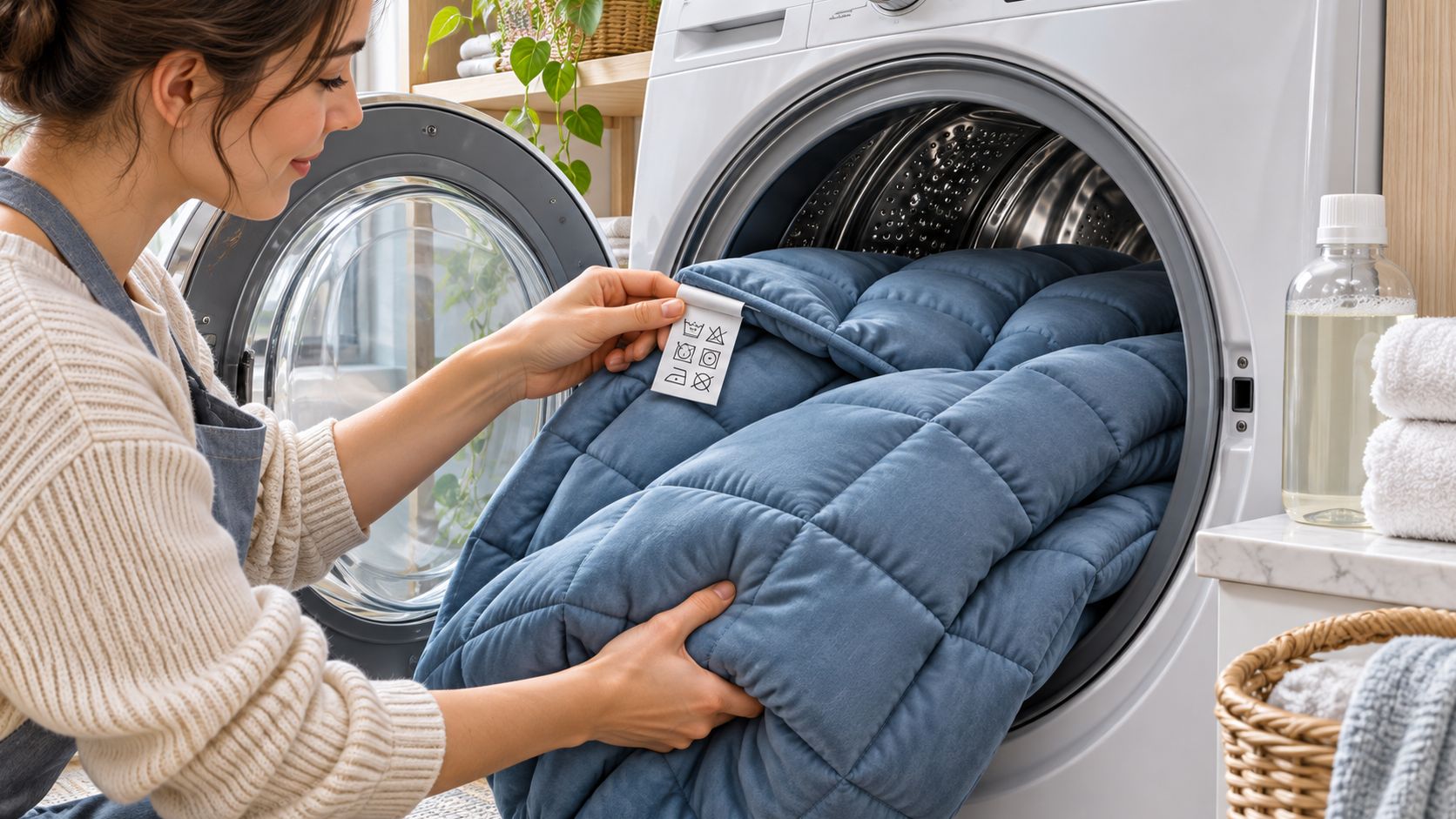
The blanket has been on the bed since November, and now it smells faintly of scalp and needs a real wash. You check the sewn-in label, spot the words machine wash, and start folding it into the drum. That moment is where most weighted blankets get ruined, and the detergent is rarely the reason.
A weighted blanket is dense rather than bulky, which is the opposite of what a washing machine is designed to handle. Dry, yours may sit comfortably inside the drum. Soaked, it becomes a compact, unbalanced mass that loads the seams, the stitching and the machine's suspension all at once.
Start here: the label and the filling decide the method. Your machine only decides whether you can carry that method out at home.
Check the Label and Filling Before You Wash
Two pieces of information settle the question before any water touches the fabric: what the sewn-in care label says, and what the blanket is filled with. Everything else, cycle choice, temperature, detergent, is downstream of those two facts.
Canadian washing guidance draws the practical line at the filling. Blankets filled with glass, steel or plastic beads may be suitable for a large-capacity machine, provided the label permits machine washing, while blankets filled with sand, rice, beans or other natural materials are generally recommended for dry cleaning or another label-approved method, because moisture can affect the filling and the blanket's structure, as Maytag's Canadian care guidance sets out. Where a machine wash is allowed, the baseline is a gentle cycle with cold water and a mild detergent, with bleach and fabric softener left out entirely. Air drying is strongly preferred.
| Filling or label condition | Home washer | Recommended method |
|---|---|---|
| Glass, steel or plastic beads, label allows machine washing | Yes, gentle cycle | Machine wash alone in cold water with mild detergent |
| Glass, steel or plastic beads, label does not allow machine washing | No | Follow the label: hand wash or dry clean |
| Sand, rice, beans, corn or other natural fill | No | Dry clean or another label-approved method |
| Label reads hand wash only or dry clean only | No | Hand wash or dry clean as the label states |
| Leaking compartments, split seams or exposed pellets | No | Stop and have the blanket assessed before any wash |
| Heavier than about 20 pounds or too large for the drum | Usually no | Commercial laundromat with large-capacity equipment |
| Antique, fragile or non-colourfast textile | No | Textile-care professional assessment |
Pre-wash checks that stop the cycle before it starts
Run your hands across every seam and compartment edge before the blanket goes anywhere near a drum. What you're feeling for is bead migration, clumps where the fill has slid into one corner, split stitching, exposed pellets, and any electrical component in a heated or vibrating model. Any of those findings ends the conversation: the blanket needs repair or assessment, not a wash cycle.
Whether the fill still sits evenly through its compartments matters as much as the fill type itself, and the Hobbs versus Pellon loft comparison is a useful primer on how different battings hold their loft through repeated washing. A blanket that has already flattened into uneven patches won't recover in the drum.
A label reading hand wash only or dry clean only rules out the machine, full stop. If your label points toward solvent care, understand dry cleaning versus laundry before treating the two as interchangeable, because they aren't. A blanket that clears every check goes to the step-by-step wash. One that fails goes to the decision at the end.
How to Wash Your Weighted Blanket Step by Step
For a blanket that passed every check, the routine is short. Canada's textile labelling requirements state that care instructions may be written or use standardized symbols, and that any instructions given must accurately represent an appropriate care method. Read that as the rule for the whole wash: the label sets the ceiling on temperature and agitation, and every choice you make stays under it.
The order matters as much as the settings, so the steps below are fixed.
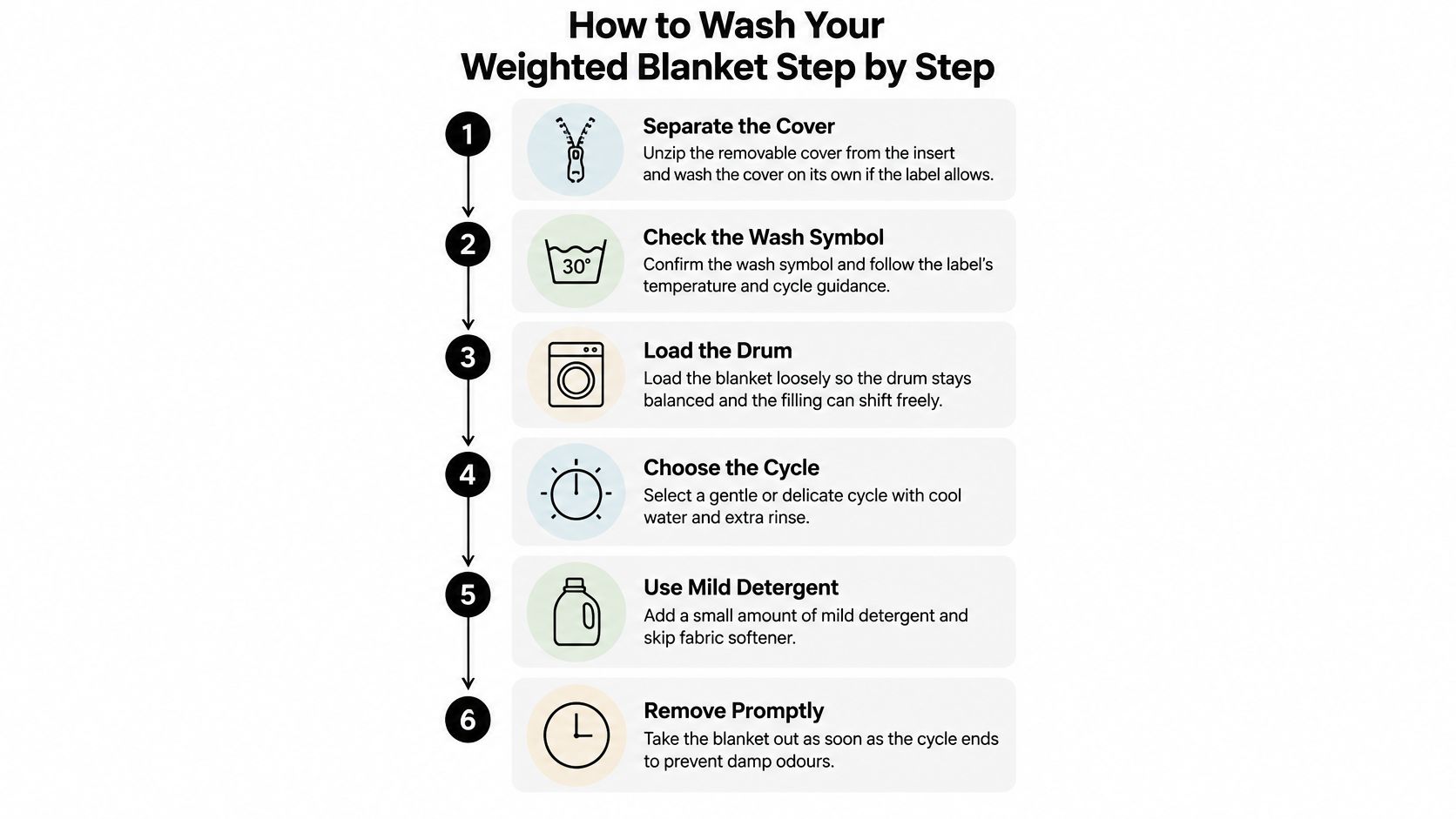
- Separate the cover from the insert. Most premium blankets have a removable cover, and washing it on its own spares the weighted insert the mechanical work. Covers and mattress protectors wash on similar terms, and the Protect-A-Bed mattress protector care guide gives the temperature and drying limits for that layer if you're laundering bedding at the same time.
- Confirm the wash symbol. Canada's official textile-symbol guide sets wash temperatures from 30°C to 60°C, so run the lowest temperature the label states and default to cold wherever it allows. A warm wash on a cold-only label is how covers shrink.
- Close zippers and fasten ties. Loose hardware snags the drum and the fabric, and a snagged seam is the start of a bead leak.
- Load the blanket alone. A saturated weighted insert creates real imbalance and mechanical stress, so keep sheets and towels out of the drum where they would pack against it.
- Choose the gentle or delicate cycle and a mild detergent. Skip bleach, skip fabric softener, and skip anything sold as a cleaning booster. Softener coats the fibres, makes the fabric slippery, and lets the fill migrate inside its pockets.
- Stop the machine at the first bang, failed spin or error code. An unbalanced drum does not correct itself, and letting the cycle run is how bearings get damaged.
- Pull the blanket out the moment the cycle ends. A soaked blanket sealed in a closed drum starts to smell within hours.
Hand washing when the machine is out
A bathtub works for any blanket the label allows you to hand wash. Fill with cold or lukewarm water and a small amount of mild detergent, press the blanket down to saturate it, and rinse until the water runs clear. Never wring or twist it, and never lift a saturated insert by one edge, because the wet fill concentrates its full weight on a few seams. Support the blanket from underneath with both arms and carry it flat to the drying area.
A good wash is easy to check afterwards: even weight from edge to edge, no lumps when you press the compartments, seams lying flat, and no soapy slick on your hands after the final rinse. If the fabric still feels slippery, rinse again. For a refresh between full washes, cleaning blankets without washing covers spot treatment and airing.
Matching Machine Capacity and Load Balance
Dry weight is the number everyone checks and the least useful one. A weighted blanket holds a great deal of water after washing, so the load your machine spins is considerably heavier than the blanket that went in. That gap between dry weight and wet weight is where residential washers fail.
The 20-pound figure quoted in most guides is a rough marker, not a safety rule. Business Insider's 2025 guide is blunt about what sits above it: blankets heavier than that will likely need a commercial laundromat rather than a typical residential washer. Below it, fit still decides, because a compact drum in a condo laundry room can be defeated by a blanket that's technically light enough.
- The hand test: once loaded, you should be able to push your hand down beside the blanket. If the drum is packed solid, it's too big a load.
- The door test: the door should close without force and without compressing the blanket into a folded slab.
- The spin test: if the machine thumps through the spin cycle or refuses to extract, stop and move the blanket to larger equipment.
Toronto households have a second reason to be deliberate about when they wash. The Regional District of Nanaimo's water guidance reports that laundry represents approximately 20% of average Canadian indoor water use, and Natural Resources Canada figures cited there show ENERGY STAR-certified clothes washers use on average 25% less energy and 33% less water than standard models.
The practical consequence: wash a weighted blanket when it genuinely needs full laundering, not on a schedule. Use the largest machine you have access to, and keep the water cold where the label permits, since most of a wash cycle's energy goes to heating water.
Drying Your Blanket Without Damage or Mould
Drying is the highest-risk stage of the whole job. Pull the blanket out promptly, redistribute the filling by pressing it flat while it's still damp, and don't consider it finished until the blanket is completely dry through the centre. A weighted blanket put back on the bed before its centre is fully dry can start to smell of damp quickly.
Reading the drying symbols
The drying symbols on the label are instructions, not suggestions. Canada's Guide to Apparel and Textile Care Symbols defines low-heat tumble drying as no higher than 55°C, while some labels prohibit tumble drying altogether. When a symbol is ambiguous, pick the cooler option, since heat is the setting most likely to be wrong.
| Label symbol or instruction | What it permits | What to do |
|---|---|---|
| Tumble dry, low heat (no higher than 55°C) | Dryer allowed at low heat | Remove promptly and check the centre at intervals |
| Do not tumble dry | Air drying only | Lay flat on a clean, dry, ventilated surface |
| Dry flat | Flat drying only | Turn the blanket at intervals so the filling settles evenly |
| No instruction on drying | Treat as air dry only | Support broadly and avoid hanging from one corner |
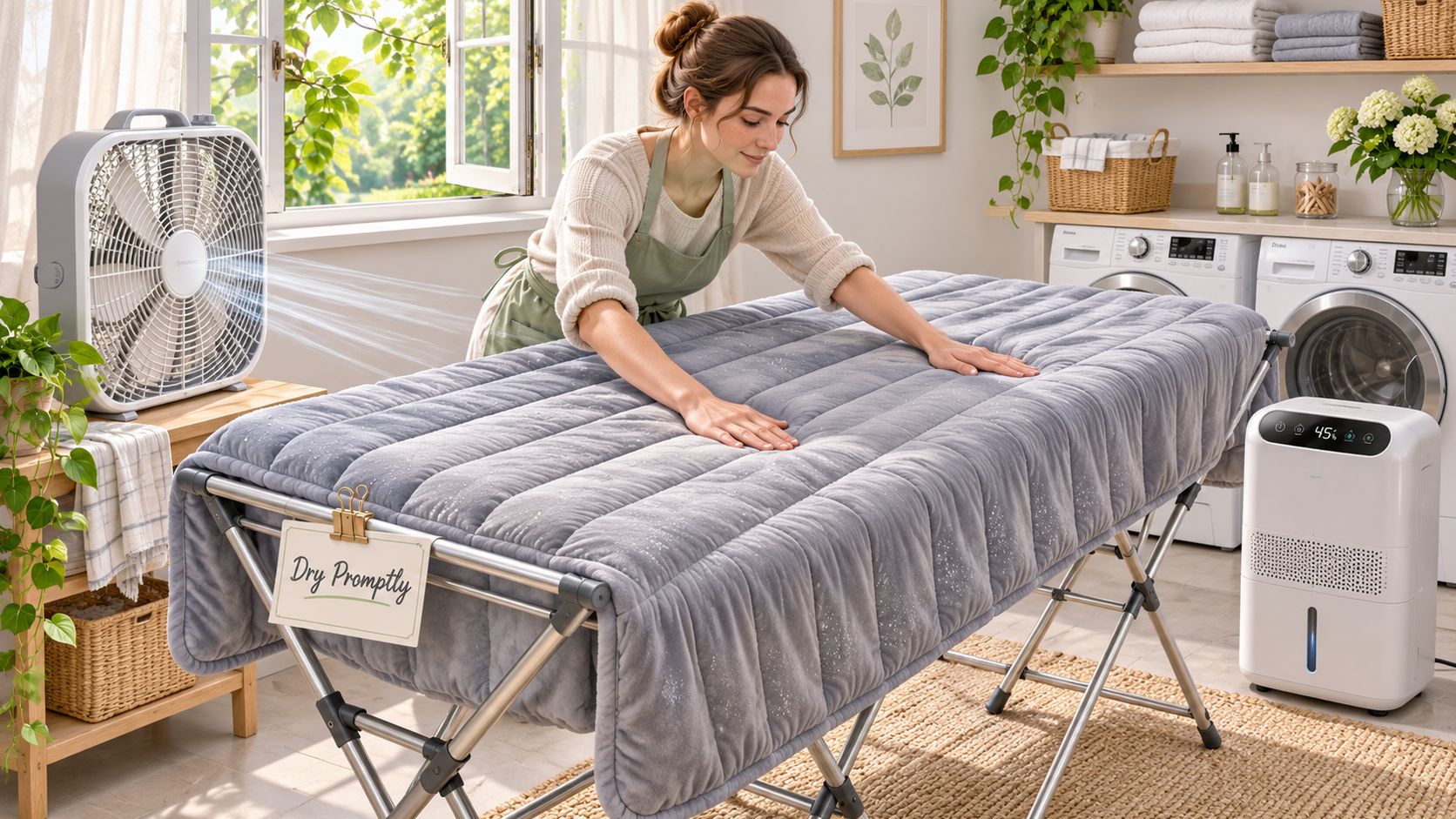
If you're air drying, spread the blanket across a broad, clean, ventilated surface and turn it every few hours. A saturated blanket weighs far more than its dry weight, so support it across its full width rather than from an edge. Never hang it from a single corner or drape it over a narrow line. The wet weight will stretch the seams and pull the fill down into one end, and that stretching can be hard to reverse.
The damp test before storage
Surface-dry is not dry. The outer fabric finishes first, while moisture sits longest in the fill pockets at the centre, which is exactly the part you can't judge by touch alone.
Press the thickest part of the blanket with a flat palm and hold for a few seconds. If your hand comes away cool or feels moisture, it isn't dry, even if the surface feels finished. If the blanket still feels noticeably heavy in spots, water is sitting in those pockets and it needs more time.
Airflow speeds the process, which is why an exhaust fan or a dehumidifier earns its place during a long indoor dry. Vent any dryer outdoors to cut excess moisture and mould risk in the room.
The recurring failure points are always the same: too much heat, an under-dried centre, carrying a saturated blanket by one corner, and washing without noticing a broken seam or leaking fill. Lofted fills behave differently from beads during drying, so if you're also handling a duvet this season, the down duvet cleaning guide covers the rules for that fill type.
Fixing Odour, Clumping and Washer Problems
A common complaint after a first wash is a musty smell that appears a day or two after the blanket goes back on the bed. The usual pattern is simple: the blanket was folded or stored before the centre had dried, and the fill held that moisture.
Most faults at this stage trace back to the wash decision more often than to detergent choice. Water on a fill the label did not allow, a drum chosen for dry weight instead of saturated weight, or heat used to rush a slow dry will show up later as odour, lumps, thumping or a cover that no longer drapes.
| Symptom | Likely cause | Fix |
|---|---|---|
| Musty smell after drying | Stored before the centre was dry | Dry again with airflow and check the centre |
| Dark spots or mould | Damp storage or contaminated water | Stop washing, follow mould guidance and seek professional assessment |
| Clumped or lumpy filling | Fill settled while damp | Knead gently while damp, then dry flat |
| Washer thumps or will not spin | Overloaded or unbalanced drum | Stop the cycle, reload alone or use a larger machine |
| Leaking beads or split seam | Stitching failed before washing | Do not wash; have the blanket repaired or assessed |
| Stiff or shrunken cover | Heat drying above the label limit | Wash cold, air dry, and avoid the dryer |
Dark spots deserve a hard stop. Mould on soft furnishings can be difficult to clean once contamination has set in, so keep the blanket out of use and have it assessed; severe cases may mean disposal.
Time cost of each fix: a re-dry is one drying cycle. Clumping needs gentle redistribution plus a full flat dry. A split seam or leaking beads means the blanket is out of use until it is repaired.
If the washer bangs or refuses to spin, stop it before the suspension pays for the mistake. A saturated blanket can be far heavier than its dry label weight, so reload it alone or move to a larger machine instead of forcing the spin.
For odour that lingers on other textiles, the same logic behind removing musty smell from clothes applies here: find the trapped moisture and remove it instead of covering it with fragrance.
Decide Whether to Wash at Home or Use a Cleaner
The main question was never which cycle to select. It's whether this blanket belongs in a residential washer at all, and a machine-washable label doesn't guarantee that it does. Whirlpool's Canadian care guide frames the same caveat: steel, glass or plastic beads may be machine-washable only where the care label permits it, sand and organic fills such as beans, corn or rice may be unsuitable for full washing, and the 20-pound threshold is a guide rather than a universal rule.
Home washing makes sense when the label allows it, the fill is bead-based, the blanket fits the drum with room to move, and you have a proper drying space. Everything else points elsewhere: natural fill, a dry-clean or hand-wash label, a blanket too heavy or oversized for the machine, mould, or any seam damage.
For that second group, we dry clean blankets as part of our household linen service. Dry cleaning uses dry solvents rather than water, which suits fills that shouldn't get wet at all. Bag the blanket, schedule the earliest pickup, and you'll get it back in a reusable bag with a notification when it's ready. If you're weighing up the cost first, what dry cleaning costs breaks down how household items are priced.
If the label or the filling says no, don't force the blanket into a washer. Repair, dry cleaning or professional assessment is cheaper than a new blanket and a service call.
When a weighted blanket's label points to dry cleaning, or the insert is heavier than anything your building's laundry room can spin, CleanOnline, North York's Premium Dry Cleaners handles it as part of our household linen service, with doorstep pickup, tracking updates and delivery back in a reusable bag. We also launder everyday bedding and blankets that need a proper deep clean rather than a quick refresh. Visit CleanOnline, North York's Premium Dry Cleaners to schedule a pickup or find the Yonge Street location.